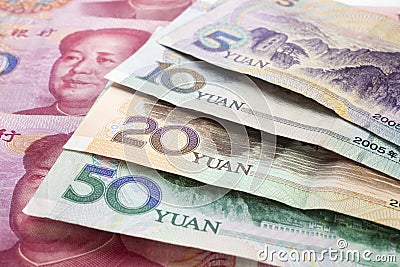
It's true that Chinese currency unit the renminbi (RMB) AKA the yuan has been
devaluing these past few months in tandem with slowing PRC growth. Aside from the most optimistic of speculators, did anyone really think that the currency would steadily rise forever? Yet, the global adoption of the currency continues apace as China experiments with greater liberalization of its current account. Among the early beneficiaries of this process are multinationals who've already benefited much from China opening up to the world that can now
take advantage of PRC currency reforms:
As China's internationalization of the RMB and its associated
deregulation continue to advance, a variety of new opportunities for
both MNCs and local corporations are emerging. One recent example is the State Administration of Foreign Exchange's
(SAFE) April 2014 release of a Circular on supporting MNCs’ centralized
foreign exchange management. The circular aims to further simplify MNCs’
trading and investment processes, supports MNCs’ centralized treasury
management across domestic and overseas entities, and continues to
explore capital account convertibility.
Whilst the new rules are only applicable to eligible MNCs, they allow
corporations to convert foreign exchange (FX) freely for Foreign Direct
Investments (FDI) and foreign debt funding. This gives corporations
important, additional flexibility that will assist them in managing
their FX exposure effectively.
JP Morgan adds further implications of these changes for MNCs. First, no longer will payments and transactions handling need to be separated into a "mainland China-only" entity but these can be streamlined into firm-wide (international) backroom operations. Second, and following from the first, operations can thus be centralized for documentation purposes:
Plugging China Into Regional/Global Operations
Previously, China has been somewhat isolated by regulatory hurdles
from corporations' regional and global operations. While it has been
possible to perform treasury management within the country, linking that
to regional or global management has not been easy. However,
de-regulation is gradually remedying this situation, so it is now
possible to connect China with operations elsewhere in a variety of
areas. Whilst some of these are as yet only fully connectible as part of
pilot schemes (such as those operating in the Shanghai Free-Trade Zone)
and have not yet been rolled out nationwide, they
currently include
areas such as liquidity management, netting and payables/receivables on
behalf of.
Seizing the Centralization Edge
A considerable number of Chinese treasury-related operations have
formerly been decentralized in terms of management. This has often been
due to significant physical documentation requirements, as in the case
of cross-border flows. The net result was that many financial processes
ended up having to be conducted on an entity by entity basis, resulting
in appreciable duplication, non-standardization and additional costs.
However, as Chinese regulatory bodies continue to simplify or remove
documentary requirements, companies have the opportunity to standardize
and centralize their Chinese treasury operations. Ultimately, many
activities that were replicated across multiple business units in China
can now be standardized in accordance with any regional or global
processes which a company may have established. They can then be run
from a Shared Service Centre, either within China or elsewhere. Apart
from economies of scale, standardization and centralization also serve
to reduce the operational risks associated with individual business
entities developing and running their own financial processes.
The third and most intriguing possibility is of reducing foreign exchange risks emanating from moving RMB back and forth between onshore and offshore accounts:
Making China FX Risks History
RMB internationalization and the reduction of regulation in China also
give corporations the opportunity to minimize FX risks. In the past,
cross-border flows with China were foreign currency-denominated,
typically U.S. Dollars (USD). As a result, even though a domestic
business would have RMB as its functional currency, any incoming USD
investment had to be converted to RMB and vice versa for
outgoing flows, such as dividends or trade payments. This resulted in FX
risk exposure and associated costs that corporate treasuries had to
handle. However, the internationalization of the RMB and the shrinking
of associated regulatory hurdles mean that it is now possible to
minimize FX exposures while also benefiting from increased currency
mobility.
For example, a corporation might opt to include surplus onshore [read: mainland-issued] RMB in
its global liquidity pool. Should it subsequently require RMB onshore
(perhaps to fund a new onshore business unit or to make an acquisition),
the funds can simply be remitted from the global liquidity pool back
onshore. These two transactions would previously have incurred two FX
dealing spreads (from RMB to USD and back again) plus administrative
overheads. It will not take many such transactions under the new regime
to accrue a very substantial saving over the previous regulatory
requirements.
Make no mistake: the China opening up the West story still has a few more chapters waiting to be written.