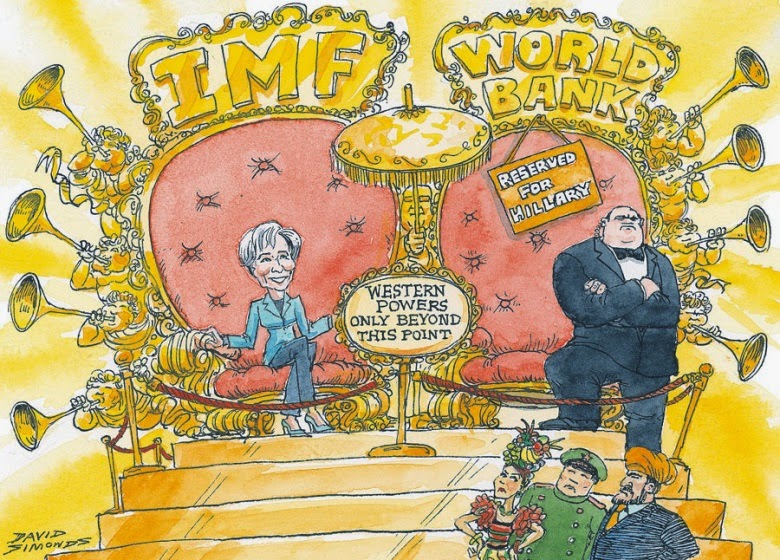
Christine Lagarde is famously the first non-economist to head the International Monetary Fund. Aside from being in charge during a time of transition when more developing countries want greater representation at the lender of last resort--see the cartoon above and an earlier
post on this matter--the economics profession is coming under fire post-global financial crisis.
Do economists really know how to run an economy, let alone a world economy? Nowadays, of course, "everything else" is beginning to gain more consideration in global economic governance. Not only do we need to bring political, social and technological factors back into consideration, but
also a gendered focus:
In
truth, some IMF staff also fear that gender issues are a distraction
from the more pressing problems of financial stability, say, or monetary
policy. But to Lagarde these naysayers miss the vital point: she thinks
the IMF, like the rest of the policy world, urgently needs to overhaul
how it does “economics”. “When I got here I found silo-thinkers,” she
explains. “They thought that things like women’s contribution to the
economy, or climate change, or income inequality, didn’t matter. But it
does.”
In many ways, then, she wants to consider all the other things economists neglect and have marginalized at the IMF for most of its history. She wants to practice IPE, in other words:
This partly reflects her own background: unlike most of her
predecessors, Lagarde has not had economic training. Some critics
consider this a handicap. She disagrees. “There are three things,” she
says, ticking the points off her fingers, her spinach pushed aside.
“Firstly, I am a quick learner. Secondly, I know when I am out of my
depth. But thirdly, my management style is all about bringing people
together. So I ask people to explain. And that is very important,
because economics has too much jargon, so many models, that ordinary
people just cannot understand it. And that is dangerous.”
She is particularly concerned about what she sees as a structural
disconnect between economic and political structures. On the one hand,
she notes, the global economic system is becoming increasingly integrated; on the other hand, the global political system
is fragmented and becoming more so because of a backlash against the
way that globalisation is hurting some people. “What we are seeing with
all this regionalism, with the Scottish people wanting to go their own
way, is going in the direction of less globalisation,” she says.
To be sure, this sort of stuff is old hat to IPE specialists. Dani Rodrik, for instance,
questioned whether globalization has gone too far back in 1997. Given the copious amount that's been written about the IMF by IPE scholars of all stripes, for example, I think that Lagarde would do well to engage with our field since many of these areas have already been covered by political economists instead of mainstream economists.