Showing posts with label Demography. Show all posts

Will Korea Welcome More Migrants Than Japan?

♠ Posted by Emmanuel in ,, at 3/04/2016 11:41:00 AM
Maybe "Korean multiculturalism" won't be an oxymoron in the near future.
When it comes to the least fertile countries in the world, East Asian ones are pretty much at the bottom of global league tables. Since the demographic consequences of this phenomenon are dire--ever-fewer workers supporting a larger number of economically inactive--these countries have naturally been investigating solutions ranging from increasing benefits for new parents to improving the image of parenthood. To date, none have really worked in East Asia.

Enter migration: if people will not have children of their own who will eventually enter the workforce, why not bring in persons of working age from abroad? Better than wait for children to grow, they can work now. As relatively homogeneous societies, however, the fear remains that of cultural dilution. That said, there may be differences even among East Asian countries.

Consider South Korea. Make no mistake: On the balance, the general public holds negative views of migrant workers:
More than half of Koreans have a negative attitude towards foreign workers residing here, a recent survey showed. In a survey by local pollster Gallup Korea, 54 per cent of respondents said that the migration of foreign workers to Korea is "not a good thing." The study was conducted on 1,500 Koreans aged 19 and above.

Thirty-nine per cent said that it is a "good thing," which is significantly lower than the 57 per cent average across the 69 countries that participated in this global survey.
That said, multi-ethnic marriages and families are becoming more of a staple in South Korea. Call it another globalization phenomenon:
Interracial marriages [...] have grown since the 1990s in largely homogenous South Korea as the country started opening up following the end of military rule in 1993, and its people engaged in trade and tourism exchanges with nationals of neighbouring countries, including China, Vietnam and the Philippines.

As of 2014, there were 795,000 multicultural family members, comprising South Koreans, their foreign spouses and their biracial children, living in the nation of 50 million people, according to the Ministry of Gender Equality and Family. The country is also home to about 1.7 million foreigners.

Over 63 per cent of interracial marriages are between South Korean men and foreign-born women, the majority of whom hail from China, Japan and South-east Asian countries such as Vietnam and the Philippines. South Korean women marrying foreign men make up 24 per cent, and the rest are marriages that include one or two naturalised foreigners.
Unlike Japan, South Korea's government has been more active in changing public attitudes towards these multi-ethnic families:
Last November [2015], a revision to the Multicultural Families Act was made to put greater emphasis on changing biased views of these families, preventing discrimination of biracial children and encouraging more openness among Koreans towards these families.
This marks a shift in the government's policy, from merely integrating migrant spouses into the Korean society to more active efforts at promoting multiracial harmony. Details are being worked out and will be announced later.
While it's true that Korea's government is dragging its foot somewhat on the subject matter, there is a clear difference with Japan which has not really tackled the issue of acceptance in a significant way. In this respect, Korea is ahead--if only slight so, it's still a meaningful public policy difference.

More on How Aging Societies Hinder Growth

♠ Posted by Emmanuel in at 12/22/2015 04:45:00 AM
There's an interesting article on Bloomberg drawing on recent work from HSBC on how aging populations in different countries are likely to be a drag on their growth. Japan is, of course, today's most prominent example of the difficulties encouraging growth against a backdrop of demographic disaster. However, the situation of Japan will hardly be unique over the coming decades as the forces of depopulation replicate themselves all over the world. Worryingly, it is not only developed but also developing countries which will likely experience this phenomenon:
From such advanced economies as the U.S. and Japan to developing countries, such as China and India, the change in the shape of population pyramids is poised to crimp productivity growth over the next decade, HSBC contends. "The population structure in many economies does not lend itself to an increase in productivity, with a higher share of older (or younger), less productive workers," wrote the economist. "The change is huge, suggesting that the make-up of these populations will be less conducive to productivity growth in the future than it has been in the past."

Pomeroy adds that along with peak productivity, the 45- to 54-year-old age bracket also boasts the highest consumer spending in the U.S. People aging out of this category present another channel by which the graying process will drag on growth. And health care, a segment that will be in high demand among the elderly, is a sector with notoriously poor productivity growth.
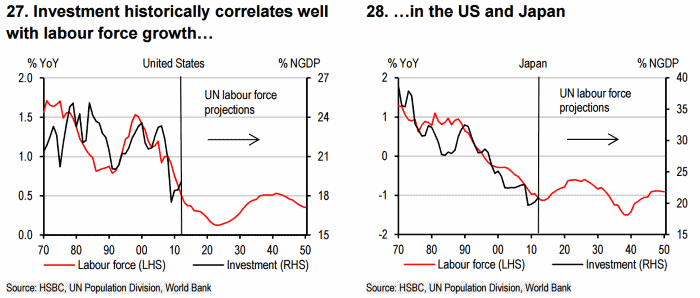
Another thing is that investment growth tends to track labor force growth. With labor forces the world over shrinking--Japan being today's case in point--the trends look worrisome.
Investment growth, meanwhile, tends to track the growth of the labor force rather closely:
It would likely take a breakdown in this historical relationship—in which capital supplanted rather than complemented labor—to allow for the possibility that productivity growth could offset the deleterious effect of lower hours worked on GDP.

"Unless something changes and we see more investment from either public or private sources, the rest of the developed world may succumb to a similar fate to Europe today, where the dearth of investment is hampering output growth," concludes Pomeroy.

Two-Child Policy & China's 'Asian Tigerization'

♠ Posted by Emmanuel in , at 11/09/2014 01:30:00 AM
China needs more babies.
That the world's lowest fertility rates belong to Asian tiger economies belies the saying about "being a tiger in bed" to denote virility. In development studies, we are taught about the demographic transition in which large, predominantly rural families make way for small, predominantly urban families. Not only is real-estate and life in general more expensive in cities. but there is less time available to care for the young'uns. The end result is a decline in total fertility rates or the number of live births expected per woman. Apparently, the Asian tigers have taken this lesson to heart since they are at the foot of the world league tables in fertility. They have tons of money anyway, so why complain, right? The CIA World Factbook indicates that the Asian tigers plus Macau are the countries or territories with the world's lowest fertility rates:

220 Korea, South
1.25
2014 est.
221 Hong Kong
1.17
2014 est.
222 Taiwan
1.11
2014 est.
223 Macau
0.93
2014 est.
224 Singapore
0.80
2014 est.
Being so far below the replacement of 2.10 to keep a steady population size, depopulation is inevitable in these places absent mass inward migration. Which brings us to China, ranked 185th in the world at 1.55 according to the same source. Recently, Chinese apparatchiks relaxed infamous one-child policy controls on births given certain conditions such as at least one of the spouses--bastardy is relatively uncommon in China--being an only child. Somewhat surprisingly, the number of applications far undershot projections:
China’s expected baby boom is turning out to be a bust. Not as many married couples as expected are taking advantage of a loosening in China’s one-child policy that allows them to have two children if one spouse is an only child.

Around 804,000 couples applied by the end of September to have a second child, the National Health and Family Planning Commission said in a statement, dramatically short of the annual two million new births projected by health officials as a result of the policy shift announced last November. The shortfall has wide implications for China—from investment by businesses to the country’s tightening labor supply and the vitality of its economy.
But the low figure highlights the demographic challenges facing China, where a rapidly aging society and an array of new health issues are threatening the country’s population growth, its future workforce and economic stability.
The expected windfall for purveyors of paraphernalia and services for tots have been massively disappointed--as have the champions of loosened population controls:
News of the policy change last year brought a frenzy of anticipation from baby-related businesses, with shares of baby-formula producers and even piano makers jumping. Tutoring companies’ shares climbed on the assumption that urban families would fill their cribs and eventually classrooms.

The lack of interest from couples surprised even demographers who have long urged the government to act fast and dismantle the birthing policy altogether, to avoid a collapse in the labor pool. The numbers are “way, way off the mark,” said Wang Feng, a demographer and professor at the University of California at Irvine and affiliated with Shanghai’s Fudan University.

Experts say a combination of factors, including a focus on higher education, bulging costs of living and increased employment migration, have damped the desire for an extra child. China follows a pattern seen in other countries, especially ones with growing middle-class populations. Singapore, for example, offers incentives for babies; yet they often don’t outweigh the load of child-rearing.
Ah yes, the baby-less Asian tigers [sic]. Such may be the fate of China that it will not reach a similar "developed" status before its begins to depopulate, prematurely consigning it to a Japan-like fate before having a taste of such opulence on a nationwide scale:
Low birthrates means new workforce entrants are dwindling while the portion of the elderly is rising, prompting demographers to worry that the government is running out of time to change course. Between 2010 and 2030, China’s labor force is expected to lose 67 million workers, according to projections from the United Nations.

Health and family-planning officials said in the statement they are monitoring population changes to make future policy adjustments. A report from the official Xinhua News Agency this week said there are currently no plans for further policy relaxation.
The two-child policy being a big yawn does raise wider questions about Chinese development that lawmakers should consider. To wit:
  1. What constraints are faced by couples of childbearing age in major cities to raising children?
  2. What conditions--political, economic, social or environmental--lead couples to put off having children?
  3. How will hard-to-reverse demographic trends impact the trajectory of Chinese development?
  4. What is it that drives those who acquire wealth and prosperity to wish to leave China?
I suspect the fourth question will reveal the most uncomfortable truths for a totalitarian regime, but hey, desperate times call for removing the facade of all being hunky-dory. Make no mistake: China's prospects going forward have already been affected in a big way by the state poking into all aspects of their citizens' lives. It doesn't take a rocket scientist to figure this out.

BoJ's Kuroda, Monetary Kamikaze Without a Pause

♠ Posted by Emmanuel in , at 11/06/2014 01:30:00 AM
Kuroda-san administers smelling salts to Japan's economy & asks it how many fingers he's holding up.
I have long been fascinated with the apparent disconnect between the typical Japanese comportment of apologetic politeness and their occasional bouts of banzai, devil-may-care excesses when they throw caution to the wind. Current Bank of Japan Governor Haruhiko Kuroda is a case in point. A few months ago I prepared an Asia-focused contribution to IPE stalwart Thomas Oatley and Kindred Winecoff's new edited work on international monetary relations where I discussed Kuroda's influential role in steering the Manila-based Asian Development Bank (ADB) where he was its president until being recalled by the current Liberal Democratic Party (LDP) leadership. He best embodies the duality I'm talking about: he looks like the dignified and mild-mannered career civil servant that he is, but he is also responsible for throwing the world economy off-balance by announcing even more quantitative easing to hopefully pull Japan out of its deflationary slump that's now well into its third decade.

If I were to pick a metaphor, it's the last-chance saloon for Japan monetary-wise. Having run out of bullets shooting at the deflation beast, Kuroda has now flung the revolver at it. Or, for a Japanese rather than a Western analogy, Kuroda has instructed that the cockpit of his Mitsubishi A6M Zero be welded shut as he flies his aircraft straight into the deflation beast. His career as a civil servant is at and end; the only real question is if he can slay deflation. Prior to catching world markets off-guard last week, he reiterated his commitment to staying the course despite some unwelcome economic performances:
The BoJ has been criticised lately — even by [PM Shinzo] Abe — for a possibly excessive yen depreciation. But Kuroda insisted that “yen depreciation so far has been broadly in line with fundamentals and financial conditions. And that will be beneficial to the economy.”

Japan’s export volume had been “rather flat”, Kuroda admitted, but he attributed this in part to weak external demand, especially in East Asia, where more than 50% of Japanese exports go. Much Japanese manufacturing production has also moved offshore, limiting the benefit of a cheaper yen. But the weaker currency had still helped Japan, Kuroda insisted, by raising profitability in yen terms, whether from exports or from profits remitted from overseas production.

Kuroda has been pressured to extend the March 2015 deadline for achieving his inflation target. But Kuroda made it clear he intends to stay on track. “We are still half way there —around 1.25%,” he said. “Our target is 2%, so we will continue our quantitative and qualitative easing until we achieve the target.”
Which brings us to Kuroda's kamikaze attack on deflation. The extent of money printing is humongous to be honest, and unprecedented even by the American experience:
According to an analysis in the November 3 Nihon Keizai Shimbun, when Kuroda achieves his target the BoJ balance sheet will have exploded–and liquidity forced into Japan’s (and the global economy)–to a level of over 70% of Japan’s GDP (up from 30% when Kuroda assumed his position), compared with a level of some 25% of U.S. GDP which the Fed has pledged not to exceed for the foreseeable future.  The GDP/monetary base level for the European central bank is something over 10%.
If buying every single yen's worth of Japanese government bond (JGB) issued from this day onward is what it takes, Kuroda says he will do it:
Bank of Japan chief Haruhiko Kuroda highlighted his determination to stoke inflation in the world’s third-biggest economy, saying there’s no limit to measures he could take to reach its price target.

It’s natural to act if risks to price gains become substantial, and last week’s stimulus was “a true display of the Bank’s unwavering commitment,” Kuroda said in a speech in Tokyo today. “As for measures for additional easing, I don’t think there is a limit, including on bond purchases.”
Convincing consumers and companies that he means business is critical to the central bank’s efforts to end what it calls a “deflationary mindset” in Japan. The BOJ last week surprised markets with an expansion in already-unprecedented asset-purchase program that sees it ready to buy every new bond issued by the government. 
Once more, I simply believe that the "problem" with Japan is not even in the first instance a monetary condition. For one thing, the natural tendency with a nation in the advanced stages of depopulation is for the people to hold off consumption. There is simply not enough people out there to buy all the stuff being made. Besides, people keep saving for a rainy day since they rationally expect that few young people will be around to pay into the pension system in their old age. The depopulation-deflation cycle is a vicious one, but again, it cannot be solved by purely monetary means.

The only feasible solution--the one they haven't tried yet and Japanese leaders don't address in a substantial way since it's politically contentious--remains welcoming migration in large numbers in the absence of interest among the natives in reproduction. Helicopter dropping has already runs its course, and more of the same doesn't appear to be helping at all.

Reviving Japan: From Abenomics to Womenomics

♠ Posted by Emmanuel in ,, at 9/10/2014 01:30:00 AM
While Japan is a country which much to be proud of, its record in promoting gender equality may not be one of them--yet. Among OECD countries, the wage disparity among sexes is third greatest in Japan after South Korea and Estonia. Prime Minister Shinzo Abe recently made a gesture towards rebalancing this disparity by appointing five female cabinet ministers, matching the previous record. Why not more, you may ask? Remember that in a parliamentary system like Japan's, cabinet members are not political appointees but sitting ministers. With admittedly few female Liberal Democratic Party parliamentarians, selection is made more difficult:
Japan's prime minister picked five women for his Cabinet on Wednesday, matching the past record and sending the strongest message yet about his determination to change deep-seated views on gender and revive the economy by getting women on board as workers and leaders.

Japan has a vast pool of talented, well-educated women, but they are far under-represented in positions of power in government and corporations. Women make up 10 percent of parliament and just 3.9 percent of board members of listed Japanese companies, versus 12 percent at U.S. corporations and 18 percent in France. Women here have long complained about the obstacles to getting taken seriously at work, receiving equal pay for equal work and finding child care or helpful spouses.
Equality may be a good in itself, but is there reason for us to believe that females are necessarily better administrators, civil servants, lawmakers or managers? Women may be less prone to groupthink and excessively aggressive behavior, true. Moreover, I do not think that Abe is looking to make the opposite argument that women "outdo" men. Rather, they should have equal opportunities insofar as Japan is wasting a lot of talented people for discriminatory reasons. What's more, they may bring a fresh perspective to issues their country is facing:
Prime Minister Shinzo Abe reiterated Wednesday that a key part of his "Abenomics" growth strategy is making greater use of women and promoting them to leadership posts — a campaign dubbed "womenomics," a term he has embraced. Abe has set a goal of having women in 30 percent of leadership positions in both the private and public sectors by 2020. "Realizing a society where women can shine is a challenge our Cabinet has undertaken," he said during a news conference. "I look forward to the wind of change these women will bring."
Perhaps these women will finally begin to promote migration into Japan to revive its moribund demographics and hence its economy?

UPDATE: SCMP has a profile of Yuko Obuchi, Japan's new industry minister charged with reinvigorating her country's moribund industrial base. Aged 40, she is the youngest minister in the postwar era. Her job # 1 is restarting nuclear power plants closed in the wake of Fukushima: I have discussed the urgency of doing so before.

Enlivening Naypyitaw, Myanmar's "Ghost Capital"

♠ Posted by Emmanuel in , at 1/05/2014 08:06:00 AM
Where Google Earth fears to tread. Welcome to Naypyitaw
In the pantheon of vanity projects, there is none more hubristic than establishing a nation's capital in the middle of nowhere. The archetypal and best-known example is Brasilia, the erstwhile seat of Brazilian government. Lesser-known but no less the product of planning on a grand scale are Australia's capital of Canberra and Canada's capital of Ottawa. None of these so-called capitals are among these countries' liveliest cities; it is difficult to pre-plan a "happening" town, and they generally prove this point. Seen any rock albums entitled Live in [Brasilia, Canberra, or Ottawa]?

The debate between creating master-planned gateway cities and allowing them to emerge spontaneously (Le Corbusier versus Jane Jacobs) is a very interesting one with enormous policy implications. For instance, would any urban planner have allowed the emergence of megacities built on fault lines (San Francisco and Los Angeles)? Or, for that matter, megacities in arid regions alike Las Vegas and Phoenix which add insult to injury by drawing people away from ("Rust Belt") cities that do not have problems with water supplies or generating power for massive amounts of air-conditioning? People do not necessarily decide to live in places where it makes ecological sense to do so.

This all brings me to Southeast Asia's own, rather obscure Naypyitaw, the Burmese junta's own capital in the middle of rice paddies. Originally meant to seclude government from prickly opposition types in the old capital of Rangoon (today's Yangon) among other things, it has long suffered from having government and not much else. Sounds familiar, ey? However, its situation has been exacerbated by the ruling clique deciding on who can stay there, as well as the general isolation of sanction-ridden Myanmar. However, with the country now opening up to the world, things are looking up in the country and Naypyitaw is benefiting particularly:
Eight years after Naypyitaw — "Abode of the King" — was proclaimed the new government seat, it has become something more than a "ghost capital hacked out of the jungle," as it was once described. Private enterprise is staking some ground. More shops and restaurants have opened and 79 hotels are operating or under construction. Some foreign companies, notably the Japanese, have set up small branch offices.

A dozen impressive stadiums, meeting halls and hundreds of villas for visiting VIPs have been built here for the Southeast Asian Games, an 11-nation event (featuring all ASEAN members plus Timor Leste) that began Wednesday. Naypyitaw (nay-pee-thaw) will be in the spotlight again next year when Myanmar chairs the 10-member Association of Southeast Asian Nations.
The sheer scale of the project, however, makes it difficult to "fill" Naypyitaw. Remember too that this was a country lumped with North Korea not so long ago in the hermit sweepstakes:
But the capital remains far from meeting the grand expectations that built it. It's 40 times the area of Washington, D.C., dotted with enormous public buildings that seem incongruous in one of the world's poorest countries. The U.S. Capitol is positively puny compared with the equivalent here. The main conference center dwarfs the United Nations building in New York, and the airport, home to just two international airlines, is designed to handle up to 10.5 million passengers a year. Vast empty spaces dominate. Many government workers live alone because their families don't want to move here.
It will be interesting to watch whether they can make Naypyitaw something more than a curiosity; an answer to a trivia question. Certainly, it will take the buy-in of more than the generals if it is to become so. It is very much a matter of political geography.

So, Just How Urbanized is Our World?

♠ Posted by Emmanuel in at 11/21/2013 11:46:00 AM
To be exact, it is 52.1% urbanized in terms of persons living in cities according to the latest 2011 figures from the UN Department of Economic and Social Affairs (UNDESA). Having turned the corner in 2007, the pace is accelerating for better or worse as more people choose to live in cities.

Also above is a map [click to enlarge] depicting global trends in urbanization according to each nation's percentage of city dwellers. It's interesting stuff, especially from an urban planning point of view.