Showing posts with label Bretton Woods Twins. Show all posts

The IMF, Team Transitory & You

♠ Posted by Emmanuel in at 4/26/2023 07:27:00 PM


I have a confession to make in being on board "team transitory", or the belief that the recent (global) increase in inflation is due to largely temporary factors. As these factors fade, we are set to resume the previous economic environment of relatively benign inflation. On the demand side, these temporary factors include increased demand for consumer goods as people stayed more at home due to the pandemic. Economic stimulus provided by rich countries to their citizens further fueled this demand. On the supply side, disruptions in goods production, transportation and retail also arose due to the pandemic. More demand + less supply = inflation.

Meanwhile, critics of the idea that high inflation is transitory argue that there have been changes in the world economy which contradict the transitory idea such as the emergence of a major war on the European continent--the first since the end of WWII--causing strains in the availability of commodities like energy and grains. Also, prices of not only goods but also services should be factored in since the latter have increased, too. In other words, inflation is becoming entrenched and is not a temporary phenomenon. 

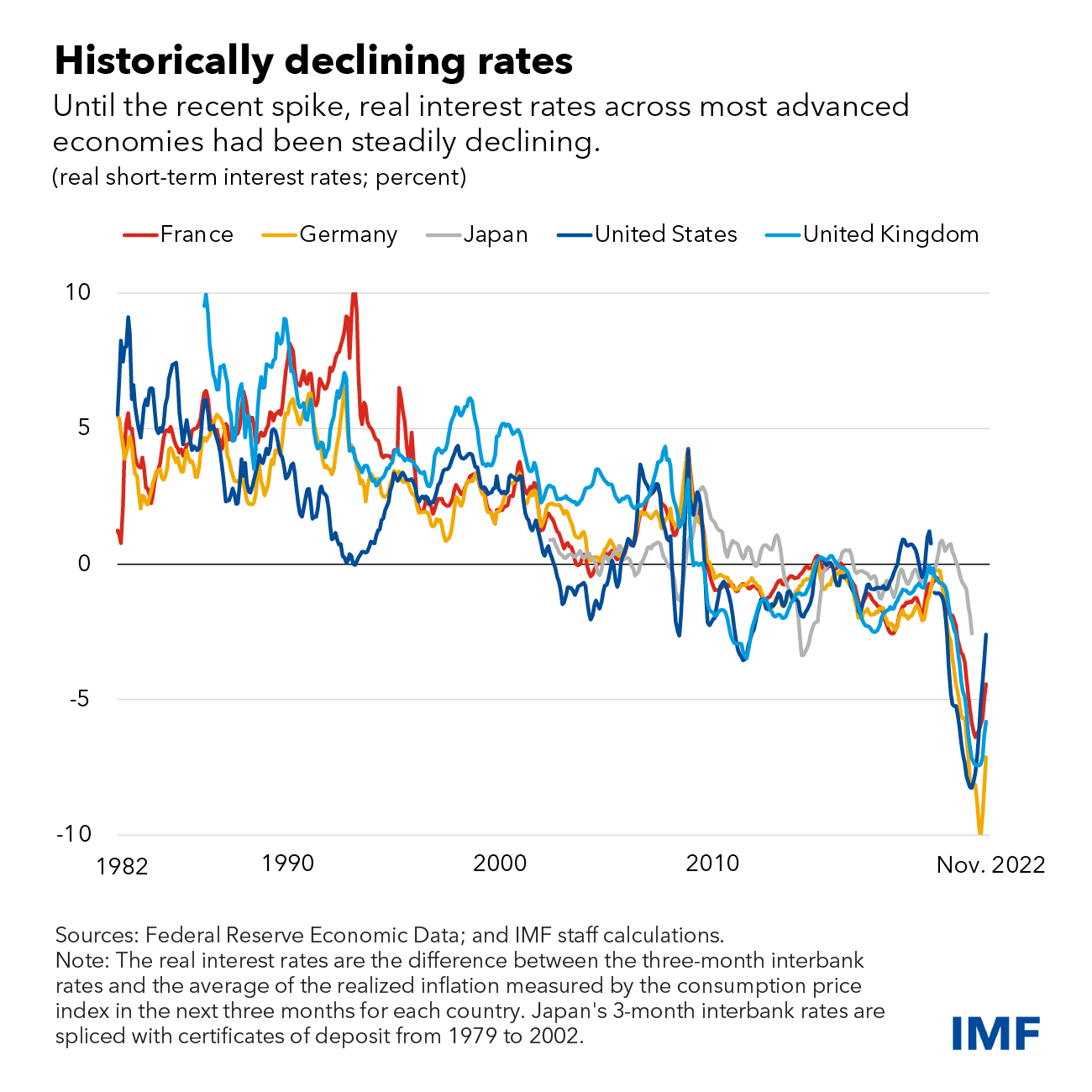
Little-noticed in this debate is the International Monetary Fund (IMF) weighing in recently with its most recent take on the matter. According to the IMF, there were longstanding economic phenomena well underway before the pandemic that point to lower inflation whose momentum will be very difficult to overcome. These include: 

  • Total factor productivity falling significantly, which lowers economic output;
  • Demographic changes resulting in fewer persons of working age (and more retirees), which also reduces economic output;
  • For developed countries at least, inflows of capital from developing countries in search of more secure returns. 

While there too are factors pushing up rates such as running sizable national budget deficits (that have to be funded by offering higher returns to lenders), the overall picture in the developed world is of declining rates, on the balance. Here is another IMF chart:


Absent some unforeseen modern-day productivity boom or baby boom, you would generally expect rates to trend downward in the developed countries. As they become older--like China whose population is already falling outright--developing countries should follow the same path. Add in other factors the IMF found also lead to lower rates such as elevated and rising inequality--rich people tend to save more and spend less--as well as the decreasing labor share of income--leaving workers with less disposable income--and the picture for rate moderation is compelling. 

On this matter at least, I think this IMF research is spot on, with some caveats. We are not quite sure when current (transitory) inflation pressures let up precisely, but they will eventually be swamped by stronger factors favoring lower rates. Aging and diminished productivity along with a handful of other factors will lead us back to a low rate economic environment once more. You have to be brave to bet otherwise.

Biden's War on Coal @ World Bank

♠ Posted by Emmanuel in ,, at 2/14/2021 11:00:00 AM

There's an interesting article on Politico about how the Biden administration's pledge to limit emissions from fossil fuels will be implemented on the global stage. Sure, reducing subsidies for fossil fuel extraction and consumption at home to set an example for the rest of the world is one thing. However, there are also things the United States can do internationally to help ensure fossil fuels are kept in the ground. 

In an executive order issued last month, Biden tasked the United States' agencies involved in foreign assistance and development financing--the International Development Finance Corporation (formed in 2019 by combining the Overseas Private Investment Corporation and the Development Credit Authority), Treasury, USAID, and the Millennium Challenge Corporation among others--with devising emissions-reducing financing. 

This executive order also extends to the multilateral organizations the US is a member of, including the World Bank. It states:

[The Treasury Secretary shall] develop a strategy for how the voice and vote of the United States can be used in international financial institutions, including the World Bank Group and the International Monetary Fund, to promote financing programs, economic stimulus packages, and debt relief initiatives that are aligned with and support the goals of the Paris Agreement.

In doing so, the Biden administration wants to contrast clean, green American with dirty energy China. However, there is a danger that developing countries not as green-minded as Biden may instead be pushed to deal more with China:

President Joe Biden’s plan to halt U.S. funding for overseas fossil fuel projects will turn the global spotlight on China for bankrolling coal projects around the globe. But it could also push poor countries closer to Beijing — and risk ceding the United States’ position as a leading financier for developing economies...

Biden's directive last month to move toward withholding money from international institutions like the World Bank that help poor nations build fossil fuel power plants stands in stark contrast to Beijing's flow of cash under its Belt and Road Initiative, which supplies 70 percent of the financing for the world's new coal-fired plants. The White House is betting its move will paint China as hypocritical as that country — the world's top greenhouse gas emitter — aims to take a leading role in international climate change efforts.

To be sure, there will need to be a (sorry for the public administration jargon) whole-of-government approach for the US to get its message across in a way that resonates with developing countries deciding between clean energy and fossil fuels:

But the plan will require the Biden team to closely coordinate its foreign policy, trade and clean energy initiatives, because the absence of U.S. money for coal projects won't on its own sway other nations’ energy plans. And the U.S. cannot unilaterally offer sweet enough financial terms for clean energy to lure countries away from China's coal finance.

It's fair to say the US has its work cut out for it in a world which has not forsworn fossil fuels. It is worth pointing out that the Obama administration which Biden was a part of already started encouraging similar measures at the World Bank that have impacted the amount of fossil fuel-based energy projects it funded:

But the U.S. could immediately start shifting billions of dollars away from fossil energy if [Treasury Secretary] Yellen directs U.S. representatives at the World Bank and other multilateral funders to vote against coal, said Joe Thwaites, an associate with the World Resources Institute’s Sustainable Finance Center.

The number of coal projects funded by those institutions has already dwindled, due in part to efforts under the Obama administration, though multilateral development banks in which the U.S. is a shareholder accounted for $69.5 billion of fossil fuel finance between 2008 and 2019, according to environmental group Oil Change International.

Should the World Bank Still Lend to China?

♠ Posted by Emmanuel in , at 4/16/2018 01:17:00 PM
There's an interesting behind-the-scenes discussion going on at the World Bank about the Chinese still receiving loans from the development lender. Not only is a country well on its way to becoming the world's largest economy still borrowing, but it's actually the largest borrower at its International Bank for Reconstruction and Development (IBRD) arm, which charges at market rates plus a relatively small spread. From the Financial Times:
China was the IBRD’s top borrower last year, according to the World Bank, with $2.4bn in funds committed. That was 11 per cent of the IBRD’s lending and more than it committed to education and health programmes worldwide.
Things get a more interesting when politics enter the fray. While the US wants to involve China in the workings of the World Bank, it does not want China to begin rivaling American influence at the development lender at a time when the World Bank requires more funding to become self-sustaining in its lending activities. Hence, Americans have to juggle four hard-to-reconcile objectives:
  • Maintain Chinese interest in participating at the World Bank as a contributor
  • Limit Chinese borrowing at the World Bank as an IBRD borrower
  • Keep American influence at the World Bank despite Trump's "America First" (isolationist) inclinations
  • Encourage lending to truly lower-income countries, not middle-income ones like China
The compromise being worked on to meet these disparate objectives is somewhat elaborate:
The increase in paid-in capital will be split into two with $7.5bn going to the International Bank for Reconstruction and Development, the bank’s main arm, and $5.5bn to the International Finance Corporation, its private sector lender, the official confirmed. The US is set to provide $1.3bn to the IBRD capital increase, the official added, but has not yet decided whether it will inject new capital into the IFC.
As part of the deal China will see its voting power in the IBRD rise from 4.45 per cent to around 5.7 per cent, people familiar with the matter said. The deal is expected to be endorsed in principle by World Bank shareholders at the spring meetings, according to people familiar with the discussions. Final approval is expected before this year’s autumn meetings. 
Then there is the US love-hate relationship with China:
The US has been concerned about the World Bank lending to a rival power that has been sitting on trillions of dollars in foreign currency reserves since Barack Obama was president. But Mr Kim has long argued that lending to a rising China helps to solidify a future for the World Bank and gives it a voice in Chinese economic reforms.

The Trump administration’s push to get the World Bank to stop lending to countries such as China is likely to take time to take effect. Some people familiar with the discussions said Beijing’s cost of capital at the bank would not rise immediately, as the new band for countries in its situation was established. Instead, they said, the interest charged to countries such as India in lower bands could be reduced. 
It's a fine line to thread in dealing with China that the Americans face, divided as they are among themselves to begin with. The Obama-era appointee Kim wants to engage with China, while the Trump administration alternately wants to leave the World Bank alone or limit China's role if it does choose to engage with the development lender. Why a country with historically unprecedented foreign exchange reserves [China] needs to borrow from the World Bank is also puzzling: Maybe it's more for gathering technical assistance-style knowledge than funding per se.

Utterly Predictable: Candidate H Clinton 'Opposing' TPP

♠ Posted by Emmanuel in ,, at 10/08/2015 01:37:00 PM

The general rule for modern Democratic candidates is to voice skepticism for trade agreements in the run-up to elections, and then warm up to them once in office. The electoral dynamics are simple: organized labor remains strong within the Democratic party even if they are a much-diminished force in the overall picture Stateside. I bring this up because there are so many articles coming out about how Hillary Clinton has allegedly changed her position on the Trans-Pacific Partnership enlargement. Here is a representative quote:
Hillary Clinton said Wednesday she opposes the 12-nation Trans-Pacific Partnership, marking a significant break with the Obama Administration as she heads into the first Democratic presidential debate.

In an interview with PBS NewsHour, Clinton said that while she is still reviewing the deal, she is “worried” it benefits drug companies and does not address currency manipulation. “What I know about it as of today, I am not in favor of what I have learned about it,” Clinton said. “I’ve tried to learn as much as I can about the agreement, but I’m worried...”

“I’ve tried to learn as much as I can about the agreement, but I’m worried,” Clinton said. “I’m worried about currency manipulation not being part of the agreement. We’ve lost American jobs to the manipulations that countries particularly in Asia have engaged in.”
To make a long story short, like Obama and her husband before her, masquerading as a trade-o-phobe during election campaigning to please organized labor constituencies is standard practice. Witness the 2008 nomination process where it was [surprise!] the supposedly trade-hating Obama--under whom TPP was concluded--criticizing Clinton for jumping on the FTA-bashing train late during the 2008 campaign:
In Ohio, where union workers are a major presence and the manufacturing economy is hurting, Sen. Barack Obama attacked Sen. Hillary Clinton for her position on the North American Free Trade Agreement, called NAFTA.

"Yesterday, Sen. Clinton also said I'm wrong to point out that she once supported NAFTA," Obama said. "But the fact is, she was saying great things about NAFTA until she started running for president. A couple years after it passed, she said NAFTA was a 'free and fair trade agreement' and that it was 'proving its worth.' And in 2004, she said, 'I think, on balance, NAFTA has been good for New York state and America.' "

The Clinton campaign says Obama is wrong, that Clinton was critical of NAFTA "long before she started running for president." We looked into Clinton's past remarks on NAFTA and concluded that she has changed her tune, from once speaking favorably about it to now saying the agreement needs "fixing."
Some people never learn, If elected, I am sure that Missus Clinton will support TPP ratification Stateside after reading the TPP text "more carefully"--or something along those lines. Unlike Obama who was a senator in 2008 when running for president, she doesn't even hold any office at present, so what does it matter if the "opposes" TPP?

As an aside, the China-aimed currency manipulation concern about TPP is the most asinine thing I've ever heard. First, China is not a party to the @#$%^& agreement. Second, even if it were, it is drawing down and not increasing its foreign exchange reserves, implying that it is trying to maintain the value of its currency.

Would Korea Have Developed Following World Bank?

♠ Posted by Emmanuel in ,,, at 8/17/2012 11:45:00 AM
Although more than a few colleagues tend to view the World Bank in quite a negative light no matter what they do, I have come to a more ambivalent position. (Newer readers should note potential conflicts of interest since they gave me not-insubstantial prize a few years back when I was still a PhD student.) Yes, their policies tend to follow what's in vogue among American elites. Yes, their policies too have in the past been less than considerate of the particular circumstances of developing nations in attempting to transplant foreign models of development. But ultimately, I do not think that more sinister motives attributed to them hold. Rather, "America knows best" has often been combined with off-target advice for mixed results in more than a few circumstances.

Which brings me to today's post. While proctoring exams, I've had more time to read Kim Chung-yum's firsthand account in From Despair to Hope: Economic Policymaking in Korea: 1945-1979. Although it's common knowledge that the West didn't rate South Korea's chances for becoming a development success after the Korean conflict, what's starkly evident is how World Bank personnel readily lumped it in as another case of overreach. While the Pohang Iron and Steel Company (POSCO) eventually became regarded as the world's most efficient steel producer in the world, it bears remembering that it could not even avail of any lending whatsoever from the US or the World Bank at first:
[The] KISA [Korean International Steel Association] conducted negotiations with the World Bank, the Export-Import Bank of the United States (EX-IM) and other creditors from the UK, West Germany, Italy, and France, to secure financing. However, there was little progress in the negotiations. 
The world frowned upon developing countries that sought to construct an integrated steel and iron mill. At an annual general meeting of the IMF and the World Bank, this view was made clear by Eugene Black, the President of the World Bank (1949-1963), when he said (to paraphrase): “There are three myths in a developing country. The first is construction of expressways, the second is construction of an integrated steel and iron mill, and the third is construction of a monument for the head of state” [pp. 159-160].
And speaking of expressways, it should come as no surprise either that the World Bank didn't think much of them despite paving the way for South Korea's success. As ever, the best way to silence DC-based bigwigs is through success:
In light of the IBRD’s reluctance to assist in the construction of expressways, Korea pressed ahead anyway with the construction of the Seoul-Busan Expressway, the Daejeon-Jeonju section of the Honam Expressway, and the Shingal-Saemal section of the Yeongdong Expressway with its own financial resources. After Korea showed it was able to build the Seoul-Busan Expressway with its own financial and technological resources at half the time and a fraction of the cost, the IBRD began to rethink the economic feasibility of expressways in Korea [p. 312].
Other agencies also dispensed bad advice. USAID didn't help matters by far underestimating the energy requirements of South Korea:
The electricity shortage of 1967 was due to underinvestment. The initial investment proposed in the First Electric Power Development Plan had been reduced based on the recommendations of a US research team (Thomas Research Team) commissioned by US AID to conduct a study of Korea’s electricity requirements in September 1964. The study conducted by the research team concluded that the electricity demand forecasted in the First Five-Year Electric Power Development Plan during period of 1962 and 1966 was too high, recommending to the Korean government and USOM to lower the projections. As such, the downward revisions to the initial investment plans reduced electricity capacity by 224,000 KW [p. 152]. 
It's interesting to see how sceptical the World Bank was of South Korea at the outset. I do this not to poke fun at World Bank advice, but to again reinforce the point that the World Bank is ultimately just another source of input and finance among others. Ultimately, developing countries are responsible for their own development or otherwise, generally well-intentioned outsiders notwithstanding.

Palace Coup? World Bank Vets Pick Okonjo-Iweala

♠ Posted by Emmanuel in ,,, at 4/06/2012 12:57:00 PM
News is becoming sparser as most of the Christian world slows for the Easter holidays. However, in the run-up to the selection of the next World Bank president which should happen in a fortnight or so, we've had ringing endorsements of Nigerian Finance Minister Ngozi Okonjo-Iweala. (See a previous post for further ruminations.) We begin with an interesting counterblast to the current climate of economist-phobia at development institutions post global financial crisis. While it may be trendy to put non-economists at these institutions, the Economist (surprise!) slams this trend in endorsing her as the best candidate for the job:
Okonjo-Iweala is an orthodox economist, which many will hold against her. But if there is one thing the world has discovered about poverty reduction in the past 15 years, it is that development is not something rich countries do to poor ones. It is something poor countries manage for themselves, mainly by the sort of policies that Ms Okonjo-Iweala has pursued with some success in Nigeria.
While I am nowhere near as partial to economists as a publication dedicated to them in name, I did enjoy the insinuation that the United States which encouraged World Bank lenders to avoid corruption was doing so by choosing its favoured candidate to yet again fill a top (international) job.

Meanwhile, the Financial Times seconded the motion, accentuating the positives of extensive work at the World Bank:
Its new leader should have a command of macroeconomics, the respect of leaders of both the funding and the funded countries, and the management skills to implement his or her vision. These requirements make Ms Okonjo-Iweala the best person for the role.

Having served as managing director under outgoing World Bank president, Robert Zoellick, she also has a unique knowledge of how the institution works. While one risk could be the temptation not to challenge the status quo, she might find it easier than other candidates to gain the respect of staff and build on Mr Zoellick’s legacy.   
More importantly for me, however, is that many World Bank veterans have come out in a strong show of support for Okonjo-Iweala. Lest you think that its employees don't matter, remember how the Ameriscum Paul Wolfowitz was eased out as World Bank president even during the Bush administration. From the Vanguard of Nigeria:
As the World Bank gets set to interview the three candidates vying for its presidency from April 9-11 before announcing its decision the following week, a group of former World Bank officials, including one-time chief economist, Francois Bourguignon, said it supported Nigerian Finance Minister, Dr Ngozi Okonjo-Iweala’s candidacy to become the lender’s president even as Governor of Central Bank of Nigeria, Mallam Sanusi Lamido Sanusi said Nigeria’s nominee was the best candidate for World Bank top job.

The 39 former managers, in a letter to the bank’s members, cited Okonjo-Iweala’s “deep experience in international and national issues of economic management” and said she had the ability to increase the bank’s effectiveness. Okonjo-Iweala, who was a managing director at the bank until last August, “would hit the ground running and get things done from the start,” the letter said.

According to the former World Bank officials, “challenges for the future president range from international fundraising to brokering agreements on global issues and while all the three presidency candidates, including former Colombian Finance Minister Jose Antonio Ocampo, have strong qualifications, Okonjo-Iweala’s skills cover the full spectrum of criteria. Uri Dadush, a former World Bank director of policy and one of the 39 signatories, provided a copy of the letter.
Before concluding I should also point out that an assortment of heterodox economists (including the LSE's own Robert Wade)--many from the Global South besides--signed on to a similar petition for the Colombian candidate Jose Antonio-Ocampo. Although they're both long shots given the history of the institution in question, Okonjo-Iweala is more of an insider to it and Ocampo an outsider.

Still, the IPE Zone comes down in favour of Okonjo-Iweala if previous merit is the criteria. Nevertheless, what's obviously fascinating about the succession race is that it not only pits vested Western interests against rising ones from the Global South but it is also a trial of sorts for mainstream economics' place in development practice. Go ask Jagdish Bhagwati.

World Bank Boss: Kim, Okonjo-Iweala or Ocampo?

♠ Posted by Emmanuel in ,,, at 3/26/2012 05:30:00 PM
I'd like to say the competition to become the next World bank president is heating up if it weren't for the common understanding that it will be another American stitch-up. While I'd have preferred the term "whitewash," the White House has thrown those of us who are critical of Western domination of these institutions a curveball by nominating an Asian-American candidate in Jim Yong Kim. Thinking it over, I can offer a number of pros and cons. Starting with the good stuff I can think of--I am a charitable lad, yes...

  1. Global health is one of the areas where multilateral development institutions have actually made significant strides. Disease prevention is usually a large-scale intervention, and it is here where top-down efforts have shown promise. Witness the eradication of smallpox and the near-eradication of river blindness for instance. Since Kim's global advocacy is more on TB and HIV/AIDS, the more tentative results there are not really indicative of a lack of skill but of the increased difficulty in addressing the illness at hand;
  2. Becoming a university president--especially at a venerable Ivy League institution like Dartmouth--involves no small amount of political skill (Larry Summers notwithstanding);
  3. It will be a welcome change to have a physician by training head the World Bank instead of yet another economist or political scientist;
  4. It is also good that Jim Yong Kim is not a loyal party figure alike Zoellick and his American predecessors but rather someone who does not really come from the inner circles of US politics.

On the downside, though...

  1. This "pick a non-Caucasian to silence the critics" strategy would work better even as a token if he came from an LDC. Remember, South Korea famously joined the OECD in 1996 just before the outbreak of the Asian financial crisis a year after. We kicked it out of the G-77 after acceding to this rich country club, so he's not really someone who comes from today's Global South;
  2. His post as a university president aside, he will need to juggle conflicting interests from rich countries wishing to keep their hegemony at the World Bank as is and poor ones that are interested in being more involved in global governance but have found it hard to be among the big boys. There is not much from his previous experience that may prepare him for the rough-and-tumble of development politics.
Let's now turn to Ngozi Okonjo-Iweala, the Nigerian who's put her name up for candidacy via her supporting countries' World Bank representative. Also there's Jose Antonio Ocampo, the Colombian candidate put forward by a number of Latin American nations. Alike the bid by the Mexican Agustin Carstens to replace the infamous Dominique Strauss-Kahn at the IMF, it's probably best not to take these two bids very seriously (unfortunately)...
  1. The Jim Yong Kim ploy aside, the US shows no signs of breaking its stranglehold on World Bank leadership anytime soon, so both bids are forwarded more as "protest" votes;
  2. Alike Carstens, both LDC candidates are hampered by iffy support from disunited developing countries. After all, they've again failed to rally around a single candidate. Alike the Americans with their blinders, those that have volunteered someone have chosen a person from their own region. Not much "third world solidarity" here, eh? United we stand, divided we fall it is once more;
  3. Moreover, many other LDCs would probably be dissuaded from backing someone other than the US pick in justifiable fears of retribution from the West through vetoing future World Bank loans and grants;
  4. What's more, many "realists" would prefer to just aim for the backup spots alike being a World Bank managing director (the #2s). Indonesia's Sri Mulyani Indrawati probably understands this glass ceiling more than most. Call it the Zhu Min strategy;
  5. Okonjo-Iweala and Ocampo are hardcore development persons familiar with those working in this area and many LDC grandees. However, this status may actually detract from the idea of bringing in new blood in development work.
So in some (symbolic) ways Jim Yong Kim marks a real break as the American nominee--in terms of being a doctor by profession and an outsider to US politics. That said, these token gestures are unlikely to comfort the likes of yours truly since the guy probably knows who butters his bread when push comes to shove. At least U2's Bono was non-American. The more things change, the more things stay the same.

UPDATE: There is a lot of relevant material on the succession debate from the "World Bank President" site co-authored by my colleague Peter Chowla of the Bretton Woods Project.

White Man's Burden 2012: World Bank Succession

♠ Posted by Emmanuel in at 3/05/2012 03:16:00 AM
Take up the White Man's burden--
Have done with childish days--
The lightly proferred laurel,
The easy, ungrudged praise.
Comes now, to search your manhood
Through all the thankless years
Cold, edged with dear-bought wisdom,
The judgment of your peers! 


Well here is more discouraging news for those wishing for more diversity and better representation of LDCs at key international organizations. Just a few months back, the unexpected departure of Dominique Strauss-Kahn from the IMF revealed the hollow rhetoric behind calls for change in the tradition of Europeans having discretion over choosing the IMF head. While perhaps sudden, the unceremonious departure of le grande seducteur showed that when the opportunity finally came for change at that IO, none was forthcoming. The excuse then was that having several European nations in dire financial straits made it only natural to have a tried-and-tested European figure as IMF managing director.

Again, PIGS countries are not suffering primarily from balance-of-payments problems the IMF was meant to address. Even Wolfgang Muchau, euro-hater, concedes as much:
However, it is hard to understand why everybody feigns surprise at the fact that current account imbalances can be financed indefinitely in a monetary union. Is this not one of the characteristics that distinguish it from a fixed-exchange rate system?

As long as banks have access to the central bank, and can provide good collateral, countries can run current account deficits for an infinite period. A friend of mine once remarked – when I asked about the significance of intra-eurozone current account imbalances – that the way to solve the problem sustainably was no longer to publish the figures. He was only half joking.
And so we come to the announcement of current World Bank head Robert Zoellick that he will leave that institution shortly. While he is departing neither under inauspicious circumstances nor at an entirely unanticipated moment, the jockeying to keep the status quo intact is similar to the DSK situation. That is, pressure to keep the World Bank head an American choice remains. This time, the excuses are as follows:
  • It is politically unlikely that the US, which remains the World Bank's largest funder, would countenance a non-American head during an election year;
  • The United States is wary of relenting on World Bank leadership lest it be perceived as yet another sign of American decline;
  •  The implicit understanding that the US will insist on having its way means that no LDC candidates have put their names forward (which in itself indicates regression from the IMF succession race in which some at least entertained the notion of an LDC head despite the inevitable outcome)
Alan Beattie further suggests that the same fig leaf covering yet another whitewash at a Bretton Woods institution may be of nominating a woman. Again, this sort of compromise is unlikely to placate LDC grievances. Honestly, though, it would be equally unlikely that LDCs themselves would agree on a single candidate to back. It's not as if there is a scarcity of viable candidates alike Indonesia's Sri Mulyani Indrawati--currently #2 at the World Bank and formerly Indonesia's finance minister.   


Also see John Kerry on this matter. The more things change, the more things stay the same, indeed.

The Race is On to Succeed Zoellick at World Bank

♠ Posted by Emmanuel in at 2/16/2012 05:25:00 AM
I have to run but it's going to be very interesting going with the current World Bank President Robert Zoellick indicating that he is about to resign his post. The search is on for a successor with the US naturally in the vanguard. However, given the controversy of yet another European succeeding the ill-fated Dominique Strauss-Kahn with Christine Lagarde at the IMF, it is high time that representation at the Bretton Woods institutions became at least as cosmopolitan as changes in the leading players of the world economy. That is, non-European leadership at the IMF and non-American leadership at the World Bank where both jobs have been stitched up ever since. From Reuters:
World Bank President Robert Zoellick said on Wednesday he will step down in June and Washington pledged to put a replacement candidate forward within weeks for a job that has always gone to an American. The Obama administration said it would open the process to competition [to non-Americans], marking the first time it has shown willingness to loosen its grip on the world's top development lender...

Developing countries have for years pressed for a greater voice in leading global financial institutions and are likely to stress the importance of a competitive process, but the United States is still widely expected to retain its hold on the job.

"It is very important that we continue to have strong, effective leadership of this important institution, and in the coming weeks, we plan to put forward a candidate with experience and requisite qualities to take this institution forward," U.S. Treasury Secretary Timothy Geithner said in a statement.
There is also supposedly a "hostage" situation of US congressional funding being contingent of selecting yet another American for the top post:
While Geithner called for an "open and expeditious process," analysts say Washington can ill afford to give up the post without risking the U.S. Congress cutting funding for the Bank. Zoellick, who discussed the selection process with the board in a two-hour meeting on Wednesday, said the first step was for the board to call for nominations. "An open process is important," he said...

Speculation has been rife over who might take the job when Zoellick departs. Possible U.S. candidates include Secretary of State Hillary Clinton and former White House economic adviser Lawrence Summers, but the State Department said Clinton would not be taking the job. "She has said this is not happening," spokeswoman Victoria Nuland said.

Emerging market and developing countries have campaigned hard in recent years to break Europe's grip on the top position at the International Monetary Fund and the United States' hold on the presidency of the World Bank.

Officials from large emerging economies like Brazil said on Wednesday the selection process for Zoellick's successor should be based on qualifications and not nationality. However, they acknowledged that given U.S. congressional pressure the job will probably remain in the hands of an American.
But there are always excuses based on American political expediency--again, as if the world stops to wait for what America does:
Last year, emerging market economies made an aggressive push to fill the IMF top job in a bitter contest won by France's Christine Lagarde. On Capitol Hill, lawmakers said the World Bank job should stay in U.S. hands. "I think it ought to be (an American) given the balance between that and the IMF and the interests that we have right now," said Senate Foreign Relations Committee Chairman John Kerry, a Democrat from Massachusetts.

Senator Richard Lugar of Indiana, the committee's top Republican, echoed that sentiment: "Ideally I would like to see an American replace him ... That would be my preference."

Nancy Birdsall, who heads the Center for Global Development in Washington, said that while the United States was committed to an open process on paper, domestic politics necessitated a American successor. "The election year timing puts the White House in an especially unenviable position. There is a risk that the World Bank could become a highly partisan, U.S. hot-button issue, as the UN has too often been," she wrote in a recent blog.

Hugo Away: Chavez Ignores World Bank on Exxon

♠ Posted by Emmanuel in ,,, at 1/09/2012 10:31:00 AM
File this under: pre-emptive strike. It appears that the indefatigable Hugo Chavez is back on the warpath against all things American. A few days ago he publicly suspected the United States of unleashing cancer on fellow left-leaning Latin American leaders. In less improbable news, however, we now understand that his Venezuela will not abide by subsequent rulings that find the country liable for nationalizing ExxonMobil oil fields in the Orinoco Belt. At the end of last year, forum shopping ExxonMobil received a favourable $746.9 million verdict against state oil company PDVSA at the International Chamber of Commerce (ICC) Court of Arbitration over the expropriation. While a victory nonetheless, ExxonMobil believes that this sum amounts to less than a tenth of its original investment.

Now, as most of you know, the International Court for the Settlement of Investment Disputes (ICSID) is a World Bank body that does what it says on the label. That is, it addresses legal conflicts over the handling of international investment--most often cases of expropriation alike what Venezuela is said to have done to ExxonMobil. ICSID is currently set to pass judgement on ExxonMobil's investment in Venezuela alike many others who've similarly complained about expropriation at Chavez's hands.

Anticipating a more negative ruling, Chavez is already signalling that Venezuela will not honour the decision of the Washington-based institution:
Venezuela won’t accept any verdict from the World Bank’s International Centre for Settlement of Investment Disputes, including Exxon Mobil Corp.’s claim for its nationalized Cerro Negro project, President Hugo Chavez said. The Washington-based court is considering Exxon’s claim in one of about 20 suits filed there against the Venezuelan government. Chavez, a self-professed socialist revolutionary, has taken over assets in the energy, metals, cement and telecommunications industries.

“We won’t recognize any decisions from the ICSID,” Chavez said on state television yesterday during his first Sunday program since announcing he had cancer last year. The company is “seeking the impossible, that we pay what we will never pay.” Exxon, the world’s largest oil company by market value, was the first to abandon Venezuela after Chavez expropriated industry assets in the Orinoco heavy crude belt in 2007. The president forced foreign oil producers into joint ventures as minority partners that year and is also in arbitration with ConocoPhillips, which rejected the terms...
Despite being a buffoon in many respects, Chavez logically assumes that the World Bank's ICSID and its usual American influences will result in a less favourable outcome. Here's a thought for you, though: What if the ICSID awards ExxonMobil an even smaller amount than the ICC's International Court of Arbitration or even finds in favour of PDVSA? The willingness of PDVSA to compensate ExxonMobil for what the ICC adjudged means it believes that it's as good as it gets:
In a separate case, the New York-based International Chamber of Commerce, an arbitration court, ruled last month that state oil company Petroleos de Venezuela SA must pay a net $746.9 million for the nationalization. Venezuela will compensate Exxon for the Cerro Negro project as ordered by that court, Chavez said yesterday.

“If Exxon gets an award in the ICSID, the enforcement mechanisms are strong,” Michael Nolan, a partner in the Washington office of Milbank, Tweed, Hadley & McCloy who has represented clients in arbitration with Venezuela, said in a telephone interview last week. “There’s a treaty.” Exxon in 2010 reduced its claim to $7 billion from $12 billion, according to PDVSA, as the Caracas-based company is known. The Venezuelan company said Jan. 2 that it would pay $255 million in cash for the International Chamber of Commerce judgment, after accounting for about $300 million in a frozen New York bank account and $191 million of Exxon debt that it will cancel.
Perhaps unsurprisingly, ExxonMobil is again forum shopping for the best result. Having been disappointed by the ICC ruling, it now awaits that of the ICSID which is supposedly considering a more strictly enforceable bilateral investment treaty (BIT) as evidence as opposed to a contract between just ExxonMobil and Venezuela. On the other hand, PDVSA is also looking for the best deal to get ExxonMobil off its back for now which it believes can be done by promptly (or at least by Venezuelan standards) paying at least part of the $746.9 million. I leave you to (enjoy?) more Hugo-isms:
“It’s insane!” Chávez said. “It’s such an insane position taken by this company than the decision [of the court] recognizes less than 10 percent of what they were asking for. How much must these companies have robbed in the last hundred years? They stole from us; they had to pay us back for damages made in the last hundred years; the capital they have wouldn’t be enough,” Chávez said.
Even Hugo knows a good deal when he sees one (perhaps). Still, I would be gobsmacked if the average Venezuelan knows what the ICSID is when most persons don't. Moreover, permanently blowing off those with the actual know-how to extract extra-heavy sour crude may not be the best course of action insofar as PDVSA does not necessarily have this expertise on its own.

The IMF, (Hypocritical) Dispensers of Bad Advice

♠ Posted by Emmanuel in ,, at 9/27/2011 11:14:00 AM
Just so you know, I've regularly been receiving (print!) newsletters from the Bretton Woods Project whose most famous campaign was "Fifty Years is Enough" concerning the aforementioned IMF and World Bank outlasting their usefulness. Though I sometimes think BWP can be a little overcritical and tends to overestimate the influence these institutions exert, perhaps it's rather timely to consider whether dismantling the IMF in particular is overdue.

I needn't go over my longstanding objections concerning the misappropriation of emergency funds meant for balance of payments crises going towards bailouts of troubled European peripheral states not primarily suffering from such problems. Moreover, think of how various regions of the world are coming up with their own bailout funds expressly designed to make IMF borrowing superfluous to a certain extent: Europe has its European Financial Stability Facility (EFSF). Asia has its Chiang Mai Initiative Multilateralization (CMIM). Meanwhile, Latin American countries have mooted a Banco del Sur. It is not inconceivable that every key global region will soon have its own rainy day fund. You also have to consider the mounds of reserves individual developing countries have accumulated since the Asian financial crisis.

For this post, though, let's focus on one of the most annoying things the IMF does which is peddle rather poor, hypocritical advice. Alike with questions of succession tilted towards Europeans and what it means for emergency lending, the IMF being headquartered in DC also has deleterious consequences. For, it has continually been the case that the IMF has prescribed austerity...except for "special cases" (like its host country). From a recent Lagarde speech I am pained to hear this refrain once more:
For the advanced economies, there is no question that fiscal sustainability must be restored through credible consolidation plans. But we also know that consolidating too quickly will hurt the recovery and worsen job prospects. So the challenge is to find the pace of adjustment that is neither too fast, nor too slow.

The precise path of fiscal consolidation will differ by country. Those that are facing considerable market pressure, or could face it in the absence of upfront adjustment, must press ahead with fiscal consolidation now. But in others, there is scope for a slower pace of consolidation, combined with policies to support growth [my emphasis]. The key is to clarify a credible medium-term strategy to first stabilize, and then lower debt ratios. Within this strategy, fiscal measures that reliably deliver savings tomorrow will help create space for supporting growth today—by permitting a slower pace of consolidation.
Lagarde repeats this common story that near-term stimulus--for those who markets haven't punished--can accompany medium-term consolidation for the best of both worlds. Bah humbug. Take the case of the IMF's darling America. To be perfectly accurate, once federal expenditures increase, they tend not to decrease. Nominally, the last time US federal outlays went down year-on-year was 1965--nearly 46 years ago. This fiction that federal spending is like a tap whose floodgates can unleash a torrent and then be made to drip soon thereafter is highly unlikely. There's no saying that it can't be done, but the weight of history is certainly against doing so.

Another qualifier here is the judiciousness of embarking on expansionary policies while not currently "facing considerable market pressure." Sure, such a situation may hold for now, but for how long? This point is not a churlish one from my point of view. Consider the market for Euro-denominated sovereign debt in the aftermath of the implosion of Lehman Brothers. Well into 2009, spreads of troubled PIIGS economies' bonds over their German equivalents were nugatory. If they had followed the Lagarde prescription, they'd have borrowed freely alike in years past at this point. Which they of course did and suffered from in the months to come. The idea is that markets are flighty, and we cannot really know if and when they will take flight. I for one certainly didn't expect such a harsh reaction to the likes of Greece et al. or I would be a very wealthy man by now instead of a mere blogger.

Who's to say when a similar fate will not befall America? I say stick on the safe side and just stop drinking that Kool-Aid. With IMF "advice" like this, who the heck needs to watch CNBC to delude oneself to no end? To paraphrase John Bolton, if the IMF was done away with overnight, I don't think there will be many lamenting its disappearance since, well, sixty-five odd years are probably enough.

On Hillary Clinton Angling to be World Bank Chief

♠ Posted by Emmanuel in at 6/10/2011 12:00:00 AM
You've probably seen the headline that Hillary Clinton is agitating to become the White House's pick to succeed Bush-era appointee (and former USTR) Robert Zoellick as the World Bank president when his term runs out next year. While it's the rumour of the day (evening?), consider:
  1. I'd believe it more emanating from Hillary Clinton herself.
  2. If France's Christine Lagarde becoming the next in an unbroken run of European IMF chiefs weren't bad enough, how about Hillary Clinton among American World Bank heads? Whatever happened to more diverse voices at Bretton Woods institutions?
While I am more favourably disposed to Hillary Clinton than Barack Obama and still think she'd have done a better job as US president, I honestly don't see how, if true, another American rubber stamping would improve the World Bank's image as a truly global institution in representation. Would the Europeans have any choice but to back Missus Clinton as a quid pro quo for Geithner backing Lagarde? The West--the US and Europe--looks poised to keep the old order alive. Bloomberg already suggested as much a few days ago. Coincidence? I sure hope so:
U.S. Treasury Secretary Timothy F. Geithner says France’s Christine Lagarde and Mexico’s Agustin Carstens are both qualified to run the International Monetary Fund. He may have little choice but to support Lagarde.

Under an unwritten agreement that dates back to the end of World War II, the IMF has always been led by a European while the World Bank has been headed by an American. Backing a non- European for the IMF could mean relinquishing U.S. control of the World Bank -- an outcome members of Congress who decide on funding for development banks are not ready to contemplate.

“For the sake of influencing policy and lending, as well as maintaining congressional support, it is very important that the World Bank continue to be led by an American,” Representative Nita Lowey of New York, the top Democrat on the House Appropriations Committee panel that oversees foreign-aid spending, said in an e-mail. Congress has yet to approve the Treasury Department’s $3.4 billion international aid budget for next year, which includes funding for the World Bank.

“We would like to see the U.S. continue to play and have a leadership role in these institutions,” Representative Robert Dold, an Illinois Republican and vice chairman of the Financial Services Committee panel that oversees development banks, said in an interview.
Plus, there's a Foreign Relations Committee report that supports continued US dominance of such lenders, the point being that American would be more comfortable funding them if one of their own was in charge:
A March 2010 report by the staff of Senator Richard Lugar of Indiana, the top Republican on the Committee on Foreign Relations, recommended that the U.S. “preserve” its leadership at the World Bank “and senior level positions at the other” international financial institutions. “Having an American at the helm of the World Bank helps ensure continued U.S. support for the institution and facilitates communication” with the bank, the report said.
I'd take fright at the idea even if Bill Clinton's name was put forward. Once more, there are any number of folks from the developed world who can readily fill this position. Besides, the days when the US could easily write the cheques are long gone. Nowadays, it's more honestly the PRC and other LDCs lending the US to fund Bretton Woods institutions, and it may not be long before IMF headquarters are in Beijing due to China's growing contributions.

LDCs, band together to fight this rearguard movement. United we stand, divided we fall.

UPDATE: The White House vehemently denies that she is after the World Bank's top job. Hey, anything to scuttle this bid to maintain the status quo would help, so I thank Reuters in any event.

Divided We Fall: Mexican Agustin Carstens' IMF Bid

♠ Posted by Emmanuel in ,, at 6/03/2011 12:03:00 AM
[NOTE: I highly recommend reading Agustin Carstens' manifesto for an LDC IMF head before moving on.] Although you may occasionally get the feeling that I'd happily back boxing legend Julio Cesar Chavez as the next IMF managing director, let's just say I am more a fan of third world solidarity than most of the rest. Following up on my previous post about a lack of LDC unity on the matter--aside from rhetoric (only) pointing toward consideration of an LDC IMF chief, we have a really sad case on our hands here.

As I trod through the lonely road of lost causes, let me just say that Banco de Mexico Governor Agustin Carstens would have been my choice for the post among declared candidates in the running to be the next IMF managing director. He certainly has the qualifications as a former IMF deputy managing director. As Mexico's central bank governor, he too has overseen the transformation of an economy that, in previous decades, suffered from chronic balance of payments crises. Nowadays, foreign investment is flooding into the country as the peso--that former symbol of chronic devaluation--is becoming positively muscular.

So what's the problem? Well again, there's next to no backing from other LDCs. Uruguay aside [?!], nobody has indicated support for Carstens despite him going on a roadshow to garner support:
Mexican central bank Governor Agustin Carstens, nominated to lead the International Monetary Fund, criticized European nations for publicly backing French Finance Minister Christine Lagarde before all the candidates are known. “I find it strange that they are advocating in some forums for an open, transparent, merit-based candidate and they have made up their minds before the candidates are on the table,” Carstens, 52, said in an interview today in Sao Paulo. “All the other countries are playing by the book.”

Carstens, who has won a single public endorsement abroad, from Uruguay, said he expects emerging markets to support his candidacy once there is a final list of nominees to serve as the IMF’s next managing director. He met with his counterpart from Brazil today before traveling to Buenos Aires in a bid to rally support among developing countries for his candidacy.
Still, there is hope that while he isn't yet a name to rival Christine Lagarde among the central banker / finmin crowd, he is building name recognition so that he will be the front-runner when Lagarde or whomever European candidate gets the nod steps down.
While Carstens’ campaign is unlikely to succeed, his strong credentials as a former IMF deputy managing director are impossible to overlook and may advance his bigger goal of giving emerging markets more say in how the world economy is run, Guillermo Le Fort, a former IMF economist from Chile, said in a telephone interview. “Carstens is making a principled stand,” Le Fort, who was also a director on the IMF’s board for Chile and five South American nations from 2000 to 2004, said. “If he’s successful in advancing the cause of emerging markets, the Europeans might feel red in the face and decide to hold more honest, open elections based on merit in the future.”

Any of the IMF’s 187 member nations has until June 10 to nominate candidates for the managing director’s position, the fund said in a May 20 statement. The IMF executive board, which will select a managing director by June 30, is aiming for consensus rather than a majority vote, according to the fund.
And as the title says, divided we fall, although Carstens may be wily in thinking longer term:
Emerging economies that advocate a merit-based selection process appear unlikely to break Europe’s hold on the top job because so far they have been unable to rally around a single candidate, Arturo Porzecanski, a professor of international economics at American University in Washington, said. “The likes of Brazil, Russia, China, India will not support one another -- never mind Mexico,” he said in a telephone interview June 1. “Emerging countries are not being supportive.”

Carstens’ trip is similar to that of a political campaign designed to gain support in emerging countries for his bid, Morris Goldstein, senior fellow at the Peterson Institute for International Economics in Washington, said in a May 31 telephone interview. Carstens’ meeting today in Sao Paulo with central bank President Alexandre Tombini followed a meeting yesterday in Brasilia with finance chief Mantega. He’ll be traveling to Ottawa after Buenos Aires to promote his candidacy.

Brazilian officials and Carstens share the view that IMF needs to continue to reform and give developing markets more representation, the Mexican official said. “What is clear is that we have very similar views on the challenges and the solutions that need to take place in the institution,” said Carstens about his meeting with Tombini.

Carstens could be building his reputation for a successful future run if his bid for the IMF top job fails this year, Kevin Gallagher, associate professor of international relations at Boston University, said in a telephone interview June 1. “He’s trying to carve out a space for emerging markets and let people know who he is,” Gallagher said. “He’s all of a sudden become a household name in this community. Maybe five years from now the world will think that maybe it will be Carstens’ turn.”

To be sure, Carstens’ campaign isn’t necessarily doomed, according to Goldstein, who was an IMF official for 24 years. “It’s a matter of whether he can get support first of all in the rest of the emerging market world,” he said. “If he were able to unite the emerging markets, he would have a real chance.”
It's put up or shut up time. Unfortunately, it seems LDCs are squandering a perfectly good opportunity with a more than viable candidate to break the US-Europe stranglehold on Bretton Woods institutions. It's a shame--a real shame.

LDCs Strike Back: The Coloured Man's IMF Burden

♠ Posted by Emmanuel in , at 5/19/2011 11:02:00 AM
Before getting to the topic at hand, let me point out Desmond Lachman of the AEI and his scathing indictment of Dominique Strauss-Kahn's performance as IMF managing-director--but without offering an alternative. From my vantage focusing on global governance, this much is clear: the "mistake" of Dominique Strauss-Kahn was favouritism toward Europe by granting Greece, Ireland, and now Portugal access to IMF funds meant for balance of payments troubles for what were, in essence, fiscal woes. Is this prudent lending? You first have to consider if the IMF should have lent to these countries at all. Latvia, Ukraine, Hungary, Iceland, Pakistan, etc. definitely had BOP woes so I have no issue with their borrowing. Lending to the abovementioned EU states genuinely rankles me, however.

That said, recent events have forced us to reassess the future of leadership at the IMF and the World Bank a bit further down the line when Robert Zoellick's term ends. In my previous post on the white man's IMF burden, I pooh-poohed the argument that European dominance at the IMF should be continued given current circumstances in peripheral EU economies. And now the cavalry has arrived to back me up, by which I mean the major developing economies. Hence the current post title lacking originality.

Let us consider the 500-pound gorilla of China weighing in on the issue. Just today, John Ikenberry--a name that should be familiar to nearly all IR scholars--launched his new book Liberal Leviathan at LSE IDEAS. It is a distillation of his longstanding conviction that the United States' relative decline is cushioned by the bedrock of liberal institutions it has established, including the IMF contemporaneously enough. Fortunately, I had the chance to ask him about IMF succession. To him, the Chinese leadership's statements on the matter demonstrate a continuing unwillingness to be more proactive in international institutions and "free ride" on others' work. Ikenberry further suggests that the careful wording is meant to possibly encourage an IMF chief from an LDC but save China from embarrassment if s/he is not. Anyway, here's what PRC Foreign Ministry spokeswoman Jiang Yu had to offer:
"We've taken note of this situation, and it would not be appropriate to further comment," ministry spokeswoman Jiang Yu told a regular news briefing when asked about the arrest of Strauss on sexual assault charges.

"You also raised the issue of the selection of the Fund's senior leadership. We believe that this should be based on the principles of fairness, transparency and merit."
To this observer, the "fairness" bit generally references the rising economic clout of LDCs and specifically their increased contributions to the IMF. After all, China now has the third most quota allocations in the IFI. At a broader Global South level, however, there is no sign of them uniting behind a single candidate to replace DSK. Given that it's early days, let's not make too much of this (yet):
Emerging nations have yet to unite behind a candidate to take over as the head of the International Monetary Fund, even as they reiterate their long-held stance that the position should not be reserved for a European. Brazil and South Africa have expressed a desire for an end to the tradition of the IMF’s managing director’s job going to Europe, just as they oppose the convention that the head of the World Bank is always an American.

Chile and China also have said that the position should be filled “on merit”, without publicly putting forward any candidates themselves. The likely resignation from the IMF of Dominique Strauss-Kahn, now in jail in New York pending the hearings of charges of sexual assault against him, has brought the sensitivities surrounding the job to the fore.

For many emerging countries the sinecures at the top of the World Bank and the IMF symbolise the old order established after the second world war, which they argue is no longer representative of the global economy.
South Africa and India certainly have viable names, but they are not tooting their horns too loudly at the moment:
In South Africa, Pravin Gordhan, finance minister, said Europeans “must be alive to changes in the world”. Mr Gordhan floated the name of Trevor Manuel, who was a long-serving finance minister in South Africa and who is now head of the national planning commission, calling him “highly respected in the world”.

India has been more cautious on possible changes in the leadership of the IMF, making little public comment on the management of any succession. Montek Singh Ahluwalia, the influential deputy chairman of the planning commission, has sought to damp speculation that he could be a possible candidate for the position of IMF chief. “I am not putting my name forward for any of these things,” Mr Ahluwalia, a former senior official at the World Bank and IMF, said. “I am quite happy with what I am doing and I am not looking for a change.”
To me this is a no-brainer: all change at Bretton Woods institutions to LDC heads is long overdue given that Europeans have always headed the IMF while Americans the World Bank. Are the demonstrated leadership qualities of Dominique Strauss-Kahn and, er, Paul Wolfowitz really that great? Nuff said.

UPDATE 1: TIME has a pretty good take on the succession topic, too.

UPDATE 2: Obviously, I have no problem with Dani Rodrik championing Kemal Dervis for this post, though he must be kidding if the French and Germans would consider him as "European" in justification.

The White Man's IMF Burden (Merkel Edition)

♠ Posted by Emmanuel in ,, at 5/17/2011 12:01:00 AM
As expected, jockeying for the appointment of the next IMF managing director has begun. In an odd twist on the American deficit lubber's argument that medium-term fiscal consolidation is a desirable objective but not one in the near term since the US is just recovering from a deep recession, we have Europeans offering the same. Here, Europeans who still hold voting rights out of proportion with their share of the world economy claim that while medium-term diversity among heads of Bretton Woods institutions is a desirable goal, it shouldn't happen immediately given the pressing woes of peripheral European economies Greece, Ireland, and Portugal.

Again, I must point out my longstanding objection that the IMF is primarily meant to handle balance-of-payments crises, not fiscal ones alike those being experienced by the troubled trio. What is more, I am not alone in sensing fairly blatant favouritism that is hampering IMF reform to reflect the changing global balance of economic activity as well as a simple misallocation funds. Why should poor countries' IMF contributions be used to assist rich countries that don't really qualify for assistance as per the IMF's articles of agreement concerning BOP difficulties? The IMF shouldn't be a pet EU institution. But enough righteous indignation; here are the Europeans on this issue:
Mr Strauss-Kahn’s arrest on sex charges at the weekend prompted some commentators to declare it may be an opportunity for emerging market countries to take charge of the multilateral lender. But European officials on Monday asserted their case for keeping the top job for a European, as is customary, with Angela Merkel, the German chancellor, leading the charge. Ms Merkel told reporters on Monday that finding a replacement for Mr Strauss-Kahn was “not a question for today”, but given the sovereign debt crisis on the eurozone periphery there were “good reasons” to propose a European candidate...

Didier Reynders, the Belgian finance minister, argued on Monday that “it would be preferable if we continued to hold these posts in the future”.
It becomes a question of, first, to what extent will developing countries protest the continuation of the (neocolonial, perhaps) status quo? Second and based on LDC reactions, to what length will Europeans go to preserve the unwritten tradition of appointing a European head? Various commentators have suggested the Europeans will strike a deal with the Americans who've traditionally appointed the World Bank president to keep things as they are--you scratch my back, etc. Either way, I predict a fight on our hands if history repeats itself:
The comments by Ms Merkel and Mr Reynders suggest that Europe will fight to maintain the tradition at the two institutions. The number two job at the IMF, held by an American, will also become vacant soon when John Lipsky, who is running the fund in Mr Strauss-Kahn’s absence, steps down at the end of August.

Emerging market countries argue that it is unacceptable for Europe and America to continue to stitch up the top jobs even as developing nations take a growing share of the global economy.

However, even European countries that were willing to consider an emerging markets candidate for the IMF this time are having second thoughts now that the fund is central to short-term European interests. Ms Merkel said that developing countries had a right to the top jobs in the “midterm”.
Just as you don't cure American debt addicts by continually providing their fix, so you shouldn't expect Europeans to change their ways by embedding outmoded habits even further. The time of Turkey's Kemal Dervis or a similarly qualified LDC candidate is long overdue. Certainly, you can't say developed nations have an automatic right to lead the IMF by virtue of their superior economic management in this day and age.

Repairing the Adulterated IMF Post-Strauss-Kahn

♠ Posted by Emmanuel in ,, at 5/15/2011 02:02:00 PM
I wonder what our colleagues at the Bretton Woods Project would make of this. Before going to sleep last night, I caught news that IMF Managing Director Dominique Strauss-Kahn was held in New York en route to France on attempted rape charges [1, 2]. Having written about the big kahuna's peccadilloes before, this latest episode will probably surprise Americans more than those of us in Europe who've become accustomed to these sorts of allegations against DSK. Yet, alike with the Monica Lewinsky allegations, the magnitude of these claims invites initial disbelief. This news story has even topped Yahoo! News. When the IMF only receives popular coverage when an event like this happens, you know that it has a problem with getting the public to understand what it does as well as with the kind of attention it receives. Pick your news outlet of choice: it may be a slow weekend, but DSK is front-page on nearly every one.

Much comment has already been made about the incident. While innocent until proven guilty is the operating principle, you can certainly argue that this incident has damaged DSK's credibility mortally. There are of course many implications here:
  1. His chances of being the Socialist Party standard-bearer for next year's French election against the UMP's Nicolas Sarkozy are now nugatory. Various polls have claimed that he led Sarkozy at various points in the run-up to 2012. Though he probably did not foresee the extent of it, offering DSK as IMF managing director was a Sarkozy masterstroke in neutralizing a potential rival on the domestic political scene. Segolene Royal partie deux, mon ami?
  2. In his place, American First Deputy Managing Director John Lipsky--formerly of JP Morgan and a securitization cheerleader in his earlier days [1, 2]--takes control. This certainly isn't the outcome most of us wishing for more diversity in IMF leadership want. However, this is mitigated by Lipsky indicating that he will step down at the end of August. Fancy that: a guy most clearly associated with promoting securitization prior to the crisis now has to deal with the fallout from their abuse and misuse.
  3. On the bright side, the unlikely return of DSK and the stopgap term of Lipsky will put to test IMF indications of reform (including from DSK himself) to make it reflect the world's changing centre of economic activity. Your truly will certainly hold it to account in choosing its next chief from a developing country instead of the unbroken tradition of having a European head and an American #2. Given the buildup in previous years, I can certainly assure you that developing countries will cause a ruckus if it doesn't happen this time around. All change at the top is long overdue.
  4. A non-European head would still come too late to limit IMF "mission creep." I have written on why the IMF should not bail out Greece, Ireland and Portugal since the primary causes of their crises were not balance-of-payments difficulties which the IMF was designed to address. Hopefully, an LDC chief would resist calls from rich Western countries to misallocate funds meant for aforementioned BOP crises--especially contributions from LDC members. If the EU wants to bail out its own, fine, but don't use monies set aside for other purposes at the IMF.
  5. DSK was already becoming antsy about Greece's similarly socialist leaders not living up to their end of the bargain. With this rapport now ended, the IMF's already limited powers of persuasion in keeping Greece in line will probably take another knock. Ironically, Sarkozy's efforts to keep EU bailouts a European affair will likely suffer a blow from his fiercest rival effectively discrediting himself via nasty entanglements. The IMF/EU/ECB troika with the possible exception of the ECB has taken its lumps. but is not terminally damaged to the point of not being able to work alongside each other.
Personal factors aside, IMF prescriptions will likely not change under whatever new leadership it will have in a couple of months. It may have eased somewhat on high neoliberal orthodoxy during his time in charge--especially when friends in high places rather than low places got in trouble--but conditionalities are still there that are quite harsh for the rest. Ask Greece. Still, one hopes that an LDC chief can signal a more truly cosmopolitan outlook for the organization in composition while returning to its core mission of handling BOP crises.

As for le grand seducteur, some people just want to party all the time. DSK is a socialist in the way Super Mario is a communist, and his hankering for the good life looks to have terminally ended his future political prospects. But hey, loving the limelight, he can always become an Eliot Spitzer-esque talking head.

UPDATE 1: The NYPD making DSK do the perp walk shows a good amount of confidence by the authorities in their case.

UPDATE 2: Yahoo! News now features three stories on the case. Is this a case of misplaced priorities or something else? You know something is up when the IMF shares top billing with the world's best known if deceased terrorist.

World Bank Lends for Worker Repatriation from Libya

♠ Posted by Emmanuel in ,, at 5/01/2011 12:00:00 AM
Well this is a somewhat newer form of lending that just shows you the increasing prominence of migration not only in the headlines but in development work in general. Once more, it seems our friends from Bangladesh have felt the brunt of global events. If there is a country that has been terribly unlucky with fate practically from its very inception, it's Bangladesh.

Unfortunately, no one should be surprised that many of our Bangladeshi colleagues find themselves stuck amidst an ongoing conflict in Libya. Unlike, say, the Philippines with its comparatively sizeable apparatus for handling economic migration, the public management of migration flows is less formal in Bangladesh. To help resolve matters, the country has now been granted loans by the World Bank's concessional lending arm the International Development Association (IDA) to fund repatriation from Libya. While nearly half are now safely home, some 36,000 or so remain in Libya:
The World Bank today approved $40 million for the Repatriation and Livelihood Restoration for Migrant Workers Project in support to the Government of Bangladesh for repatriation of its migrant workers escaping the ongoing conflict in Libya. In addition to bringing them back to their home country, the project will provide a one-time cash grant to help returning migrant workers meet immediate needs.

“Migrant laborers have contributed mightily to sustained growth and development in Bangladesh. Their remittances fuel domestic investments throughout the country and boost consumption to alleviate poverty,” said Ellen Goldstein, World Bank Country Director for Bangladesh. “It is fitting that Government would support them in their time of need, and the World Bank is pleased to be able to respond to Government's request for support within just a few weeks’ time.”

Libya has been a host-country for migrant workers from Bangladesh as well as from other countries in South Asia, East Asia, Sub-Saharan Africa, and other countries in the Middle East and North Africa. An estimated 70,000-80,000 Bangladeshis were working in Libya before the crisis of which about 34,000 have since returned due to the security concerns.

The project will finance part of the cost of transport of returnees and provide a one-time $775 cash grant following their return to support their immediate needs while additional donor funds will help returning workers seek available employment opportunities.

“The crisis has created a very serious situation requiring humanitarian support by the international community,” Bernice Van Bronkhorst, Project Team Leader said. “For those who have only recently migrated, this crisis has not only rendered them penniless but heavily indebted. The project is designed to help them get back on their feet. ”

The $74.1 million project is supported by a $40.0 million World Bank Credit in conjunction with a government contribution of $4.6 million and $29.5 million by donors through the International Organization for Migration (IOM), which will implement the project on behalf of the Government of Bangladesh.

The credits from the International Development Association (IDA), the World Bank’s concessionary lending arm carries a maturity of 40 years with a 10-year grace period with a 0.75 percent service fee.
It's a sign of the times, I guess. Development concerns are a-changing, and migration is one of the more prominent items on today's checklist.

Robert Wade on De-Neoliberalizing the World Bank

♠ Posted by Emmanuel in ,, at 2/08/2011 12:02:00 AM
Here's yet another interesting article from the new LSE house journal Global Policy. It all started in the second issue of this publication when Robert Wade, a famously "heterodox" economist in our development department, envisioned post-crisis options for developing states. In particular, he mentioned possibilities for something the World Bank has long disdained--industrial policy--correcting the belief that markets are self-obviously superior to states in such areas as disseminating information, determining prices, and allocating resources.

Well, the global financial crisis seems to have broken faith in these "neoliberal" beliefs. After all, a characteristically hypocritical North American nation fond of preaching the gospel of deregulation, liberalization, and privatization as the keys to economic heaven for errant developing countries suddenly began an unprecedented regime of reregulation (of financial services providers), deliberalization (of securities trading), and nationalization (of automakers and banks) when faced with its own crisis. Who's got "national champions" now, white man? Your industrial policy looks a lot like ours--but is far more encompassing in scale and scope. The picture to the right is the Storm Thorgerson-designed cover of Mars Volta's De-Loused in the Comatorium. While not my favourite listen, it may be an apt metaphor for what's happening with the excesses of neoliberalism--delousing subprime globalization as the Washington Consensus is left for dead.

It should thus be mentioned that no small amount of gloating has also emerged from those like Robert Wade and Ha-Joon Chang who've long argued for a more active role for states. To make a long story short, Justin Lin--the first non-G7 chief economist at the World Bank--did not disagree as much as you'd expect with Wade in his succeeding article in Global Policy. Rather, Lin had qualifiers on the extent to which industrial policy should be practised and under what circumstances. In turn, Wade has just issued his comment on Lin's reply. While it's true that the World Bank now has less influence over developing countries--again, many receive much more in the form of workers' remittances than official development aid provided by institutions like the Bank--its relaxation of a hardline market approach as represented by Lin's softer position represents a gradual meeting of minds according to Wade:
----------------------------------------------

Here are a few directions in which some vigorous pushing is needed, whether by the World Bank or others. First, on the supply side, is the distinction between ‘existing comparative advantage’ and ‘future’ or ‘latent’ or ‘dynamic’ comparative advantage. Most of the time Lin wishes to limit ‘interventions’ to helping firms exploit the opportunities offered in the existing comparative advantage – with the qualification that ‘economic development is a dynamic process that requires industrial upgrading’, a dynamic process that may change the existing comparative advantage and in which the government may have an important coordinating role. I wonder how to operationalize the distinction between existing and latent comparative advantage. Lin suggests that government and firms in country X should scrutinize the kinds of products and services produced in comparably endowed countries with per capita incomes roughly double X’s, and look for promising items or processes within this set. Indeed, Japanese, Korean and Taiwanese planners did do a lot of this ‘looking ahead down the river’ kind of exercise. But they often took target countries much more than twice as rich as they were at the time. And today, more than when the capitalist East Asians went through their fast-growth decades, there is more ‘vertical’ differentiation in the production of any one product, creating niches in the production of final products which, as final products, appear to be far beyond the ‘latent’ comparative advantage of country X (see my Governing the Market (Wade, 2004)).

This line of thinking invites serious attention to the rather neglected subject of industrial upgrading and diversification, including to the concept of stages of growth. It is remarkable how ideas about the transition from resource-based industries (for example, textiles and apparel) to heavy and chemical industries, to scale-sensitive assembly-based industries like automobiles and electronics, to Internet-based industries (all with very different appropriate roles of government) have largely disappeared from development economics. Here it is worth going back to the seminal work of the Japanese economist Akamatsu and his flying-geese theory of intra-industry evolution within one national economy and linked flying-geese theory of inter-country evolution in a hierarchical division of labor. Akamatsu published his main work before the Second World War. There is no better place to understand his arguments and see their application to development patterns of the past several decades than Terutomo Ozawa’s important new book, The Rise of Asia: The ‘Flying-Geese’ Theory of Tandem Growth and Regional Agglomeration (2009). Much of Lin’s thinking resonates with that of Akamatsu and Ozawa.

Another big hole in conventional development economics, which Lin and the World Bank could help to give more attention to, is on the demand side – above all, the tendency for wages to increase more slowly than productivity growth, which limits domestic demand and concentrates income and wealth at the top, distorting the economy by the efforts of the wealth holders to find ways to store their wealth (in natural resources, complex financial products, overseas bank accounts, political patronage). The World Bank could give its support to Rooseveltian measures like a legal minimum wage, cash transfers to the poor and guaranteed public sector employment at the minimum wage. The trouble is that its [Country Policy and Institutional Assessment] formula hard-wires in the assumption that a completely free, ‘undistorted’ labor market with virtually no worker protections is the ideal labor market for development. This needs to change.

A third – and for present purposes final – big hole in conventional development economics concerns the strong advantages of mobilizing domestic savings, as distinct from relying on foreign borrowing. For too long economists have presumed that foreign saving will help to raise domestic investment, downplaying its dangers – a presumption indirectly derived from the interests of western financial firms. No one was more adamant – and one eyed – about the need for free capital flows and for developing countries to borrow abroad to supplement domestic savings than Larry Summers, during and after his tenure as chief economist of the World Bank. One of the most eloquent arguments about the need for and methods for boosting domestic savings is set out by the Brazilian economist Luiz Carlos Bresser Pereira, in Globalization and Competition: Why Some Emergent Countries Succeed while Others Fall Behind (2010).
----------------------------------------------

IMHO, the intellectual terrain has shifted from "Should countries be allowed to use industrial policy?" to "How can industrial policy be gainfully applied?" While I still have some trouble with some of Wade's ideas (and Chang's for that matter), let's say we agree that Larry Summers is...not so great. Still, I'd certainly like to see examples other than Asian tigers being cited. If industrial policy can be made to work, then certainly there are other countries who've applied it to good effect, right?