APEC Vaporware: Free Trade Area of the Asia-Pacific

♠ Posted by Emmanuel in ,, at 11/11/2014 02:57:00 PM
Put 'er there, pal, put 'er there (which is precisely nowhere).
This is a quick interjection since I've already made a lengthier post on the unlikely resurrection of an APEC-based Free Trade Area of the Asia-Pacific (FTAAP) proposal originally dreamed up by the Americans that got nowhere...only to be revived by the Chinese to counter another American-led FTA initiative in APEC, the Trans-Pacific Partnership (TPP). To be sure, Beijing has scored some cheap PR points that the media has mistakenly picked up by flogging FTAAP anew: "APEC Leaders Endorse China-Led Free Trade Zone" says the Voice of America. "APEC Summit: Chinese Trade Pact Plan Backed by Leaders," the British Broadcasting Corporation chimes in.

If you actually read the text of the leaders' declarations, however, the FTAAP reality is much more modest. What APEC leaders have actually said is that they will commission a study that will be done by 2016 on the prospects for an FTAAP:
Launch a collective strategic study on issues related to the realization of the FTAAP by building on and updating existing studies and past work, providing an analysis of potential economic and social benefits and costs, performing a stocktake of RTAs/FTAs in force in the region, analyzing the various pathways towards the FTAAP, assessing impacts of the “spaghetti bowl” phenomenon on economies, identifying trade and investment barriers, identifying challenges economies may face in realizing the FTAAP, and considering any recommendations based on the study’s findings. The CTI Friends of the Chair Group on Strengthening REI and Advancing FTAAP, led by member economies, will organize and lead a task force to undertake the study and will seek contributions from interested APEC economies, the APEC Policy Support Unit, ABAC [APEC Business Advisory Council], PECC [Pacific Economic Cooperation Council] and APEC Study Centers. The linkage with the second term review of Bogor Goals will be strengthened while carrying out this study. The CTI and SOM will review progress annually, finalize the report, along with any recommendations, arrived at by consensus, and submit them to Ministers and Leaders by the end of 2016.
All the APEC honchos agreed to, then, is to ask a bunch of folks in an alphabet soup of APEC-related bodies to write some report due at the end of 2016. Big deal. There is no guarantee that they will act on the completed report, let alone begin negotiations for an FTAAP. To consider this statement on the FTAAP as a "victory" for China is stretching matters very far indeed.

Actually, the FTAAP proposal is not only rather ineffectual but does not necessarily favor either the US or China's visions for a pan-regional FTA. Instead, the text does the diplomatic thing in stating that either the US-led Trans-Pacific Partnership or the China-led Regional Comprehensive Economic Partnership (RCEP) may be building blocks to including all member economies in an FTAAP:
The FTAAP should aim to minimize any negative effects resulting from the proliferation of regional and bilateral RTAs/FTAs, and will be pursued by building on current and developing regional architectures. Greater efforts should be made to concluding the possible pathways to the FTAAP, including the TPP and RCEP.
It beats me how they'll avoid trade diversion by doing nothing to discourage the proliferation of pan-regional FTAs, but for FTAAP itself, it's much ado about nothing. It's APEC pencil-pushing--vaporware--at its finest.

Detours to Linking HK, Shanghai Stock Exchanges

♠ Posted by Emmanuel in at 11/11/2014 01:30:00 AM
The Hong Kong Stock Exchange has yet to be, ah, Shanghaied
The recent turmoil over student protesters jamming the normal course of traffic (and commerce) in Hong Kong has caused the PRC leadership more than just political annoyance. True, the presence of protesters has caused disruptions to Chinese shoppers and other visitors, but there are other consequences in play as well. One which hasn't been discussed at much length elsewhere is the delayed implementation of cross-listing between the Shanghai and Hong Kong stock exchanges. This integration would be a boon to offshore investors looking to take a punt in mainland stock exchanges, albeit for b-shares only permitting foreign ownership. It would also allow mainland investors a bit more diversification by being able to invest in Hong Kong's more liquid equity bourse.

Or so that was the plan. Actually, the data infrastructure to allow the interchange is already in place and the paperwork has already been largely sorted. However, the strained relationship between Hong Kongers and their erstwhile rulers the mainlanders has delayed implementation. You know how the Chinese are about auspicious timing and all that:
The exchanges are ready. Regulators have signed off. And now Hong Kong’s leader says he hopes the program will start soon. All that’s needed for the Hong Kong-Shanghai bourse link to begin is a green light from China’s top leadership, according to Zheshang Securities Co. and Dragon Life Insurance Co. Brokers and investors, who had anticipated making their first cross-border trades last month, have been left in the dark on the start date after six months of preparation.

Delays in the program, which gives foreigners unprecedented access to China’s $4.2 trillion stock market and lets mainland investors buy Hong Kong shares, have fueled volatility in the city’s equities and sparked losses in shares of Hong Kong Exchanges & Clearing Ltd. While Chinese Premier Li Keqiang hasn’t spoken publicly on the start date or reasons for the delay after unveiling the plan in April, some investors say China’s leadership may be waiting for clarity on tax rules and an end to pro-democracy protests in Hong Kong.

“The final say on when the exchange connect will start should be in the charge of the State Council, and top leaders still want to see how the event in Hong Kong is going,” said Wu Kan, a money manager at Shanghai-based Dragon Life, which oversees about $3.3 billion.
The hope of the integration's proponents time-wise is that the bigwigs will sort the matter out in Beijing. Recall that APEC is a gathering of economies, not countries, meaning that Hong Kong (along with Taiwan for that matter) have their own representatives at the gathering:
Hong Kong Chief Executive Leung Chun-ying told reporters today he will discuss the start date and seek China’s support for the program during the Asia Pacific Economic Cooperation meeting scheduled this month in Beijing...

The deciding power on when to start the link should be in the hands of levels that are higher than the CSRC [China Securities Regulatory Commission], say, the State Council,” said Wang Weijun, a strategist at Zheshang Securities Co. in Shanghai. The CSRC, or China Securities Regulatory Commission, is the nation’s financial markets regulator while the State Council is the country’s cabinet
I am sure the link will be completed' the only question is when since Party bigwigs want it to look like a smooth unveiling instead of one made amid the chaos of student protesters mucking about in Hong Kong. Especially with financial concerns, optics matter.

Two-Child Policy & China's 'Asian Tigerization'

♠ Posted by Emmanuel in , at 11/09/2014 01:30:00 AM
China needs more babies.
That the world's lowest fertility rates belong to Asian tiger economies belies the saying about "being a tiger in bed" to denote virility. In development studies, we are taught about the demographic transition in which large, predominantly rural families make way for small, predominantly urban families. Not only is real-estate and life in general more expensive in cities. but there is less time available to care for the young'uns. The end result is a decline in total fertility rates or the number of live births expected per woman. Apparently, the Asian tigers have taken this lesson to heart since they are at the foot of the world league tables in fertility. They have tons of money anyway, so why complain, right? The CIA World Factbook indicates that the Asian tigers plus Macau are the countries or territories with the world's lowest fertility rates:

220 Korea, South
1.25
2014 est.
221 Hong Kong
1.17
2014 est.
222 Taiwan
1.11
2014 est.
223 Macau
0.93
2014 est.
224 Singapore
0.80
2014 est.
Being so far below the replacement of 2.10 to keep a steady population size, depopulation is inevitable in these places absent mass inward migration. Which brings us to China, ranked 185th in the world at 1.55 according to the same source. Recently, Chinese apparatchiks relaxed infamous one-child policy controls on births given certain conditions such as at least one of the spouses--bastardy is relatively uncommon in China--being an only child. Somewhat surprisingly, the number of applications far undershot projections:
China’s expected baby boom is turning out to be a bust. Not as many married couples as expected are taking advantage of a loosening in China’s one-child policy that allows them to have two children if one spouse is an only child.

Around 804,000 couples applied by the end of September to have a second child, the National Health and Family Planning Commission said in a statement, dramatically short of the annual two million new births projected by health officials as a result of the policy shift announced last November. The shortfall has wide implications for China—from investment by businesses to the country’s tightening labor supply and the vitality of its economy.
But the low figure highlights the demographic challenges facing China, where a rapidly aging society and an array of new health issues are threatening the country’s population growth, its future workforce and economic stability.
The expected windfall for purveyors of paraphernalia and services for tots have been massively disappointed--as have the champions of loosened population controls:
News of the policy change last year brought a frenzy of anticipation from baby-related businesses, with shares of baby-formula producers and even piano makers jumping. Tutoring companies’ shares climbed on the assumption that urban families would fill their cribs and eventually classrooms.

The lack of interest from couples surprised even demographers who have long urged the government to act fast and dismantle the birthing policy altogether, to avoid a collapse in the labor pool. The numbers are “way, way off the mark,” said Wang Feng, a demographer and professor at the University of California at Irvine and affiliated with Shanghai’s Fudan University.

Experts say a combination of factors, including a focus on higher education, bulging costs of living and increased employment migration, have damped the desire for an extra child. China follows a pattern seen in other countries, especially ones with growing middle-class populations. Singapore, for example, offers incentives for babies; yet they often don’t outweigh the load of child-rearing.
Ah yes, the baby-less Asian tigers [sic]. Such may be the fate of China that it will not reach a similar "developed" status before its begins to depopulate, prematurely consigning it to a Japan-like fate before having a taste of such opulence on a nationwide scale:
Low birthrates means new workforce entrants are dwindling while the portion of the elderly is rising, prompting demographers to worry that the government is running out of time to change course. Between 2010 and 2030, China’s labor force is expected to lose 67 million workers, according to projections from the United Nations.

Health and family-planning officials said in the statement they are monitoring population changes to make future policy adjustments. A report from the official Xinhua News Agency this week said there are currently no plans for further policy relaxation.
The two-child policy being a big yawn does raise wider questions about Chinese development that lawmakers should consider. To wit:
  1. What constraints are faced by couples of childbearing age in major cities to raising children?
  2. What conditions--political, economic, social or environmental--lead couples to put off having children?
  3. How will hard-to-reverse demographic trends impact the trajectory of Chinese development?
  4. What is it that drives those who acquire wealth and prosperity to wish to leave China?
I suspect the fourth question will reveal the most uncomfortable truths for a totalitarian regime, but hey, desperate times call for removing the facade of all being hunky-dory. Make no mistake: China's prospects going forward have already been affected in a big way by the state poking into all aspects of their citizens' lives. It doesn't take a rocket scientist to figure this out.

Dr. Dre's $70M USC Innovation School, Gangstas & Race

♠ Posted by Emmanuel in ,, at 11/08/2014 01:30:00 AM
Dig USC President Max Nikias trying to get down with Dre.
This is an interesting idea for innovation in higher education: is gangsta rap impresario Dr. Dre your idea of a college benefactor? He doesn't have a doctorate as his name would suggest or even a college degree, but then again, nor do Steve Jobs, Bill Gates and Mark Zuckerberg--who nonetheless gained ideas for their companies from attending college. As pop music listeners of a certain age know, the mean streets of Compton, CA were his university of life. Nor is he politically correct since he helped establish the template for gangsta rap which glorifies ostentatious displays of wealth obtained by means fair and foul, maltreatment of women, violence towards police, gang violence, drive-by shootings and the copious consumption of hallucinogenics. What sort of "higher education" does gangsta rap impart, exactly?

And so it was with great interest that I came across a WSJ article discussing the $70 million "Jimmy Iovine and and Andre Young Academy for Arts, Technology and the Business of Innovation," funded by the sale of the Dr. Dre Beats headphone brand to Apple. How gangsta rap culture has moved into the mainstream is an interesting phenomenon. Together with legendary pop producer Jimmy Iovine, they claim to reinvent innovation studies:
Iovine and Dre know about changing the game. For two and a half decades, Iovine, 61, was the head of Interscope Records (later Interscope Geffen A&M), where he helped oversee the careers of U2, Lady Gaga, Gwen Stefani and the Black Eyed Peas. Dr. Dre, 49, is a legendary producer with six Grammys and hundreds of millions in sales to his name, who has helped guide proteges such as Snoop Dogg, 50 Cent and Eminem. Together, they launched their company, Beats Electronics, in 2008, building it from a start-up headphone manufacturer with cool celebrity endorsements into a technology brand so lucrative that Apple recently paid $3 billion for it. Now Dre and Iovine are using $70 million to fund their school.

As Iovine explains it, the school is as much an investment in their own future as it is philanthropy. “We wanted to build a school that we feel is what the entertainment industry needs right now,” he says. “There’s a new kid in town, and he’s brought up on an iPad from one and a half years old. But the problem with some of the companies up north [in Silicon Valley] is that they really are culturally inept. I’ve been shocked at the different species in Northern and Southern California—we don’t even speak the same language. The kid who’s going to have an advantage in the entertainment industry today is the kid who speaks both languages: technology and liberal arts. That’s what this school is about.

“The problem with the school system is that a lot of it’s cookie-cutter,” he adds, “so what we’re trying to do is disrupt it a bit.” In other words: They’ve revolutionized hip-hop. They’ve revolutionized headphones. Now can they revolutionize college?
I. In a celebrity-obsessed age, I doubt that being a gangsta rap star is a useful credential for teaching "innovation." After all, what is so innovative about being misanthropic and misogynistic? Such attitudes have been around since the time of the cavemen. Then there are Dr. Dre Beats headphones themselves. While their bottom-heavy sound is popular with the rap crowd, they are strictly speaking not "high fidelity" electronics that advance the state of consumer electronics but marketing-heavy gimmicks. They are exactly like those boomy subwoofers on annoying cars that go to 120 dB. They are certainly L-O-U-D but quite inaccurate. If Dr. Dre is "innovative" because of something you and I can easily do by turning the "bass" knob all the way, what's next, Justin Bieber teaching marriage and family therapy at USC? He has even better credentials since he has more Twitter followers and has pics with Floyd Mayweather Jr. in them, right?

II. There is also the thorny matter of the host institution itself, the University of Southern California. The neighborhood of USC is a rough-and-tumble sort which has gained recent attention for the fatal beating of a Chinese student. (Compton is also nearby.) In response, the USC campus is being highly securitized to guard against precisely the sorts of downtrodden gangstas Dre used to rap about before "going legit." It's one thing to act white, but it's another thing to give millions to those who represent an establishment more interested in isolating USC from gangstas instead of promoting community outreach. After all, Dre's bio proudly proclaims on this school's website:
Born Andre Young in Compton, Calif., artist, producer and entrepreneur Dr. Dre began his career as a member of the World Class Wreckin’ Cru. In 1986, he co-founded N.W.A. [Niggaz Wit Attitude] and won critical and commercial acclaim with the group’s 1988 landmark rap album Straight Outta Compton. In 1992, Dre released his solo debut, the G-Funk masterpiece The Chronic, which Rolling Stone hailed as one of the greatest albums ever made. In 1993, Dre produced the solo debut of rapper Snoop Dogg, which spawned the worldwide hip-hop hit, “Gin and Juice.”
How things change when the guy who co-penned "F--k the Police" about shooting cops is now helping fund the same cops who do their best to keep brothers from the 'hood away from the USC campus. If rapping about killing law enforcers is a laudable item on the CV, why is he showering money on USC of all places which symbolizes racial divides in Los Angeles?
The questions become even more poignant in light of complaints from USC students about racial profiling occurring on campus.   During a recent campus party, the LAPD sent nearly 80 police officers in riot gear with a helicopter to break up an event that was full of African Americans.  The police were responding to noise complaints and are not known to have ever responded with this much force to a white party on campus.  Even the white students at a similar party across the street were stunned to see their fellow students in handcuffs.
The African-American community did not receive this news so well, either. What sort of precedent Dr. Dre sets is unclear. Despite his faults, Barack Obama set a positive role model in staying away from drugs and crime while working and studying hard to reach the pinnacle of American society. Dr. Dre, on the other hand, glorifies black-on-black crime, the murder of police, physical abuse of women, drug use and so forth. By taking so much of Dre's money, does USC condone the actions Dre raps about? Conversely, has Dr. Dre "sold out" to the white establishment? Having come from an academic institution that has had its name sullied by money taken from dubious sources, all I can say is that they've both been warned. As one of the rapper's most popular numbers went:

A young nigga on the warpath
And when I'm finished, it's gonna be a bloodbath
Of cops dying in LA
Yo Dre I got something to say

BTW: those interested in accurate-sounding music playback do not take Dr. Dre Beats with their boompa-boompa sound any more seriously than gangsta rap lyrics.

Saudis Discipline Venezuela, OPEC's Weakest Link

♠ Posted by Emmanuel in ,, at 11/07/2014 01:30:00 AM
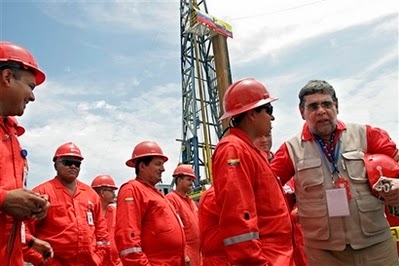
Not just oil workers but comrades in arms.
In part due to a popular game show, everyone knows the saying that "a chain is only as strong as its weak(est) link." This saying holds especially true with commodity cartels during periods of price downturns. Now is one of those periods for oil producers as the Organization of Petroleum Exporting Countries (OPEC) grapples with the possibility of protracted low prices due to a global economic slowdown and significantly increased US production. I am quite happy as an oil consumer, but the most vulnerable OPEC member, Venezuela, is not. Grappling with galloping inflation, goods shortages, high crime and generally unbearable living conditions, cratering oil prices were the last thing it needed. As such it's been calling on other OPEC members to cut production. However, the Saudis are having none of it and sent their emissary to Venezuela to silence the socialist wannabes:
Top officials from major oil producers Venezuela and Saudi Arabia held a rare bilateral meeting Wednesday as OPEC member countries grapple with a continuing price slump. Venezuelan Foreign Minister Rafael Ramirez, who until recently was head of state energy giant Petróleos de Venezuela, or PdVSA, and is the country’s OPEC representative—and Saudi Oil Minister Ali al-Naimi usually meet at scheduled gatherings. But the two convened on the sidelines of a climate conference on the Venezuelan resort island of Margarita in a sign of the pressure building up on the Organization of the Petroleum Exporting Countries amid crude oil’s price drop of more than 25% since the summer.

The two countries hold opposing attitudes toward the price slump. Venezuela’s public finances are reliant on high prices while the Saudis are reluctant to take steps to support prices by cutting its oil output. This week, Saudi Arabia lowered the price for crude sold to the U.S.—a move seen to maintain its market share for exports to the country.
Here we have a game-theoretic example of how a "sock it to the weakest link" strategy will pan out. Instead of investing proceeds when oil prices were high in improving production facilities and hence output--even with the help of (heaven forbid) foreigners--Venezuela has unwisely chosen to divert proceeds into all sorts of pseudo-socialist projects like funding an uncompetitive Formula One driver. Venezuela is an inefficient and therefore high-cost producer whose breakeven price for extraction is of a magnitude higher than Saudi Arabia's. The latter prefers to wait it out; can US shale producers with their newfangled techniques sustain themselves at these lower prices levels? The Saudis don't think so and are prepared to duke it out. Meanwhile, Venezuela is literally bankrupting itself at these selfsame levels:
During past oil-price slumps, the group has acted collectively to rein in production to support prices. This time, its influence over the market has become limited because much of the oil flooding markets comes from booming shale-oil production in the U.S. that is beyond the group’s control. That has effectively left OPEC members reluctant to cut their output in an increasingly competitive environment.

“Al-Naimi is going to explain to Ramirez that not much can be done at the moment and it is a cycle the market is going through,” said another Saudi official. Of the OPEC members, Venezuela has been the most vocal about the rapid slide in oil prices since June. Last month, it made an unheeded call for an emergency meeting of the group.

Even before prices plummeted in the summer, Venezuela was confronted with a weak economy. The steep price drop in the commodity that makes up to 96% of the Venezuela’s export revenue has compounded its economic challenges. President Nicolás Maduro has seen his popularity plummet to a record low, according to polls, as dollar shortages have led to a precipitous decline in the value of the local bolívar currency and contributed to scarcities of food and consumer goods.
While the analogy is imperfect, think of Germany and Greece in the EU. The threshold for a strong euro currency is much higher for Germany than it is for the 50-pound weakling of EMU economies, Greece. Saudi Arabia has an ulterior motive of testing the waters of American extractive efficiency. It is leaving Venezuela high and dry by making the excuse that the supply boom is due to a producer outside the cartel, but a true cartel would not just stand around and do nothing. Also see Daniel Yergin on this matter.

Even among would-be oligopolists, there are power games afoot. 

BoJ's Kuroda, Monetary Kamikaze Without a Pause

♠ Posted by Emmanuel in , at 11/06/2014 01:30:00 AM
Kuroda-san administers smelling salts to Japan's economy & asks it how many fingers he's holding up.
I have long been fascinated with the apparent disconnect between the typical Japanese comportment of apologetic politeness and their occasional bouts of banzai, devil-may-care excesses when they throw caution to the wind. Current Bank of Japan Governor Haruhiko Kuroda is a case in point. A few months ago I prepared an Asia-focused contribution to IPE stalwart Thomas Oatley and Kindred Winecoff's new edited work on international monetary relations where I discussed Kuroda's influential role in steering the Manila-based Asian Development Bank (ADB) where he was its president until being recalled by the current Liberal Democratic Party (LDP) leadership. He best embodies the duality I'm talking about: he looks like the dignified and mild-mannered career civil servant that he is, but he is also responsible for throwing the world economy off-balance by announcing even more quantitative easing to hopefully pull Japan out of its deflationary slump that's now well into its third decade.

If I were to pick a metaphor, it's the last-chance saloon for Japan monetary-wise. Having run out of bullets shooting at the deflation beast, Kuroda has now flung the revolver at it. Or, for a Japanese rather than a Western analogy, Kuroda has instructed that the cockpit of his Mitsubishi A6M Zero be welded shut as he flies his aircraft straight into the deflation beast. His career as a civil servant is at and end; the only real question is if he can slay deflation. Prior to catching world markets off-guard last week, he reiterated his commitment to staying the course despite some unwelcome economic performances:
The BoJ has been criticised lately — even by [PM Shinzo] Abe — for a possibly excessive yen depreciation. But Kuroda insisted that “yen depreciation so far has been broadly in line with fundamentals and financial conditions. And that will be beneficial to the economy.”

Japan’s export volume had been “rather flat”, Kuroda admitted, but he attributed this in part to weak external demand, especially in East Asia, where more than 50% of Japanese exports go. Much Japanese manufacturing production has also moved offshore, limiting the benefit of a cheaper yen. But the weaker currency had still helped Japan, Kuroda insisted, by raising profitability in yen terms, whether from exports or from profits remitted from overseas production.

Kuroda has been pressured to extend the March 2015 deadline for achieving his inflation target. But Kuroda made it clear he intends to stay on track. “We are still half way there —around 1.25%,” he said. “Our target is 2%, so we will continue our quantitative and qualitative easing until we achieve the target.”
Which brings us to Kuroda's kamikaze attack on deflation. The extent of money printing is humongous to be honest, and unprecedented even by the American experience:
According to an analysis in the November 3 Nihon Keizai Shimbun, when Kuroda achieves his target the BoJ balance sheet will have exploded–and liquidity forced into Japan’s (and the global economy)–to a level of over 70% of Japan’s GDP (up from 30% when Kuroda assumed his position), compared with a level of some 25% of U.S. GDP which the Fed has pledged not to exceed for the foreseeable future.  The GDP/monetary base level for the European central bank is something over 10%.
If buying every single yen's worth of Japanese government bond (JGB) issued from this day onward is what it takes, Kuroda says he will do it:
Bank of Japan chief Haruhiko Kuroda highlighted his determination to stoke inflation in the world’s third-biggest economy, saying there’s no limit to measures he could take to reach its price target.

It’s natural to act if risks to price gains become substantial, and last week’s stimulus was “a true display of the Bank’s unwavering commitment,” Kuroda said in a speech in Tokyo today. “As for measures for additional easing, I don’t think there is a limit, including on bond purchases.”
Convincing consumers and companies that he means business is critical to the central bank’s efforts to end what it calls a “deflationary mindset” in Japan. The BOJ last week surprised markets with an expansion in already-unprecedented asset-purchase program that sees it ready to buy every new bond issued by the government. 
Once more, I simply believe that the "problem" with Japan is not even in the first instance a monetary condition. For one thing, the natural tendency with a nation in the advanced stages of depopulation is for the people to hold off consumption. There is simply not enough people out there to buy all the stuff being made. Besides, people keep saving for a rainy day since they rationally expect that few young people will be around to pay into the pension system in their old age. The depopulation-deflation cycle is a vicious one, but again, it cannot be solved by purely monetary means.

The only feasible solution--the one they haven't tried yet and Japanese leaders don't address in a substantial way since it's politically contentious--remains welcoming migration in large numbers in the absence of interest among the natives in reproduction. Helicopter dropping has already runs its course, and more of the same doesn't appear to be helping at all.

Best Named Horse: 'Protectionist' Wins Melbourne Cup

♠ Posted by Emmanuel in at 11/05/2014 01:30:00 AM
Protectionist gallops to victory in Oz.
The recent results of the Melbourne Cup remind us that there is a gladiatorial quality to horse racing that we do not always appreciate. Sure, auto racing involves high speeds and hence high danger, but the interface is man and machine whereas horse racing involves man and beast. This less mechanical, more physical meld of human smarts and equine strength has proven to be appealing to punters ("gamblers" to those unfamiliar with this UK term) many decades after mechanical contraptions have well outpaced, well, one horsepower. My interest was piqued by the highly colorful name of the winning racehorse in the high stakes Melbourne Cup, a fixture on the antipodean social calendar:
German horse Protectionist, for English jockey Ryan Moore, won the Melbourne Cup but favourite Admire Rakti collapsed and died after the race. Moore guided his 7-1 chance, trained by Andreas Wohler, to a four-length win from British challenger Red Cadeaux, who was second for the third time. New Zealand runner Who Shot Thebarman was third, but the Japanese-trained Admire Rakti faded and finished last.
Perhaps the owner of Protectionist is a regular IPE Zone regular? I can only hope. An uncle of mine told me about encountering a fighting cock named Saddam [!] at his local cockpit circa 1990. Before its fateful match, the trainers were stroking it and telling Saddam to "kill the opposition." Fittingly enough given the fate of its real-life inspiration, it keeled over in its very first match.

In horse racing, though, novelty names are all the rage--the cleverer, the better. Inspired by Protectionist, here are some other names--some studly, others less so but amusing nonetheless--I much recommend to horse trainers:

10. Neoliberal - epithet used by leftists for anything vaguely smacking of the market;
9. Supply Sider - for Reaganites dreaming of America's return to its 80s form;
8. Capitalist Roader - for a cheeky retro-Maoist insult;
7. Running Dog - see (8);
6. Randian - for devoted followers of the capitalist cultist;
5. Conspiracy Theorist - for the lunatic fringe;
4. Cargo Cultist - for the third world fetishist;
3. Appeaser - for Neville Chamberlain;
2. Deflationist - for Japanese-bred racehorses; and my best recommendation...
1. Ordoliberal - for horses of German origin like Protectionist.

I suspect some horses have already used some of these names, but there are infinite possibilities. With such great possibilities, why on earth would you name your horse Admire Rakti or suchlike? Even Fusaichi Pegasus is several lengths ahead.

APEC Fight Club, US v China, FTAAP Edition

♠ Posted by Emmanuel in , at 11/04/2014 01:30:00 AM
APEC, where Pacific Rim leaders play fancy dress...and that's about it.
The Asia-Pacific Economic Cooperation (APEC) is rightly regarded as a "talk shop" that does not really have much policy impact in the region. Like the yahoos who keeps yelling "Free Bird!" at rock concerts, a recurrent--and repeatedly failed, it must be said--battle cry is establishing a free trade area within APEC. At the moment the US is having a hellishly hard time establishing a wider, US-dominated Trans-Pacific Partnership (TPP). As with the WTO Doha round, TPP negotiations are stalled as the number of would-be members increases and so does the difficulty of concluding negotiations. From a recent WSJ blog entry:
Despite a joint statement of “significant progress” from the trade ministers of 12 countries negotiating the TPP trade agreement, no one pointed to a major advance in any key issue during the recent talks in Sydney, including anything that would resolve the deadlock between the U.S. and Japan over agricultural and other barriers.
See an earlier post of mine on Japan throwing a monkey wrench into proceedings. Before continuing, let's have a brief history of failed FTAs in APEC. Sometime ago, Fred Bergsten of the Peterson Institute of International Economics was championing another idea, the (surprise!) US-led Free Trade Area of the Asia-Pacific that also got precisely nowhere:
The FTAAP idea has been actively promoted by APEC’s Business Advisory Council (ABAC)[which is dominated by Bergsten, it must be said] since 2004 as the only means by which APEC could achieve its signature Bogor goals, adopted in 1993 and reaffirmed every year since (including at Sydney), of achieving “free and open trade and investment in the region.” It has suddenly become a focal point of official activity because of major shifts in policy positions by several key member economies.

The United States took the lead in promoting the initiative, and the leaders unanimously endorsed President George W. Bush’s call to give it “serious consideration” in a speech in Singapore just before the [2006] summit. Japan welcomed the idea along with its own recent proposal for an “economic partnership agreement” among the 16 leading Asian countries (including India, which is not a member of APEC). Australia, which played a key role as chairman of APEC over the past year, reiterated its support. So did Canada and Mexico, two of the six largest APEC economies and traders, along with several of the smaller members.
Friends, there is apparently nothing new under the sun since the FTAAP idea is now being revived...by China! Whereas FTAAP used to be an American counterproposal to whatever pan-regional grouping the Chinese were proposing outside of APEC, it has now become a "Chinese" initiative after the Americans moved on to pimping the TPP expansion. It sounds ridiculous because it is...yet it is also true:
The U.S. has blocked China’s efforts to use a leaders’ summit to begin negotiations on a free-trade zone spanning the Pacific, people close to the matter said, as the world’s two largest economies tussle over influence in the region and billions of dollars in trade. China, the host of this year’s Asia-Pacific Economic Cooperation forum on Nov. 10-11, has sought to highlight its expanding international role by pressing for a pact known as the Free Trade Area of the Asia Pacific.

Beijing’s free-trade zone has been on the agenda of APEC for years—and was initially pushed by the U.S.—but has been relegated to the back burner as the U.S. has poured its efforts into the Trans-Pacific Partnership, a trade pact it is negotiating with 11 nations that include Japan but not China. For Beijing, the FTAAP would offer a way to ensure that it continues to get preferential access to some of its largest trading partners. A TPP deal would cost China about $100 billion a year in lost exports as the partners trade more among themselves and less with China, according to an estimate by the Peterson Institute for International Economics, in Washington.
China reviving the lame FTAAP idea which the Americans (like Bergsten) dreamed up anyway in order to fight the United States' current TPP expansion negotiations sounds daft IMHO. Nevertheless, I am intrigued by this "competitive vaporware" aspect to the US and China vying to ink signatures of other APEC members in an FTA of some sort. In the end, both probably know that interest among other countries is negligible, and that it's simply gamesmanship between the two in "showing" how much support they have from other members for bragging rights. Therefore, I would not take figures offered about how much China would "lose" from being frozen out of TPP seriously since its prospects for meaningful completion are low.

Rightly enough, the others correctly regard these APEC-based FTAs as the pointless exercises they are by staying away by and large.

Adios, Yanqui: Argentina Kicks Out Procter & Gamble

♠ Posted by Emmanuel in , at 11/03/2014 03:23:00 AM
Argentina sends P&G back to Cincy.
Talk about an odd fixation. There is something about the Latin left and diapers. In Venezuela nappies are a scarce luxury item which you cannot find in most stores. Apparently, the Argentinians wish to replicate this state of affairs in envy of their self-styled socialist neighbors. Even if the market for these items is not very large due to communistic excesses you are well aware of, P&G dominates--make that used to dominate--this market. Like Venezuela, Argentina has implemented draconian foreign exchange controls to stem the outflow of foreign exchange from the country. With such controls in place, multinationals have a difficult time operating.

Well, for Procter & Gamble, finding ways of serving the Argentinian market is no longer a problem from this day forward since P&G has now been accused of tax fraud and has been told to suspend operations in the country:
Argentina has accused the world's No. 1 household products maker, Procter & Gamble, of tax fraud and suspended its operations in the South American country, according to a statement issued on Sunday by the AFIP tax authority.

The accusation is that the company over-billed $138 million in imports to get money out of the country, according to the statement, which was published on Argentina's presidential website (www.prensa.argentina.ar)."P&G funneled currency abroad and hid income that was subject to tax in Argentina," it said. "We have to put an end to these tricks used by international companies," the statement added.
For a trip down the memory lane of the Latin left demonizing foreign MNCs, read the presidential office's announcement (in Spanish, of course). I would not be surprised to find out that P&G attempted to circumvent currency controls in a way Argentinian officials take offense to. Then again, I would not be surprised to find that the bulk of MNCs operating in Argentina are doing the same in using their international structures to minimize the impact of such controls. P&G, however, has the misfortune of being an American giant. In order to "set an example," who better to go after than these guys? The potential ramifications are much wider: if MNCs get the message they are not welcome and start leaving en masse, it will take both a change in administration and some time to reestablish operations in the country as its autarkic delusions take hold.

Venezuela, Argentina, Bolivia, Ecuador...the list of Latin left countries aspiring to North Korea-like isolation is astounding. Did they not get the message that the modern corporation is dying anyway and are not worth persecuting anymore? Even now, scapegoating foreigners for largely homegrown failings is still in fashion with these folks as they party like it's 1979. That is, if they are still in a mood to get down as their economies go to heck.

UPDATE: Barbie, watch out--you may be next on the hit list.

Stock Buybacks & the End of the Modern Corporation

♠ Posted by Emmanuel in at 11/03/2014 01:30:00 AM
Should you even bother protesting corporations when they're dying anyway?
A most curious phenomena occurring in the new millennium as far as businesses are concerned is the number of publicly listed firms engaging in large stock buybacks. To be sure, there is a purely "window dressing" aspect to this: by reducing the number of outstanding shares, firms' earnings per share (EPS) figures are boosted to placate shareholders. But, these buybacks also raise questions about corporate governance. That is, if companies keep buying their own stock at their current pace, then pretty soon we won't have publicly listed companies anymore. If anti-globalization protesters have long demonized MNCs for being insular and unresponsive to public pressure, wait till they aren't floated on stock exchanges as the firm as we know it evolves to the next stage.

Simon Caulkin at the FT extrapolates these trends and invites us to think of a world where the public corporation is a thing of the past. Certainly, the trend described above is already in full swing in the most sophisticated of capitalist economies, the US and the UK. Are they firms dinosaurs in this day and age?
In the anglophone world at least, the publicly quoted company has been the central institution of modern capitalism, the marshalling yard for the economy’s resources – investors’ funds from one side, entrepreneurial animal spirits from the other – for 150 years. Yet all around the globe, listed companies are dying off, if not like flies then perhaps more like other things no longer suited to their environment – dinosaurs, say. 
Nor is it likely to be a temporary trend:
Could this be temporary, with normal service resumed once business has finally recovered after the crash? It seems unlikely. First, the decline in quoted numbers started around the millennium, well before the financial crisis. Second, although the shrinkage is worldwide, it is greatest – nearly 50 per cent since the high point in 1998 – in the economies most attuned to the stock market: the US and the UK. Third, unlike their 20th-century predecessors, today’s new companies have little appetite for public capital. At Google, Facebook or Apple, intangible assets dwarf tangibles, which mostly consist of offices and computers, rather than capital-intensive production plants. These companies do not even need to own them.

In fact, companies are using the stock market less and less to raise capital for productive ends, instead employing it for the opposite reason: retiring equity capital via share buybacks running at a staggering 2-3 per cent of gross domestic product, according to City economist Andrew Smithers.
Like nearly everything else, the joint stock corporation probably does not have an infinite lifespan:
If this is right, we are witnessing not just a blip but the start of a historic shift. This is the view of the University of Michigan’s Professor Gerald Davis, who in a 2013 article, “After the Corporation”, described the public corporation, at least in the US, as a “distinctly 20th century phenomenon” that had been rendered “unnecessary for production, unsuited for stable employment and the provision of social welfare services, and incapable of providing a reliable long-term return on investment”. The consequences are already visible in declining employment prospects, rising insecurity and inequality, and endangered retirement and (in the US) health benefits, as well as indirectly in social pressures emanating from the likes of the Occupy movement.
Gerald Davis has an interesting article discussing this phenomenon at greater length. For left-leaning folks, he offers the more sanguine view that the coming end of the corporation should usher in more inclusive forms of social organization. Here is its abstract:
Shareholder-owned corporations were the central pillars of the US economy in the twentieth century. Due to the success of the shareholder value movement and the widespread “Nikefication” of production [firms being mere brands as opposed to having tangible manufacturing facilities], however, public corporations have become less concentrated, less integrated, less interconnected at the top, shorter-lived, and less prevalent since the turn of the twenty-first century, and there is reason to expect that their significance will continue to dwindle. We are left with both pathologies (heightened inequality, lower mobility, and a fragmented social safety net) and new technologies suitable for being repurposed in more democratic forms. Local solutions for producing, distributing, and sharing can provide functional alternatives to corporations for both production and employment; what is needed is the social organization to match the tools that we already have, or will have shortly. The time for democratic local economic forms prophesied by generations of activists may finally be at hand.
Should globophobes cheer on the death of the corporation as we know it? I think it's too early for them to rejoice since the alternative--the non-listed entity--will likely be more insulated from public pressure emanating from being a publicly listed company. Caveat emptor, then, for both lovers and haters of big businesses alike. Even if the shape of things to come is not yet definite, we at least know change is a-coming.