Wednesday, October 31, 2007

Chinese Bank Expands...in Africa

This one caught me somewhat by surprise. I've already coined the term "Yellow Man's Burden" to describe the activities of China in Africa which some say smack of neo-colonialism: tied aid and all that. Well, here's a counterpoint care of columnist Bill Pesek over at Bloomberg. According to him, the world's largest bank by market capitalization, ICBC, is now setting its sights on the African financial services market as a purely business--not political--play:

It's rare that a business deal intrigues investors and political scientists alike. Industrial & Commercial Bank of China Ltd.'s move to buy 20 percent of Africa's largest bank is such a transaction.

It's the biggest overseas investment by a Chinese company, in this case the world's No. 1 bank by market value. ICBC's $5.6 billion purchase of the Standard Bank Group Ltd. stake is the largest in South Africa since apartheid ended in 1994.

Yet there's something even bigger at play here. This is arguably the first Chinese investment in Africa that doesn't carry a whiff of political strategy. Nor is it directly related to China's desire for resources, which can often help despots more than African households.

ICBC's Standard Bank deal may be the watershed that begins propelling China's designs on Africa from talk to just plain business, and smart business at that.

``From the regulators' point of view, this kind of diversification is a great idea,'' says Michael Pettis, a finance professor at Peking University. ``Chinese banks are too highly concentrated in China and it's not in their best interest that banks depend exclusively on Chinese growth. That kind of dependence is highly pro-cyclical and can feed booms and busts.''

Standard Bank has offices in 18 African countries, including Nigeria and Kenya, and 21 other nations such as Argentina and Taiwan. The Johannesburg-based bank has 713 branches in South Africa and 240 throughout the continent. The deal is a sign that even if the Chinese Communist Party has strategic reasons for investing in Africa, companies are heading there for the economic potential...

ICBC's stake in Standard Bank comes without that kind of baggage. It's a state-controlled China bank, making it hard to figure out where politics end and business begins. Yet the deal shows China is now making bets on Africa's economy.

Standard Bank is gaining access to the fastest-growing major economy and fattening its capital base. China is getting a foothold into Africa's nascent investment-banking and insurance industries. It's also a way for China to use its growing cash piles overseas rather than making fresh domestic loans that may go bad or fuel inflation.

All this is stellar news for Africa, which usually suffers from the ``paradox of plenty.'' All too often, inhabitants of resource-rich nations fail to prosper while corrupt politicians and their cronies get wealthy and ignore the development needs of the struggling masses.

That has been Africa's experience for far too long. And the failure of Western efforts to reverse the dynamic left the region's leaders open to Chinese investment.

One interesting element of ICBC's deal is how different it is from the usual overture from Western banks. It didn't come laden with demands about how much control ICBC will have over Standard Bank. It didn't require pledges for financial change. It's merely one bank buying a piece of another with transparent terms and conditions. It's a sign Chinese managers are willing to treat Africans as peers.

The West hasn't learned that lesson with its aid programs and lecturing. By trying a new tack, China may be testing what development economists have argued for years: Africa doesn't need more aid, it needs more genuine investment and trade.

Bono and Columbia University's Jeffrey Sachs will keep plugging away, and thank the gods for that. But Chinese companies appear to see something in Africa many in New York, London and Tokyo don't. Africa represents huge and lucrative business opportunities if it gets its act together.

That's a big ``if.'' With the exception of Botswana and Ghana, Africa's biggest consistency seems to be to pull the rug out from under wide-eyed investors. China's interests are offering Africa a rare opportunity to boost its economies.

Another interesting angle here concerns investors. Looking at ICBC along with other Chinese deals of late -- like Citic Securities Co. buying a stake in Bear Stearns Cos. -- it's clear something transformational is afoot.

In recent years, China sought foreign investments in financial firms to shore up capital and gain expertise. Now, cash-rich from trade, stock offerings and surging share prices, China no longer needs Wall Street's money. Increasingly, it's foreigners who want a cut of China's money.

``Getting access to China's market may no longer require putting money in China,'' says Brad Setser, director of research at Roubini Global Economics LLC in New York. ``It may instead require accepting investment from China.''

China may have just found a way to tame its own pressures and tap Africa without the baggage of the past.

Birth Defects and Pollution in China

What is the price of pollution-powered progress? The answer, according to Chinese authorities, includes a rise in birth rate defects likely tied to greater air pollution. In particular, China's boom in coal mines needs to be singled out. You often hear about an environmental Kuznets curve where development is initially accompanied by rising levels of pollution as development progresses but tapers off at later stages once folks become more cognizant of environmental issues. The common worry is that a totalitarian government like China's would not allow such concerns to be voiced. See the example of local authorities jailing an environmentalist for pointing out flagrant pollution. From Agence France Presse:

Birth defects in heavily polluted China have increased by nearly 40 percent since 2001, with a deformed baby born every 30 seconds, state media reported on Tuesday.The rate of defects appeared to increase near the country's countless coal mines, which produce the bulk of China's energy but are also responsible for serious air and water pollution, the China Daily newspaper said, quoting government officials.

Birth defects nationwide have increased from 104.9 per 10,000 births in 2001 to 145.5 last year, it said, citing a report by the National Population and Family Planning Commission.They affect about one million of the 20 million babies born every year, with about 300,000 babies suffering from "visible deformities.""A baby with birth defects is born every 30 seconds in China and the situation has worsened year by year," said Jiang Fan, deputy head of the commission and author of the report.

About 30-40 percent of the deformed children born each year die shortly after birth.There is a correlation between birth defects and proximity to environmentally degraded areas, said An Huanxiao, head of family planning in the heavily polluted northern province of Shanxi, source of much of the nation's coal. Shanxi tops the nation in birth defects, Xinhua said. A correlation can also be drawn with parents' poverty and low education, An was quoted as saying. China suffers from serious pollution, the price of its stunning economic rise, with air quality in major cities regularly exceeding danger levels and millions of people lacking access to clean water.

Lay Back and Think of, er, Oil

You may have heard of the "peak oil" theory that petroleum supplies have reached or will soon reach their peak and are set for a long decline. This International Herald Tribune story says otherwise and cites many energy industry experts who point out that there are jillions of barrels yet to be extracted. One of them is Daniel Yergin, author of The Prize, so I am inclined to believe that there's some truth to this story. To them, availability is not an issue but of geopolitics and the economics of extracting the oil. What about alternative energy sources? While they may be less polluting, many believe that their cost-benefit ratios work against their favor. In other words, TINA--there is no alternative (to oil):

Energy demand is surging as robust growth in developing economies offsets slower demand in the West. At the same time the scientific warnings are becoming ever starker over the global warming caused by more carbon emissions from fossil fuels.

Interest in alternative, sustainable energy sources has never been stronger. Yet, despite accelerating investment, the output capacity of these energy forms remains barely more than embryonic. Fossil fuels, reliable and accessible, will continue to provide more than 90 percent of global commercial energy needs to 2030, according to the Organization of Petroleum Exporting Countries.

Leo Drollas, an executive director at the Center for Global Energy Studies in London, shares the assessment. "Oil will be the world's most important energy source for some time," he said. "Many times we hear that it's the end of oil, it's the end of the world. It's never happened."

Oil provides about 40 percent of the world's primary energy, according to both OPEC, the exporter's cartel, and the International Energy Agency, in Paris, which advises consumer governments.

Another 20 percent comes from natural gas, with the remainder coming mainly from coal, with relatively minor inputs from nuclear, biomass, hydro-power and other renewable sources. By 2030, oil's share in the energy mix will barely have declined, to 36.5 percent, according to OPEC. Similar forecasts have been made by Washington...

In July, the International Energy Agency forecast that global oil demand would rise by an average 2.2 percent a year to 2012. Production slowdowns, it said, could lead to a supply crunch as OPEC's spare capacity dwindled.

Looking farther ahead, the U.S. Energy Information Administration, in its international energy outlook published this year, predicted a 58 percent rise in
oil consumption from 2004 to 2030, to 118 million barrels per day. To feed
consumption, it projected that production would increase by 34 million barrels
per day over the period.

Demand is being led by transportation, factories in developing countries and U.S. consumers. Energy consumption in less-advanced economies should grow 2.6 percent a year through 2030, the energy administration forecast. In the developed world, where consumption growth fell last year for the first time since the early 1980s, energy use is projected to grow 0.8 percent a year.

There is a caveat to such projections: China, which has leapfrogged Japan to become the second largest user behind the United States, heavily subsidizes oil - as does India [see supply problems related to subsidies in China]. Demand could moderate if those governments should decide that their consumers must pay more.

With that in mind, gauging the remaining viable life span of the world's oil reservoirs is one of the most vexing questions in energy policy.

"You can arrive at any number of estimates," Drollas said. "What counts is not estimates but what's extracted. And here, factors like investment, economics, recovery rates and technology come in."

"Reserves" are usually classed as oil in a reservoir that can be extracted at a specific assumed cost.

Estimates of global proven reserves are constantly revised; for example 157 billion barrels at the end of 1954 became 1.317 trillion barrels as of January, according to Oil & Gas Journal. At current rates of extraction, those would last 42 years, Drollas said.

According to the journal, 56 percent of proven reserves are in the Middle East. Since 2000, the largest net increase has been in Canada, with the addition of 174 billion barrels from oil sands. Iran and Kazakhstan have also had upward revisions.

"It's not that the oil's not there," said Paul Stevens, professor at the University of Dundee in Scotland. "It's whether there's the investment to get it out. The issues are geopolitical and economic."

The largest reservoirs, or "super giants," are the cheapest to develop, in terms of cost per barrel. But the last true super giants were discovered in 1967 and 1968, according to a paper by Robert Hirsch, Roger Bezdek and Robert Wendling that has become seminal to "peak oil" theorists, who argue that reserves will soon peak at a maximum production rate, and decline thereafter.

The 2005 paper, "Peaking of World Oil Production" collated estimated dates for the peak, ranging from last year to beyond 2025. It concluded that government intervention to slow demand was required, "because the economic and social implications of oil peaking would otherwise be chaotic."

Peak oil theory is controversial. A study released last November by Cambridge Energy Research Associates, a U.S. consultancy, estimated the remaining oil base at 3.74 trillion barrels, well above peak theorists' estimates.

There have been significant recent discoveries, in Kashagan and Tengiz in Kazakhstan, Angola, Brazil, Rajasthan and the Gulf of Guinea.

But, as the easiest oil reservoirs have been found, the major oil companies have had to invest in increasingly inaccessible sites, like the Arctic Ocean, or in expensive forms, like shale.

The scarcity of rigs, other equipment and engineers, alongside the nationalism in producer countries like Venezuela and Russia, and the scramble for deals by the state oil importers in China and India, have all combined to create a sense of an industry on the edge.

Still, "this is the fifth time that the world is said to be running out of oil," said Yergin, the chairman of Cambridge Energy. Each time, "technology and the opening of new frontier areas has banished the specter of decline. There's no reason to think that technology is finished this time."

Although the drawdown on reserves should make for a more expensive barrel, and oil's climb toward $100 per barrel has appeared to add weight to the argument, prices tend not to follow consensus for long. Fundamentals of supply lead prices for a while, then economics or geopolitics takes over.

Many current oil bulls may forget that prices were below $10 a barrel as recently as 1999, when the Asian financial crisis crimped demand. The world was awash in oil, reports said at the time, and several hundred million barrels of oil were said to be "hiding," waiting for prices to rise...

Stevens, of the University of Dundee, said the most likely scenario in the next five to 15 years was for oil to stay above a floor of $60 a barrel. Ultimately, that will trigger a demand response, as the price trims consumption in China and India and as biofuels win market share. At that point, the floor might be tested.

In April, a UBS economist, Jan Stuart, estimated a long-term price of $50, below which oil would fail to yield returns that would encourage investment in production capacity growth. HSBC has a similar long-term forecast. Its analysts, Paul Spedding and David Phillips, have just raised their 2010 forecast to $55 from $47, which "should preserve oil's competitive position in the energy stakes, slowing competition from natural gas and coal." "It should also be sufficient to meet the financial needs of most OPEC countries," they said.

Within the exporter group, there are differences on pricing strategy. Those with large reserves, especially Saudi Arabia, want crude to remain competitive. But the majority are keen for prices to stay above $50 as their own consumption - mostly heavily subsidized - expands and they become increasingly reliant on oil and gas revenue to feed budgets swollen by development and demographic pressures.

UBS estimates the "breakeven" price for major producers in a range from $23 for Kuwait to between $50 and $55 in Venezuela, where production costs are high, and Iran, which has a big population relative to production and reserves.

Whatever the price, the role of OPEC is in flux, altered by unconventional resources and the emergence of Russia and Mexico as major global suppliers. According to the Energy Information Administration in Washington, the OPEC producers' share of world oil supply fell to 41 percent by 2004, from 52 percent in 1973.

According to the Oil & Gas Journal, Canadian oil sands now represent 50 percent to 70 percent of reserves that are not off-limits to international oil companies because of government restrictions on operators. Canada is a welcoming and stable host - but production is expensive and twice as energy-intensive as normal oil extraction because of the energy needed to separate the bitumen from the surrounding sand.

Will other fuels to step in to meet demand?

According to estimates by Goldman Sachs, nonconventional fuels like oil sands and shale, ethanol and biomass liquids, coal and natural gas will meet 3.5 percent of demand by 2015, up from 2.8 percent in 2006, and the share could rise to 10.6 percent by 2030. That is a considerable change, but not enough to plug the oil wells.

In recent decades, more processes have emerged to synthesize liquid hydrocarbons from natural gas and coal. There is no shortage of supply - 65 years of proven gas reserves and 150 years for coal, compared with 40 years for oil, according to BP - but it means using one high-emission fossil fuel to create another.

After oil, coal is the No. 2 source of energy. Growth is driven mainly by developing countries; every week to 10 days, a coal-fired power plant opens in China. But coal combustion needs rail, water and power lines, and it also produces more carbon dioxide per unit of energy than oil from conventional sources.

Projects that convert natural gas to petroleum products, like Shell's Pearl project in Qatar, have proved more complex and expensive than planned. The same is true of so-called coal-to-liquids, although analysts suggest that this may be a feasible option for China, given that country's vast coal reserves, modest capital cost assumptions and soaring demand for oil.

In terms of renewable sources, there have been bold steps by governments, including an EU plan to generate 20 percent of all EU energy from renewable sources by 2020.

The largest nonfossil energy source is biomass. Liquid fuels from biomass - mainly ethanol - have grown but still contribute only about 1 percent of the energy provided by oil. Wind and solar energy produce about 1 percent of the world's energy, a share that U.S. government forecasters predict will rise modestly.

Hydro power, which supplies about 2 percent of world energy, is not likely to grow significantly, outside of China and other developing Asia-Pacific areas. Nuclear power contributes about 6 percent of energy, and could expand its share if concerns over safety, security and waste disposal can be overcome.

In all of these areas, there will be advances. But squaring the needs of global economic growth with the imperative of curbing global warming will also depend on major long-term changes in consumption behavior.

Meanwhile, oil's pride of place looks assured. Prices will rise and fall, reserves will run dry and be discovered. But the thirst will continue, and will continue to be quenched.

Tuesday, October 30, 2007

Dubai Dreamscapes & Nightmares

Ah, the wonder that is Dubai. Not only is the emirate reaching for the heavens with towering skyscrapers including one set to be the world's tallest, but it is also attempting to offer any sort of weather condition you want with indoor skiing and man-made beach islands. Pretty much any material thing your heart desires--and your pocketbook will allow--is available in Dubai. But, behind this modern-day tale of an economic boom lie many questions about what exactly is driving it. The Washington Post had a fine politico-architectural commentary [!--read it; I'm not kidding] about the place over the weekend, a brief snippet which I attach here:

But merely listing projects, or marveling at the architectural gigantism, doesn't get at what is unique about the emirates, which are emerging as the world's great post-democratic cities. They are rising at a time when American power seems to be in remission, when democracy has, in many parts of the world, lost its luster as an ideal, or necessary endpoint of social and political development. Material splendor and authoritarian government can, it turns out, go together. And architecturally, despite all the dissonance, the strange juxtapositions of the vulgar and the sleek, the blue-chip buildings next to the shabby high-rise clad in garishly colored glass and surmounted by a pagoda folly, the emirates are essentially an advertisement to an increasingly wowed world: Look at what enlightened, corporate, efficient and non-democratic government can do...

Which hints at a deeper politics underneath the architectural eclecticism. Like the vast investment in shopping malls, the celebration of materialism, the encouragement of unashamedly conspicuous consumption, architectural eclecticism is another way of reassuring people that you have everything you need here. The state has provided. The government doesn't just build mega-projects as investment, but to demonstrate competence, power and problem-solving. The striking thing about the hundreds of concrete support pillars that have sprung up in recent months along Sheik Zayed highway -- which will support a new light rail system -- is how quickly they're going up. The delays, the disputes, the litigation, the whole messy business of "Not in My Back Yard" simply doesn't exist in the country.

"Dubai is the achievement of a certain fantasy or utopia, of a society in which the corporations, private ownership and the state are all collapsed into one another," says Mike Davis, who has written about Dubai in the recently published "Evil Paradises: Dreamworlds of Neoliberalism." The book, definitely in the left-wing tradition, surveys urban planning, social justice, environmental destruction and other issues in emergent and rapidly developing cities around the world. Whereas people in the Emirates argue that they are blazing a progressive path forward relative to other Arab and regional nations, Davis writes that Dubai is pointing the rest of the world back to "a nightmare of the past: Speer meets Disney on the shores of Araby."

Dubai is even aiming to take on the City of London as a global financial center according to the Telegraph. Goodness knows what would happen if all those petrodollars went to Dubai instead of London--not an unimaginable scenario:

With a regional tide of petrodollars waiting to be deployed around the globe, Dubai's objective is simple: to establish itself as one of the world's leading financial centres.

"We aim to become one of the top three exchange groups in the world in the international capital markets," according to a spokesman for Borse Dubai, the holding company of the Dubai International Financial Exchange (DIFX) and its domestic counterpart, the Dubai Financial Market...

The Middle East's pan-regional boom looks well-set to play into Dubai's hands. Huge sovereign wealth funds amassed by neighbouring states such as Abu Dhabi and Qatar are contributing to the wall of capital which has turned the Gulf into one of the most formidable global centres for outbound mergers and acquisitions activity...

But there are reasons to suspect that Borse Dubai's long-term goal of becoming a top-three exchange group may have a touch of the desert mirage about it — or that, at least, it may take even longer to achieve than the state's ambitious rulers are hoping for.

The evidence of the period since the DIFX's September 2005 launch suggests it will take more than opera singers and snow in the desert to tempt large international companies to Dubai.

So far, only a handful have chosen to list there: in terms of trading volumes and funds raised, Dubai is not yet playing in the same league as London, New York or even Shanghai.

Data from Thomson Financial shows that, last year, IPOs in Dubai raised just $2.3bn, barely one-sixth of the total of London's junior AIM market.

While the amount of capital raised through equity offerings is only one measure of an exchange's success, the figures suggest the DIFX has a long road to travel to compete with more mature capital markets.

Big money and all these palaces in the sky bring up the natural question, "Who puts up these architectural wonders in this playground for the wealthy?" The answer is less heartening: South Asian workers who are largely sealed off from the wonders of Dubai--that's who. It is no exaggeration to say that they are being treated as second-class citizens for they have no path to eventual citizenship in the UAE, as with most Middle East countries. While the government claims that it is attempting to better relations with these workers, such doesn't seem to be the case as a number of them have gone on strike. [Hat tip Daniel Altman.] The caption of a picture of police watching South Asian workers on Altmans's blog is apt: "Soldiers won't build those skyscrapers." From the Associated Press:
Thousands of foreign construction workers, mostly of south Asian origin, went on strike Sunday over harsh working conditions in this booming Gulf city, a day after the government threatened to deport those who had rioted over low and delayed salaries.

Inexpensive foreign labor, drawn from the impoverished underclasses of India, Pakistan and Bangladesh, form the vital underpinnings to Dubai's spectacular building boom, which includes not just soaring office towers and sprawling residential compounds but whole artificial islands and winter ski resorts in this desert city.

The workers, however, have complained about long hours, no minimum wage, harsh living conditions and no legal forums in which to air their complaints about management.

Despite the illegality of strikes in the United Arab Emirates, the laborers refused to go to work over the weekend and protested in the labor camp of Dubai's Jebel Ali Industrial Zone and on a construction site in Al Qusais, a residential neighborhood.

They demanded pay increases, improved housing and better transportation services to construction sites. Some workers threw stones at riot police that heavily outnumbered the protesters on Saturday. Ali bin Abdullah al-Kaabi, the Emirates' minister of labor, described the workers' behavior to the state news agency WAM as "uncivilized."

UPDATE 11/2: The Economist adds that the workers are unhappy about the falling value of the dirham, which is of course pegged to the falling US dollar.

"Chinese stocks fairly valued, really"

Which of the following is the world's largest bank by market capitalization?
(a) Citigroup
(b) Dai-Ichi Kangyo Bank
(c) Industrial and Commercial Bank of China
(d) Bank of America

You may be surprised to know that (c) ICBC, is the correct answer. Given the incredible run-up in Chinese bourses, it was bound to happen sooner or later. In addition, you may know the reason why I threw in (b) Dai-Ichi Kangyo Bank in there as well--in 1986, the Japanese bank had surpassed what was then known as Citibank as the world's largest bank in terms of assets. So, is it the same old, same old with China instead of Japan as the flavor of the decade? The following article from Reuters argues no, and gives further reasons as to why Chinese stocks are fairly valued despite their pricey valuations. Basically, it boils down to "China is such a whopping huge market that growth opportunities are humongous."

I'm not so sure about that. Certainly there's a bubbly element to these proceedings as Chinese retail investors have no choice but to stick with local markets for there are limited opportunities to invest abroad. Still, there are many tidbits you can pick up. Did you know that SAIC Motors now has a larger market capitalization than General Motors? Like when Japan was poised to rule the roost according to some, there are many Chinese firms appearing on the scene. Did you know that PetroChina now has the second largest oil market capitalization in the world?

China has the world's largest commercial bank, its biggest aluminum maker, its No. 2 oil firm and its fourth-largest investment bank. It has five of the world's 10 biggest companies, versus three for the United States.

Never mind that outside their home markets, the companies' business operations are dwarfed in size and sophistication by Western and Japanese giants.

Soaring prices on the Shanghai Stock Exchange have propelled listed Chinese firms' capitalizations -- including shares held by government and institutional investors that have not yet become freely traded -- to the top of global tables.

For some investors, particularly foreigners, that's a sign Chinese share prices are ludicrously high [count me in].

But with China's economy on track for its fifth consecutive year of double-digit percentage growth, the market is simply looking farther into the future to value stocks, others say. And that future justifies such prices -- except perhaps for resource stocks.

"The current A-share bull run is very similar to what happened previously in Japan, Korea and Taiwan," when those economies and markets took off in the 1980s and 1990s, says Miao Junwei, CEO of ABN AMRO TEDA Fund Management.

Shanghai's stock market is up five-fold since the start of 2006. It is trading at above 40 times projected earnings for this year, dwarfing the S&P 500's 16 times. But it is still well below the 70-plus hit by Taipei at its peak in 1990, for example.

While the yuan currency keeps appreciating against the dollar and profit growth remains strong -- and there's no sign of this changing -- many blue-chip prices may continue climbing, and an extended pull-back is unlikely, Miao believes.

Take Industrial and Commercial Bank of China (ICBC), the country's biggest bank. When ICBC overtook Citigroup as the world's largest bank by capitalization in late July, it was seen as an especially absurd sign of a bubble.

Citigroup, one of the world's most sophisticated financial institutions with operations around the globe, posted net profit of $21.5 billion last year, over three times profits at ICBC, a state-controlled behemoth that is trying to modernize itself and operates almost entirely inside China.

But there's method behind the madness. ICBC has a network of around 17,000 branches across China. Citigroup, with more than a dozen Chinese branches, incorporated locally this year and entered the yuan retail banking sector, but it is unlikely ever to have a Chinese network approaching CIBA's.

The Chinese bank's earnings may grow faster than Citigroup's for years. ICBC announced a 76 percent jump in third-quarter profit last week, while Citigroup's third-quarter net fell 57 percent, partly because of exposure to the U.S. subprime loan crisis.

China's United Securities analyst Ge Jinbo estimates ICBC's profits will keep rising strongly on the back of China's economic expansion, which should produce national loan growth of about 10 percent a year, and surging non-interest income as it diversifies into areas such as insurance and investment banking.

"ICBC's earnings are expected to catch up with Citigroup's by 2010," he wrote in an article this month, predicting annual profit growth of about 35 percent in the next few years.

ICBC, which now has a market capitalization above $300 billion against Citigroup's $212 billion, also has plenty of money to grow through acquisitions. Last week it said it was buying 20 percent of South Africa's Standard Bank Group for $5.6 billion, the largest foreign investment in Africa.

ICBC's relatively backward retail banking operation could actually help earnings grow, as the bank takes modernizing steps that Citigroup and other Western banks took long ago.

Acquisitions may spur growth of China's blue chips in the next few years. At home, the government wants to consolidate industries to improve efficiency, and Beijing is encouraging investment abroad as it seeks access to resources and markets.

Another positive factor may persist for a year or two -- injections of major assets into listed firms by their state parents.

SAIC Motor quadrupled its earnings this year, and rocketed to become the world's ninth largest auto maker by capitalization, exceeding General Motors, by obtaining manufacturing ventures from its parent in a $2.4 billion deal.

The government now appears to be grooming SAIC as a "national car champion" by encouraging mergers with other local players.

In general, fund managers argue stocks related to consumer spending growth may deserve their high valuations. Lower labor costs, first-mover advantages and huge local networks of branches and customers may help these firms beat foreign competition.

Fund managers are most skeptical about valuations in the resources sector. Oil giant PetroChina, for example, which last week raised $8.9 billion in a Shanghai share offer, is now the world's second largest oil firm by market value, second only to Exxon Mobil.

In contrast to consumer stocks, resource firms' margins are in the long run expected to depend mainly on the cost at which they can obtain their raw material from abroad, while the global commodities markets mean they are unlikely to get away with charging their customers any premium.

"I really don't understand why China's resource firms should command such high premiums to their overseas peers," a senior portfolio manager at a major Chinese house said.

"PetroChina, like its foreign counterparts, sells its crude oil at international market prices and it does not hold any advantage in terms of reserve replacement."

China Pushes for FTAs w/ ASEAN

Talk about noodle bowl arrangements galore between China and the ASEAN member countries. Not only is China seeking individual pacts with various ASEAN members, but it is also seeking a regional FTA with ASEAN. With the stalling of the WTO Doha Round, can we expect to see more of these bilateral and regional deals? It seems many countries are still keen on establishing trading ties despite pessimism on a global deal. WTO, we hardly knew ye? From Radio Singapore International:

China and ASEAN, should continue to step up dialogue on investment policies and work towards an early conclusion on establishing a free-trade area investment agreement. Chinese Vice-Premier Zeng Pei Yan made the call at the start of the Fourth China-ASEAN Business and Investment Summit yesterday. Trade between China and its southern neighbours grew to almost US$160 billion last year. China is expected to establish free trade pacts with Singapore, Brunei, Malaysia, Indonesia, Thailand and the Philippines by 2010.

Dr Sarah Tong, an economist from the National University of Singapore’s East Asia Institute, tells Michael Tan that a major shipping hub like Singapore will benefit from greater China -Asean economic cooperation.

ST: I think Singapore is a very efficient and important shipping hub and it does have a very important role to play in this respect. Particularly, I think this is one of the most obvious and strong comparative advantages of Singapore among ASEAN members and in the relationship with China, that will be a very important part because China - ASEAN trade within the region has become very significant. For example, components and parts, maturity of the import and export of the region are from the region so a trading hub will be essential for these closer economic relations between China and ASEAN.

China is expected to establish free trade pacts with several ASEAN countries in 2010. How is a free trade pact with China expected to benefit South-east Asian nations like Singapore?

ST: Well, I think among the ASEAN members, each member is very different in terms of their structure, industrial structure, economic structure, so they’re going to benefit in different aspects. For a country like Singapore, which is, in terms of manufacturing, playing a relatively small part in the over-all economy, and also the manufacturers are a bit more up-scale, more technologically sophisticated, in which case it doesn’t have as much direct competition with the Chinese industries, so in which case there is a lot more complementarities between the two in terms of manufacturing. And Singapore also has strengths in research and development and in high-tech products, in which case, closer relations or more trade and cross-over investments between the two countries will benefit tremendously for both.


And what would you say needs to be done to ensure a profitable partner-ship here?

ST: Well, I think the countries and the members on both parts have been pushing forward in increasingly positive aspects which is important for anything to be profitable and beneficial. Both parties, ASEAN and China, I think it’s more important to have a positive and long-term prospect and also having more dialogue which increases the understanding of both the strengths and the advantages and disadvantages of each party, understanding, and mutually respecting. I think that’s the way to go.

Chinese Vice-Premier Zeng Pei Yan has called for an early conclusion of talks on a China - ASEAN free trade area investment agreement. What is the likelihood that dialogue of this nature reaches fruition?

ST: I think relative to the free trade area, investment agreements probably vary more widely in terms of involving more broad areas, so it’s probably a little bit more difficult, relative to just product trade. I think the important thing is not the speed of how fast you can complete something, but rather to have more transparent, deeper understanding and more meaningful and effective dialogue and agreements. I’m not sure how long that will take, but I think it’s probably more difficult for an investment agreement to be reached because it does involve a lot more parties and areas.

Monday, October 29, 2007

EU Steelmakers Call for China Tariffs

This story is a follow-up to a more extensive feature I had on aggrieved Western steelmakers crying foul over China's allegedly subsidized steel exports. It's a noteworthy dispute with EU steel users conflicting with EU steelmakers who are now pressing for China sanctions. Let us recall the side of the EU steel users before proceeding to today's story of metallic woe:

European Union steel users sought on Tuesday to counter growing calls by many EU steelmakers for trade barriers against imports from China, saying such measures could drive the industry out of the bloc.

European steel executives meeting in Berlin on Monday said they might ask as soon as this month for EU anti-dumping duties against China's fast-growing imports which they say benefit from massive state subsidies.

But European engineering association Orgalime, representing national groups whose members include big steel consumers such as Siemens , ABB, and Alcatel-Lucent plus many smaller firms, said China is now vital to the sector.

Orgalime Secretary General Adrian Harris said it did not make sense to hurt the EU's metalworking and mechanical engineering sector which employs over 7 million Europeans to protect steelmakers who provide only 250,000 jobs in Europe.

"For us matters are simple -- our companies must have access to the supplies of steel they need at competitive market conditions," Harris said in a statement.

The basic reasoning of EU steel users is that EU steelmakers don't produce enough steel to meet their needs, and hence need supplies from China. If sanctions were to be applied, EU steel users believe they would be unfairly penalized. With that in mind, on to the steelmaker's case (and more) care of the International Herald Tribune. It's going to be interesting to see what the EU makes of the steelmaker's request. With EU Trade Commissioner Peter Mandelson already striking a less than conciliatory tone towards China, expect sparks coming from this direction. Trade wars against China all around are looming:
European steel makers fired the opening shot Monday in a looming trade war with China, asking the European Commission to impose tariffs on soaring imports, which they say are being dumped on the market at prices hugely below cost.

The request sets the scene for a debate likely to divide European governments, as steel makers and companies reliant on cheap imports fight out of their respective corners.

The European Commission will investigate the complaint and could impose provisional measures on Chinese imports within nine months. The steel makers have requested duties of 25 percent to 40 percent on cold-rolled and galvanized steel, which are typically used in engineering and construction work.

The call for countermeasures is likely to be backed strongly by several South European countries and Germany but opposed by countries more committed to free trade like Britain and the Nordic countries.

Divisions within the European industry were apparent within hours of the complaint being lodged. Gordon Moffat, director general of the European Confederation of Iron and Steel Industries, or Eurofer, said Chinese output was "out of control" and talks with Beijing have failed to cap overcapacity.

Eurofer said exports of the products concerned had "inundated the EU market," following exponential export surges into the market by up to 3,300 percent over the past four years.

"Massive volumes have been dumped on the EU market at dumping margins of up to 40 percent. EU domestic prices have been undercut by up to 25 percent," Eurofer said in a statement.

But Adrian Harris, the secretary general of Orgalime, which represents the engineering industry, said that its members were already having difficulty sourcing raw materials including steel.

The key to the commission's decision is the likely effect of any countermeasures on the overall European economy.

Orgalime says that 250,000 jobs in Europe depend on steel making, as opposed to 7 million in metalworking and mechanical engineering, which use imports.

Those figures are disputed by Eurofer, which says that steel making employs 372,000 directly and a further 1 million indirectly. Moreover, the antidumping request was aimed at specific products to avoid harming consumers, Moffat said.

The extent to which some manufacturers are already dependent on imported Chinese steel makes the case a particularly delicate one for Peter Mandelson, the European trade commissioner. He recently confided in an internal document that a conciliatory approach to Beijing on trade was not yielding results and suggested that greater use should be made of trade defense instruments.

He will have to determine first whether dumped imports are injuring European
steel producers and then if countermeasures are in the EU's overall interests.

Though the price of steel is relatively high, making it harder to argue that European steel makers are suffering, Mandelson will also have to consider whether a further surge of imports is likely to follow when construction for the Beijing Olympics is completed. This work is currently soaking up Chinese production, which could be redirected to Europe.

Because of market sensitivities, the commission said that it could not formally confirm receipt of the request from Eurofer. But Peter Power, spokesman for Mandelson, said that any such demand would be investigated thoroughly. "It is bound to be a very sensitive and complex case as there is so much at stake," he added.

The commission's decision will ultimately need approval from EU member states and could be challenged by Beijing at the World Trade Organization.

Moffat said that the entire Chinese steel industry is built on subsidy.

"Everything from soft loans from state-owned banks to support from regional banks to tax holidays," he said.

Steel imports from China from January to September 2007 grew 137 percent to 8.9 million metric tons from the same period last year. Meanwhile, the European trade gap with China widened by nearly 25 percent in the first seven months of this year.

But Harris of Orgalime said that some members of the engineering industry already planned to argue against the imposition of tariffs.

"We find ourselves in a situation of strong growth in our industry, and our members are finding a shortage of raw materials," Harris said, arguing that "there is perhaps a tendency to look over one's shoulder at the past and not to the future."

The number employed in European steel making was "peanuts" compared to those reliant on imported steel, he said.

On Alleged Chinese Scholar-Spies

I usually roll my eyes when I see these sorts of stories concerning Chinese nationals studying and working abroad ferreting trade secrets at the behest of the Communist Party. Too much James Bond cloak-and-dagger stuff I say, the spy who loved me, etc. Not that I deny that this sort of thing goes on--I'm sure it does--but I disavow the more hysterical claims that Chinese scholars and workers should be expelled en masse for this very reason in act of "offensive realism" a la John Mearsheimer to protect national security interests. However, this recent episode has hit pretty close to home. A research fellow at the Chemical Engineering department here at the University of Birmingham, Dr. Wei Liu, has made waves in claiming that an international Chinese student association is a front for Communist Party espionage according to our school paper, the Redbrick.

More suspiciously, a page on the Communist Party-bashing Epoch Times which contains an excerpt of the interview has disappeared since I first visited it and attempted to link to it here (above is a snapshot of it). Hmm...things are getting interesting. Maybe there's something more to this story after all. Still, I am wary of believing these claims. If Chinese scholars were indeed spying on an appreciable scale, the US and UK would have taken serious action to curtail the influx of Chinese scholars by now. At the moment, neither has. Moreover, I think it would be natural for funders of Chinese scholars to emphasize to their student beneficiaries that they are interested in learning more about Area X or Area Y. There is nothing so underhanded about using scholarship money strategically as a quid pro quo, methinks. It looks like a fair deal all around to me: the US and UK gain talented researchers in science and engineering fields where interest from homegrown students is lacking, while China eventually reaps the benefits from improvements in its stock of human capital.

I'll send the Epoch Times a note asking why this page has disappeared. It's a bit strange, I think. You can still access the accompanying video of the interview, though, and a whole section on the Epoch Times website devoted to alleged student spying. In any event, here are excerpts from the now-gone article, wherever it's gone to. [UPDATE: The Epoch Times has now reposted the article. Note the corrections to Dr. Liu's current status and the de-emphasis on "spying"]:

Chinese Student and Scholar Associations (CSSA) worldwide claim to be neutral non-for-profit organizations dedicated to helping Chinese students overseas. But a close look at their websites reveal strong links to the Chinese Communist Party (CCP).

Many Chinese students travel overseas to study hoping for better opportunities beyond the notoriously competitive Chinese educational system. However, Chinese students who join CSSA are faced with a less safe and more sinister environment than their peers - one that prepares them for a life of part-time spying for the Chinese Communist Party (CCP). They are wooed with promises of money and better jobs at home.

Dr Wei Liu decided to reveal his identity, come forward and openly speak about his experience of spying for the Chinese Communist Party. Dr Liu served as the CSSA Chairman from 1998 to 1999 in Manchester. Dr Wei Liu currently works as a University Science Professor at the prestigious Birmingham University in England [this is erroneous; he is a research fellow there].

NTDTV: "So do they do this out in the open, or is it kind of an unspoken secret that the Chinese Communist Party runs these organizations?"
Dr. Liu: "It's a secret because only a few key members of the Association know this fact. The majority of the students and scholars, they don't know."

NTDTV: "Can you tell me where this direction is coming from? Is it coming from Beijing?"
Dr. Liu: "Yes, the Chinese Consulate or Embassy...they carry out the political agenda and policies from the Chinese Communist Party".

NTDTV: "So what sort of damage do you think this sort of spying does to Western society and universities? Do you think it's dangerous for the students?"
Dr. Liu: "I don't think most of them would like to do this, but it seems they are only fooled by the Chinese Consulate."

NTDTV: "So this has actually been going on for years? Has it being going on for a long period of time?"
Dr. Liu: "Yes. Until now the CSSA still does the same as they did 10 years ago".

We also meet up with Dr Gui Hua Li who was a part of the CSSA organization until her email got cut from the mailing list after sending information about China's live organ harvesting trade [of Falun Gong members]. At that point she began to wonder.

NTDTV: "So, Dr Li can you tell me a bit about you're experience of being a part of the CSSA organization?"
Guihua Li, Former Cambridge CSSA Member: "The CSSA is supposed to be loosely coordinated, but really it's tightly controlled. Some of the students haven't got a clear sense of what is right and what is wrong. They just feel...well, we will just do what the Chinese Communist Party asks us to do. Yeah, they just do it, because they get used to that kind of control. They don't realize the Party has no right to control them. They live outside in another country but they feel...oh, the Party is still looking after them."

NTDTV: "Do you think they get incentives or do they benefit financially?"
Guihua Li: "Oh, everybody knows, of course they do, and the Chinese Embassy always gives money to the CSSA from the very beginning."

But what will students, parents and professors do when they discover that the Chinese Communist party has long infiltrated their university campuses? The MI5 or the FBI are looking deeper into this issue.

Mundell, Eichengreen on China

The good folks over at Bloomberg, probably noticing my insatiable appetite for all things relating to China's political economy, sent along a note concerning two podcasts of undoubted interest and importance. For your consideration are two segments from Tom Keene's Bloomberg on the Markets program. To start, Nobel Prize in Economics winner Robert Mundell should be known to everyone as the father of the Euro and current advisor to China on handling the renminbi. (I recently featured a Far Eastern Economic Review article on him as well.) In the podcast, Mundell makes four assertions about China that I do not necessarily agree with:

  1. Lots of capital is being held back in China by outward exchange controls that will likely ensure that the yuan will depreciate not appreciate if floated;
  2. The Chinese banking system is not strong enough to adjust to a slower pace of reserve accumulation;
  3. There is little reason to worry about China's sovereign wealth fund buying up foreign concerns for it doesn't have the management expertise to manage them and it is thus uninterested in taking controlling stakes;
  4. Don't worry either about the currently weak $ as the currency goes through strong /weak cycles.
Listen to Mundell and decide for yourselves. Meanwhile, the Barry Eichengreen interview podcast is also worth listening to. He comes to the opposite conclusion that China will likely revalue the RMB faster. The interview focuses on the IMF's reform agenda, global exchange rate policies, and pressure on China to revalue the yuan. BTW, you can stream these podcasts without leaving the IPE Zone using the Snap tool which also plays video clips. Just hover your cursor over the podcast links and the MP3 player should pop up. Enjoy! [UPDATE: Jonathan Dingel at Trade Diversion beat me to these clips.]

Sunday, October 28, 2007

Kudlow Calls for $ Intervention [!!!]

You know that the debasing and freebasing of the dollar is hitting new lows when even Larry Kudlow, CNBC's champion of free markets, calls for the US government to step in to try and stop the downward spiral. The Kudlowian version of economic history is not one that I necessarily buy or even recognize, but it's undoubtedly one you'll be familiar with. It appears that even Mr. Kudlow isn't buying the Bush administration's "strong dollar" line. Remarkably, he's even calling for concerted action on the part of the US government to stem the decline of the dollar. Gee, Mr. Kudlow, if market forces are telling us that the dollar isn't worth much of anything, shouldn't these be allowed to rein? From the National Review Online:

Sometime in the latter half of the 1990s I coined the phrase “King Dollar.” This was back in the post-Soviet collapse period when the U.S. greenback ruled the world currency roost. As the Berlin Wall came down, taking totalitarian socialism with it, global investors and businesses sought the U.S. dollar as their currency of choice. They also chose the American model of free-market capitalism — including supply-side reductions in marginal tax rates — as their economic reform of choice.

The result was the greatest world economic boom in the history of history.

From Eastern Europe to India and China, and points in between, the world has experienced an unprecedented prosperity boom, a story best captured by the unbelievable rise in global stock markets. But along the way, as the world moved toward growth economics and away from central planning, King Dollar began to slide. Not because the U.S. was faltering (as the doom-and-gloom pessimists see it), but more because the rest of the world has been doing better. In other words, the dollar hasn’t slumped because it is necessarily weak, but because the new euro and new market economies are so strong.

However, there comes a point in this transition when the U.S. must begin to stabilize the dollar. I believe we are at that point now. It is time to think about reviving King Dollar. If we don’t, there may well be negative consequences for U.S. inflation, the stock market, and economic growth. I’m not worried about too much foreign investment, but I am concerned about too little foreign investment. I do not want to see a collapse of the worldwide demand for dollars.

Although I have never been an advocate of currency intervention by governments, there are moments in market history when unexpected interventions have worked. Clinton Treasury man Robert Rubin, a canny trader from his Wall Street days at Goldman Sachs, undertook a few interventions to buy and support the dollar in the mid 1990s. He sent a signal to currency traders, and it worked. During those years, the Greenspan Fed generally maintained firm control over the creation of new dollars. So, with a restrained money supply, the Treasury dollar-buying actions proved very effective.

Treasury Secretary Henry Paulson is today standing at a similar crossroads. Wouldn’t this be a good time for Mr. Paulson to signal that enough is enough, and call a halt to the dollar’s decline?

Oil prices are rising. Gold prices are rising. And currency traders around the world have set up huge short-selling positions in the greenback. But a few strong words from Mr. Paulson, coupled with a few well-timed rounds of dollar-buying, could turn the U.S. currency story around.

Every time an international terrorist event occurs, like the al-Qaeda assassination attempt on former Pakistani prime minister Benazir Bhutto, the dollar falls. When the Turks threaten military action in Kurdistan, Iraq, with speculation that they might march toward the Kirkuk oilfields, the dollar falls. When comrade Vladimir Putin shows up in Iran, with mischief-making statements that support trade and nuclear partnerships with that terrorist government, the dollar falls. It seems as though any nasty international event leads to a dollar decline. This is not good. The dollar needs some propping up.

Ronald Reagan stated frequently that a great country should have a reliable currency. And it was the pro-growth tax cuts and counter-inflationary money of the Reagan era that ultimately reversed a 15-year dollar decline. In President Clinton’s second term, a similar policy was undertaken, and a dollar slide that began in the late 1980s under Papa Bush was reversed.

In recent news, Treasury man Paulson has in fact taken a strong-dollar step with his proposal to slash corporate tax rates. The former Goldman head honcho is working with House Ways & Means chairman Charlie Rangel to reduce the 35 percent corporate tax rate all the way down to 25 percent. This is a terrific idea. Studies have shown that 70 percent of the benefits of a corporate tax cut would go to the American workforce, boosting jobs and wages.

Right now, Wall Street is worried about the housing recession, a subprime credit hangover, and slowing domestic profits. But a big corporate tax cut would lift the animal spirits. In fact, cutting business taxes with the potential for better wage and investment returns is a much better economic stimulant than depreciating the currency. And business tax reform would add real meat and muscle to a steadier dollar.

King Dollar just might reign again.

Can Lake Tai be Saved?

The New York Times recently featured a story on how environmental activist Wu Lihong got himself in trouble with local authorities for pointing out the environmental damage being done to Lake Tai in China by industrial pollution. He was eventually thrown in jail for three years. This next follow-up story notes that Chinese officials have now decided to embark on a cleanup of Lake Tai that will cost several billions and--it goes without saying--is by no means guaranteed to work. It is often exasperating how the Chinese government reacts with a "shoot the messenger" mentality over environmental matters not just here but also in the even more colossal catastrophe that is the Three Gorges Dam(ned). Well-intentioned people keep telling the authorities that things are not working out, but instead of addressing these concerns, their response is to muzzle criticism.

Responsive government in China is a topic beyond the scope of this post. Suffice to say, being more attuned to those who raise legitimate environmental concerns could have saved the PRC a lot of grief had things not been allowed to reach catastrophic proportions:

China will spend more than $14 billion to clean up a famed lake inundated by so much pollution this year that it became a symbol of the country’s lax environmental regulation against polluting industries.

Officials in Jiangsu Province, in eastern China, posted a notice on Friday on a government Web site announcing plans to spend 108.5 billion yuan, or $14.4 billion, for a cleanup of Lake Tai, the country’s third-largest freshwater lake. The campaign would focus initially on eradicating the toxic algal bloom that choked the lake this spring and left more than two million people without drinking water.

“Jiangsu Province plans to effectively control the eutrophication of Lake Tai in five years, and greatly improve the water quality of the lake,” the notice declared.

Lake Tai, known as China’s ancient “land of rice and fish,” is a legendary setting, once famous for its bounty of white shrimp, whitebait and whitefish. But over time, an industrial buildup transformed the region. More than 2,800 chemical factories arose around the lake, and industrial dumping became a severe problem and, eventually, a crisis.

This spring, urban sewage and chemical dumping caused an explosion of bright green pond scum that coated much of the giant lake with a fetid algal coating. Panic quickly followed in Wuxi, a nearby city that depended on the lake to supply drinking water for its 2.3 million residents. Officials were forced to shut off the drinking water supply for several days.

Local officials initially dismissed the algal bloom as a natural phenomenon, but Chinese news media broadcast images of factories dumping directly into the lake. The scandal deepened until Prime Minister Wen Jiabao convened a meeting of the State Council, China’s cabinet, to discuss the problem.

“The pollution of Lake Tai has sounded the alarm for us,” Mr. Wen said, according to state news media. “The problem has never been tackled at its root.”

Several local officials have been fired or demoted, and state news media have reported that regulators have already closed as many as 1,000 factories in the area.

But the new crackdown has not helped Wu Lihong, a local environmentalist who has spent more than a decade trying to force official action. Mr. Wu, a feisty peasant, had repeatedly protested against the chemical factories and the local officials who protected them.

Mr. Wu was arrested shortly before the algae crisis and was later convicted in August on questionable charges. He is now serving three years in prison, even as his direst warnings about the lake have come to pass.

Details about the new cleanup campaign are somewhat sketchy, though state news media reports have hinted that more factories might be closed or forced to suspend operations. In general terms, the campaign includes stricter emissions standards for industry and tighter water treatment regulations.

Ultimately, though, the success or failure of the program will depend on the sustained commitment of local officials and regulators. In other major cleanup campaigns, including one of the Huai River, corruption and the pressure for economic development have undermined environmental protection efforts.

CSR / the Global Compact Under Fire

It seems activists of various stripes are becoming more skeptical of the whole idea of corporate social responsibility (CSR) again. Accusations that CSR is just a PR gimmick and "greenwashing" on environmental matters are resurfacing--see Robert Reich, for example. I've already related the controversy over Berkshire Hathaway / PetroChina. Now, the Economist notes a couple of things. First, various NGOs have expressed dissatisfaction over how John Ruggie--he of "embedded liberalism" fame--has handled the revision of the UN Global Compact concerning CSR matters. Second, many NGOs seem to be retreating from a stance of being willing to work with companies on these matters to a more confrontational stance:

The role that business plays in promoting—or abusing—human rights has never been under such scrutiny. As well as Darfur, the uprising in Myanmar has revived criticism of foreign multinationals operating there, such as oil giants Chevron and Total. Meanwhile, more than 3,500 companies have signed up to the United Nations Global Compact, which includes a commitment to uphold the UN Declaration on Human Rights.

With the wind in their sails, it seems an odd moment for human-rights activists to fall out about business. Yet that is what has happened. The focus of the dispute is the work of John Ruggie, the UN secretary-general's special representative on human rights and transnational corporations. The Global Compact is thin on detail, and Mr Ruggie has been asked to write something stronger for the 60th anniversary of the UN Declaration next year. Earlier this month, 151 non-governmental organisations (NGOs) and other activists, including Amnesty International and Human Rights Watch, sent an open letter to Mr Ruggie, which his supporters see as an attack on their man and his strategy.

The letter, if listened to, “threatens to set back the cause of human rights in the corporate sector many years”, thundered Sir Geoffrey Chandler—who until recently ran Amnesty's Business Group in Britain and formerly worked for Shell, an oil firm—in a letter of his own. Sir Geoffrey says that some of the 151 signatories want to pursue a confrontational approach to business, rather than engage with companies. That is a shame, he says, since it is “abundantly clear that if we wish to see human rights prevail in the world, we will not do so without the positive involvement of companies.”

Some NGOs do want to work with business. Global Witness, for instance, which is not among the 151, has seconded a member of its staff to work with Mr Ruggie on drawing up guidelines for how companies should behave in conflict zones. Widney Brown, senior director of international law, policy and campaigns at Amnesty International, says that the differences are exaggerated. Amnesty believes both in naming and shaming and in dialogue, she says, and it simply wants legislation that is binding on companies in addition to Mr Ruggie's voluntary guidelines.

In mid-October however, Amnesty's British business group voted to dissolve itself, which insiders see as a sign that the NGO is hardening its line. Its business group previously helped Shell and BP draw up internal guidelines on human rights in the mid-1990s. Shell had been vilified for standing by as the Nigerian government executed an activist who protested against the oil firm, and BP had attracted criticism because the government-employed Colombian paramilitaries who guarded its pipeline also terrorised local people. Exposing companies rather than engaging with them, Chris Marsden, the business group's chairman, wrote in an internal memo, “may be seen by traditionalists as the right thing for Amnesty to do but it does go against all the lessons learnt through the work of the UK and other business groups.”

Public confrontation may be easier for an NGO to sell to its supporters than the moral ambiguities of engaging with the corporate world. But the risk is that a public squabble among NGOs could prompt the UN to put Mr Ruggie's work on the back-burner. If that happens, companies may in the end come under less pressure to respect human rights.

Saturday, October 27, 2007

UNEP's GEO-4 a Sobering Read

Photo Sharing and Video Hosting at Photobucket

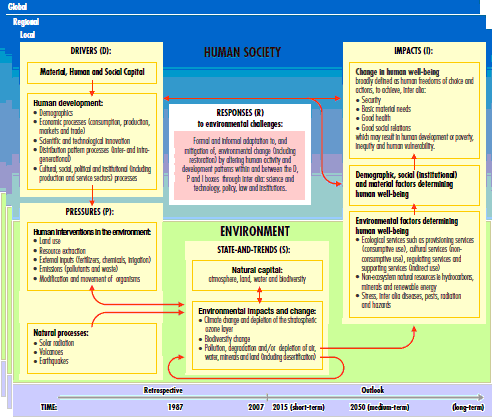
The UN Environmental Program's just-released GEO-4 flagship report puts the state of the environment in blunt terms twenty years after the Brundtland report: There are no major issues raised in Our Common Future for which the foreseeable trends are favourable. Ouch. Once again, the most damning thing about these reports on the state of the environment--unless you're a fundamentalist growth lubber (or Bjorn Lomborg, for that matter)--is that they're likely correct in calling for immediate, concerted action. It's simple, really. No Earth = no political economy or pretty much anything else. The diagram above is UNEP's conceptual framework for understanding the links between the environment and development, human wellbeing and vulnerability to environmental change. Below is part of the press blurb for the report, which can be downloaded in its 572-page entirety. It's a sobering read, but undoubtedly an important one on the shared challenges we face (including those growth lubbers and Lomborg):

On climate change the report says the threat is now so urgent that large cuts in greenhouse gases by mid-century are needed. Negotiations are due to start in December on a treaty to replace the Kyoto Protocol, the international climate agreement which obligates countries to control anthropogenic greenhouse gas emissions. Although it exempts all developing countries from emission reduction commitments, there is growing pressure for some rapidly-industrializing countries, now substantial emitters themselves, to agree to emission reductions.

GEO-4 also warns that we are living far beyond our means. The human population is now so large that "the amount of resources needed to sustain it exceeds what is available... humanity's footprint [its environmental demand] is 21.9 hectares per person while the Earth's biological capacity is, on average, only 15.7 ha/person...".

And it says the well-being of billions of people in the developing world is at risk, because of a failure to remedy the relatively simple problems which have been successfully tackled elsewhere.

GEO-4 recalls the Brundtland Commission's statement that the world does not face separate crises - the "environmental crisis", "development crisis", and "energy crisis" are all one. This crisis includes not just climate change, extinction rates and hunger, but other problems driven by growing human numbers, the rising consumption of the rich and the desperation of the poor.

BTW, you can find the 1987 Brundtland Commission report mentioned several times in GEO-4 online that coined the widely-used definition of sustainable development as that which meets the needs of the present generation without compromising the ability of future generations to meet their own needs.

On Muslim-European State Relations

The always-insightful Migration Policy Institute (MPI) has just come out with a very topical work concerning how EU states and Muslim communities can work towards a mutually beneficial understanding. Below is the press blurb; you can download the full report too:

Two years after urban riots roiled France — and as the European Union’s Year of Intercultural Dialogue approaches in 2008 — a new report provides a roadmap for how European governments can best engage Muslim communities on issues related to religious practice and integration.

Islam is Europe’s second largest religion, with at least 15 million Muslims now residing in Europe. In several European cities, the Muslim population exceeds 20 percent. Following current trends, the numbers of Muslims in Europe will continue to grow absolutely and as a proportion of the population.

The primary challenges for European governments are to safeguard religious freedoms and to ensure a voice for Muslim populations, while combating extremism and adapting European societies to diverse religious communities.

In Integrating Islam: A New Chapter in “Church-State” Relations, Jonathan Laurence, a professor at Boston College, draws on examples from throughout the European Union to provide a framework for establishing dialogues or interreligious councils. Dr. Laurence argues that these councils should not attempt to replace political processes or representation; rather, they should focus on practical matters where public policy and religious practice intersect, such as securing land to build mosques and appointing Muslim chaplains to hospitals and prisons. In doing so, councils can play a critical role in integrating newcomers of various faiths, many of whom still have foreign nationality.

Dr. Laurence recommends including representatives of the three main “viewpoints” of Muslim civil society:

  • members of organizations that enjoy close relationships with sending countries;
  • Islamist activists who obey the law and are open to dialogue with people from different origins and perspectives; and
  • individual experts from within EU Member States, particularly “minorities within the minority,” such as women and young people.

Dr. Laurence also recommends guidelines for structuring dialogues based on best practices:

  1. Governments must establish a clear purpose for the dialogue based on the understanding that respect for the rule of law is a precondition for participation.
  2. Working groups should set pragmatic agendas for concrete accomplishments, such as coordinating the observance of religious holidays.
  3. Governments should consider ways to institutionalize groups so they are permanent structures, based on a case-by-case evaluation of the consultations’ success.
  4. It is essential to balance local dialogues, which are more effective in addressing challenges of practicing the Muslim faith and clashes between faith communities, and national dialogues, which can better tackle national regulatory issues.

Looking to the future of these dialogues, Dr. Laurence notes that EU Member State governments will have primary responsibility for dialogues with Muslim communities, but, once effective structures are in place, a meaningful European superstructure may be possible.

Saudi's Foray into Int'l Higher Ed

Sometime ago I featured a series of articles in Newsweek on the competition for supremacy in the realm of international higher education as countries vied for talented scholars and researchers to bolster their science and technology efforts. However, this latest entrant may surprise y'all: the famously repressive Kingdom of Saudi Arabia (KSA). King Abdullah is personally overseeing a pricey bid in the King Abdullah University of Science and Technology (KAUST) for a piece of the international higher education market to the tune of $12.5 billion--an unimaginable sum by my standards, chump change for the KSA. Like nascent campuses in India, China, and Singapore, expect the now-standard tie-ups with Western educational institutions that lend immediate prestige--at a price. From the New York Times:

On a marshy peninsula 50 miles from this Red Sea port, King Abdullah of Saudi Arabia is staking $12.5 billion on a gargantuan bid to catch up with the West in science and technology.

Between an oil refinery and the sea, the monarch is building from scratch a graduate research institution that will have one of the 10 largest endowments in the world, worth more than $10 billion.

Its planners say men and women will study side by side in an enclave walled off from the rest of Saudi society, the country’s notorious religious police will be barred and all religious and ethnic groups will be welcome in a push for academic freedom and international collaboration sure to test the kingdom’s cultural and religious limits.

This undertaking is directly at odds with the kingdom’s religious establishment, which severely limits women’s rights and rejects coeducation and robust liberal inquiry as unthinkable.

For the new institution, the king has cut his own education ministry out the loop, hiring the state-owned oil giant Saudi Aramco to build the campus, create its curriculum and attract foreigners.

Supporters of what is to be called the King Abdullah University of Science and Technology, or Kaust, wonder whether the king is simply building another gated island to be dominated by foreigners, like the compounds for oil industry workers that have existed here for decades, or creating an institution that will have a real impact on Saudi society and the rest of the Arab world.

“There are two Saudi Arabias,” said Jamal Khashoggi, the editor of Al Watan, a newspaper. “The question is which Saudi Arabia will take over.”

The king has broken taboos, declaring that the Arabs have fallen critically behind much of the modern world in intellectual achievement and that his country depends too much on oil and not enough on creating wealth through innovation.

“There is a deep knowledge gap separating the Arab and Islamic nations from the process and progress of contemporary global civilization,” said Abdallah S. Jumah, the chief executive of Saudi Aramco. “We are no longer keeping pace with the advances of our era.”

Traditional Saudi practice is on display at the biggest public universities, where the Islamic authorities vet the curriculum, medical researchers tread carefully around controversial subjects like evolution, and female and male students enter classrooms through separate doors and follow lectures while separated by partitions...

Despite the obstacles, the king intends to make the university a showcase for modernization. The festive groundbreaking and accompanying symposium about the future of the modern university were devised partly as a recruiting tool for international academics.

“Getting the faculty will be the biggest challenge,” said Ahmed F. Ghoniem, a professor at the Massachusetts Institute of Technology who is consulting for the new university. “That will make it or break it.” Professor Ghoniem has advised the new university to lure international academics with laboratory facilities and grants they cannot find at home, but he also believes that established professors will be reluctant to leave their universities for a small enclave in the desert.

“You have to create an environment where you can connect to the outside world,” said Professor Ghoniem, who is from Egypt. “You cannot work in isolation.”

He admitted that even though he admired the idea of the new university, he would be unlikely to abandon his post at M.I.T. to move to Saudi Arabia.

Festivities at the construction site on Sunday for 1,500 dignitaries included a laser light show and a mockup of the planned campus that filled an entire room. The king laid a crystal cornerstone into a stainless steel shaft on wheels.

Cranes tore out mangroves and pounded the swampland with 20-ton blocks into a surface firm enough to build the campus on. Inside a tent, the king, his honor guard wearing flowing robes and curved daggers, and an array of Aramco officials in suits took to a shiny stage lighted with green and blue neon tubing, like an MTV awards show. Mist from dry ice shrouded the stage, music blared in surround sound, and holographic projections served as a backdrop to some of the speeches.

From a laconic monarch known for his austerity, the pomp, along with a rare speech by the king himself, was intended to send a strong signal, according to the team charged with building and staffing the new campus within two years.

The king is lavishing the institution not only with money, but also with his full political endorsement, intended to stave off internal challenges from conservatives and to win over foreign scholars who doubt that academic freedom can thrive here.

The new project is giving hope to Saudi scholars who until the king’s push to reform education in the last few years have endured stagnant research budgets and continue to face extensive government red tape.

“Because Aramco is founding the university, I believe it will have freedom,” said Abdulmalik A. Aljinaidi, dean of the research and consultation institute at King Abdulaziz University, Jidda’s biggest, with more than 40,000 students. [Does a state-owned corporation signify freedom?] “For Kaust to succeed, it will have to be free of all the restrictions and bureaucracy we face as a public university.”

Even in the most advanced genetics labs at King Abdulaziz, the women wear full face coverings, and female students can meet with male advisers only in carefully controlled public “free zones” like the library. Scientists there tread carefully when they do research in genetics, stem cells or evolution, for fear of offending Islamic social mores.

Even in Jidda, the kingdom’s most liberal city, a status rooted in its history as a trading outpost, change comes slowly. This month the governor allowed families to celebrate the post-Ramadan Id al-Fitr holiday in public, effectively allowing men and women to socialize publicly on the same streets for the first time.

The religious police were accused of beating a man to death because he was suspected of selling alcohol. Conservatives have fended off efforts by women to secure the right to drive or to run for office, although women have made considerable gains in access to segregated education and workplaces...

Upon completion, the energy-efficient campus will house 20,000 faculty and staff members, students and their families. Social rules will be more relaxed, as they are in the compounds where foreign oil workers live; women will be allowed to drive, for example. But the kingdom’s laws will still apply: Israelis, barred by law from visiting Saudi Arabia, will not be able to collaborate with the university. And one staple of campus life worldwide will be missing: alcohol.

The university president will be a foreigner, and the faculty members and graduate students at first will be overwhelmingly foreign as well. Generous scholarships will finance the 2,000 graduate students; planners expect the Saudi share of the student body to increase over the years as scholarships aimed at promising current undergraduates help groom them for graduate studies at the new university.

The university’s entire model is built around partnerships with other international universities, and faculty members are expected to have permanent bases at other research institutions abroad.

The university will also rely on a new free-market model. The faculty members will not have tenure, and almost all of them will have joint appointments. While the university will initially be awash in money, its faculty and graduate students will still have to compete with top international institutions for the limited pool of private money that underwrites most graduate research.

Suhair el-Qurashi, dean of the private all-female Dar Al Hekma College, often attacked as “bad” and “liberal,” said a vigorous example of free-thinking at the university would embolden the many Saudis who back the king’s quest to reform long-stagnant higher education.

“The king knows he will face some backlash and bad publicity,” Ms. Qurashi said. “I think the system is moving in the right direction.”

Friday, October 26, 2007

Artificial Reef--Not Reefer--Mania


The Wall Street Journal has a fine feature on so-called "designer reefs" which have been developed to more closely mimic natural reefs. I believe "biomimicry" is the correct term. In the past, creating artificial reefs involved just throwing random stuff into the sea that more often than not just polluted the environment some more. The video clip above describes the work of Todd Barber's Reef Ball Foundation NGO. Elsewhere in the WSJ article, the for-profit efforts of Eco Reefs and others is also described. While these technologies will by no way turn back the tide on dynamite fishing, agricultural runoff, pollution, global warming, and overfishing, they represent innovative efforts to stem widespread loss and degradation of reefs. For those about to reef, we salute you:
During a recent dive here, Todd Barber hovered above such familiar tropical sights as red sea sponges, iridescent fish and a half-hidden moray eel. But the coral reefs -- hollow, spherical and made entirely from concrete -- were anything but typical.

Mr. Barber wasn't surprised, though. A decade earlier, he created the artificial reefs using 300 concrete "reef balls." Now, those once-bare and ugly spheres have been transformed into minireefs, rich with life.

"They're in pretty good shape," said Mr. Barber after he climbed onto a boat and stripped off his scuba gear. He was particularly pleased by the presence of a Pederson shrimp, a translucent creature with blue flecks making a reef ball its home.

Mr. Barber is leading a charge to build "designer reefs" that will replace or support natural ones as the effects of overfishing, pollutants and disease take a growing toll on these vital ecosystems. His nonprofit Reef Ball Foundation has so far cultivated about 4,000 reefs in 55 countries. Projects range from a mile-long reef in Malaysia to a half-mile one at a millionaire's island in the Caribbean.

Artificial reefs aren't a new idea. For years, fisheries have made faux reefs by dumping junk -- old boats, airplanes, washing machines -- into the sea. But such unscientific efforts can go haywire. In 1972, about two million tires were dumped in the waters near Ft. Lauderdale, Fla., in an attempt to provide a habitat for fish. The tires failed to attract marine life and instead littered the ocean floor. They are now being removed.

The new "designer reefs" are much more sophisticated. EcoReefs Inc., of Jackson, Wyo., sells ceramic structures shaped like branching corals, essentially a prefabricated kit for making a customized reef. A Philippine company molds artificial coral whose shape, texture, color and even chemical signature are much like the real thing. One quixotic scientist tries to spur coral growth by piping low-voltage electricity through large metal mesh placed underwater.

But copying Mother Nature isn't easy. An artificial reef may work in one location but flop elsewhere. Some coral fragments thrive only in shallower waters. Others must be oriented just so or they won't grow. On the Caribbean island of Curacao, a reef-ball team made the mistake of planting corals upright instead of sideways, and they fell off in a big storm. In Oman, which isn't known for hurricanes, a storm earlier this year wiped out some coral growth on reef balls.

Reefs that develop naturally are created from colonies of tiny coral polyps. When these animals die, they leave behind a limestone "skeleton" on which other polyps grow, slowly creating larger and larger structures. These reefs range from the size of a small flower bed to the Great Barrier Reef, a coral edifice that stretches 1,400 miles along the Australian coast.

Sea creatures depend on reefs for shelter and feeding and mating grounds. For humans, they are a rich source of fish and, increasingly, a destination for snorkeling, diving and other recreational activities. The U.S. National Oceanic and Atmospheric Administration estimates that coral reefs world-wide provide as much as $375 billion of services annually.

But reefs face increasing danger as traditional threats are compounded by the effects of global warming. Higher sea temperatures have weakened or killed a large number of coral reefs through a process known as bleaching. Warmer oceans may also be triggering more frequent intense hurricanes, and a single such storm can trash parts of a 10,000-year-old reef in minutes. In addition, as more carbon dioxide is pumped into the air, more gets dissolved in the oceans -- turning the water more acidic and hurting coral growth.

"About 30% of the world's reefs have been destroyed in my lifetime," says the 43-year-old Mr. Barber. If current conditions continue, as many as 70% of the world's reefs could disappear within 50 years, according to NOAA.

Is Alibaba Worth More than Google?

The headline is from Forbes and isn't mine, BTW, and refers to possibly richer P/E valuations for Alibaba.com stock at the IPO stage than for Google. It feels like the heady days of the dot-com boom again as Chinese business-to-business web portal Alibaba.com is set to make a very, very pricey initial public offering. The main difference is that Alibaba.com has quite a viable business model. Let's start off with the Financial Times' take on the massive investor interest in the upcoming Hong Kong listing:

Alibaba.com has attracted more than $100bn in orders from institutional investors for its planned $1.5bn capital raising, reflecting keen demand for one of Hong Kong’s hottest offerings this year. [Reuters says it's now more like $180bn.]

Last year, Industrial and Commercial Bank of China, which raised $16bn on the Hong Kong stock exchange, received $350bn in orders from institutional investors and another $55bn from retail investors.

As a result of the strong interest shown in the Chinese e-commerce group it has decided to close the order book early for institutional investors in Asia and the US.

Unlike retail share applicants, however, institutions do not have to present their money upfront for Hong Kong initial public offerings. That makes it easier for them to submit big orders for popular offerings in the hopes of receiving a bigger allocation.

“It’s a bit of a [misleading] number because the dollars don’t exist,” said one person familiar with the situation.

Subscription numbers for the IPO’s retail tranche, which closes on Friday, were not available yesterday.

In another sign of Alibaba.com’s popularity, on Monday the company raised its price range to HK$12-13.50, from an indicative range of HK$10-12. Goldman Sachs and Morgan Stanley are acting as Alibaba.com’s joint global co-ordinators.

Alibaba.com, China’s largest business-to-business website, is coming to market in ideal conditions. Hong Kong’s benchmark Hang Seng Index is again testing the 30,000-point level and has risen more than 40 per cent since mid-August. Chinese companies have been particularly popular, on expectations that Beijing will soon allow mainland investors to begin buying shares in the territory.

Investor demand for Hong Kong dollars has helped push the currency to its upper limit of HK$7.75 to $1.

On Tuesday the Hong Kong Monetary Authority, which “pegs” the local currency to the US dollar in a range of 7.75-7.85, intervened in the market for the first time since May 2005, buying $100m in an effort to stop the local currency’s rise.

According to data compiled by Thomson Financial, Alibaba.com will be the largest internet IPO to come out of China and the sixth-largest offering on the Hong Kong stock exchange this year.

With that in mind, let's head over to Forbes' take on the IPO:

Alibaba.com, China’s largest e-commerce company, on Monday launched what is set to be one of the world’s most expensive initial public offerings, seeking to raise up to 11.6 billion Hong Kong dollars ($1.49 billion) through a share sale priced at a much higher valuation than investors paid for Google when it came public.

Alibaba.com, founded by former English teacher Jack Ma in 1995, is selling a 17% stake in the company, in the biggest technology IPO since Google raised $1.66 billion in 2004.

Alibaba.com on Monday revised its already high pricing range upward to between 12 Hong Kong dollars ($1.54) and 13.50 Hong Kong dollars ($1.73) a share, which would raise a maximum of 11.6 billion Hong Kong dollars( $1.49 billion) before an allotment option that would allow it to raise more in after-IPO trading.

The pricing works out to an astronomical price-to-earnings range between 94.5 and 106.3 times 2007 earnings. By contrast, Google shares were priced at a P/E of 90 in its IPO and currently fetch a 50.66 multiple.

Ma, who spoke from a road show in the U.S. via a teleconference link to a roomful of reporters in Hong Kong on Monday evening, defended the pricing, saying the company had room to raise it even higher. “Some investors who had missed out on Google’s IPO don’t want to miss out on Alibaba’s,” he said.

His No. 2 man, Alibaba.com chief executive David Wei, said many investors are buying into the company’s growth prospects for 2008 and beyond, which makes the pricing look more reasonable.

If it prices at the top of the proposed range, Alibaba would not be the most expensive stock in the high-flying Chinese Internet stock sector. Baidu.com, China’s largest search engine, is currently trading at 188 times its trailing 12-month earnings on the Nasdaq, but it has a unique edge — the support of the Chinese government, with which it cooperates hand in glove to censor the Web in China, while foreign competitors like Google face strict rules and service blockages.

Even based on 2008 earnings projections, the pricing is on the ultra-rich end. At the top end of the pricing spectrum, it is valued at 54 times its 2008 forecast, higher than Chinese Internet services provider Tencent, at 36, and Google’s 32. Nasdaq-listed Global Sources, which operates a similar e-commerce exchange in China, is trading at 33 times its 2008 consensus estimate.

But Alibaba.com would be cheaper than Baidu.com, which is trading at 57.78 times its projected 2008 earnings.

Many big-name investors have bought into Alibaba.com's growth story, including AIG Global Investment, Taiwanese billionaire Terry Gou’s Hon Hai Precision, Peter Woo of Hong Kong’s Wharf (Holdings), the Kwok family of Hong Kong’s largest real estate developer Sun Hung Hai Properties, Malaysian Chinese media and hotel magnet Kuok Hock Nien, Cisco Systems, and China’s largest bank, Industrial and Commercial Bank of China.

These seven cornerstone investors have agreed to buy a total of about 2.3 billion Hong Kong dollars ($296 million) worth of shares, or 20% of the offering.

Yahoo!, which holds a 39% stake in Alibaba Group, has agreed to buy about $100 million worth of shares.

Alibaba.com is the largest business-to-business e-trading site in China; it reported earnings of 295.2 million Chinese yuan ($39.2 million) in the first six months of 2007.

The listed company would not include two fast-growing Alibaba Group businesses: its online shopping unit, Taobao.com, and its online payment services provider, Alipay.

Hank Paulson, a "Victim of Love"?

You might be wondering about the slightly offbeat title of this post. Well, it's simple, really. Senator Charles Schumer (D-NY) claims that the White House has kept tight reins on Treasury Secretary Hank Paulson. Schumer says that Paulson is being held hostage by Bush's--how do we put it--Friedmanite leanings from addressing the subprime crisis in a substantive fashion. Schumer's observation strikes me as odd, given that Paulson was chosen precisely because he was the head of one of those Wall Street firms which have pumped a lot of cash into Bush's campaign coffers. Somehow, Goldman Sachs doesn't strike me as a bleeding heart. That Bush has an ideological commitment to small government according to Schumer strikes me as fanciful. The administration does become a champion of small government--when it comes to Democratic spending initiatives, that is. In any event, on to the Financial Times article:

Hank Paulson, the US Treasury secretary, has been “handcuffed” by George W. Bush in his handling of the subprime mortgage ­crisis, according to a powerful Democratic senator.

Charles Schumer, chairman of the congressional joint economic committee, said the president was preventing Mr Paulson from taking stronger action to stem the crisis because of his ideological commitment to free markets and small government.

“Paulson is in ideological handcuffs,” said Mr Schumer in an interview with the Financial Times. “Everybody who studies this knows the government should be involved.”

Mr Schumer’s committee published a report on Thursday predicting that 2m homes would be subject to fore­closure by the end of next year, destroying more than $100bn (€70bn, £49bn) in housing value. “This is serious and getting worse,” he said. “Until the market sees somebody is in charge and making sure this doesn’t get out of hand they are going to continue to get spooked.”

Congressional Democrats are pressing for Fannie Mae and Freddie Mac, the government-sponsored mortgage companies, to be given a bigger role in helping struggling borrowers refinance mortgages. However, the proposal is opposed by the administration, which advocates a more limited government response to the crisis.

“If there was a less ideological president, the business community would be happier because there would be much more confidence that somebody was dealing with this,” said Mr Schumer. A Treasury spokesman dismissed Mr Schumer’s criticisms as “ridiculous”, saying: “The secretary and the president have both called on the senate to take up legislation to help struggling homeowners – it’s the Senate that seems to be handcuffed.”

Mr Schumer predicted that turmoil in the mortgage market and the decline in real estate prices would have an impact on next year’s presidential and congressional elections. “If home values are going down it will matter. Everybody knows when a home is sold on the block how much it costs.”

His committee’s report showed the 10 states with the greatest number of predicted foreclosures included Ohio, Florida, Pennsylvania and Michigan – four of the most fiercely contested battleground states in recent presidential elections.

Mr Schumer said about 30 per cent of subprime borrowers were in “bad shape”. A further 50 per cent were at risk but could avoid foreclosure if given the chance to refinance.

Democratic calls for great­er intervention in the mortgage markets fit the party’s push for ­govern­ment-led so­lutions to ease the growing sense of economic insecurity in middle class America.

Thursday, October 25, 2007

Supachai: South-South FTAs' Value

Speaking of Professor Bhagwati jogged my memory about a recent entry made by former WTO Director-General Supachai Panichpakdi about why, contrary to Bhagwati's opinion that they promote unhealthy trade diversion, South-South regional FTAs can have beneficial effects for the world trading system. Supachai is currently the Secretary-General of the UN Commission on Trade and Development (UNCTAD), which was formed in the seventies to press trade-related concerns of developing countries and remains sympathetic to them:

In an in-depth study of regional trade agreements and their implications for developing countries, UNCTAD has found that there tends to be an important difference between North-South Regional Agreements, i.e. bilateral Free Trade Agreements (FTAs) between developed and developing countries, and regional agreements between developing countries, so-called South-South agreements. In particular, our research found that developing countries should strengthen regional cooperation with other developing countries, and proceed carefully with regard to North-South bilateral agreements.

The main reason for this is easy to understand: Many of these North-South agreements are missing the developmental perspective, for at least three reasons:

1. Bilateral FTAs often transform formerly non-reciprocal trade preferences between developed and developing countries into symmetric market access regulations; thus, the cornerstone of the post-war international trade system, the special and different treatment of developing countries, is continuously being eliminated.

2. WTO-plus standards and Singapore issues, e.g. labour and environmental standards, government procurement, investment and competition policy, are increasingly being incorporated into North-South FTAs, while the sector in which developing countries are highly competitive - agriculture - is left out. Moreover, these FTAs usually make no provisions at all for monetary cooperation, even though the overall competitiveness of developing countries is highly vulnerable to external shocks. Thus, developing countries often have to accept far-reaching commitments regarding formerly classical domestic policy without being adequately compensated in terms of warranted market access and market success.

3. Simultaneous participation in many FTAs with different rules and implementation horizons makes policy coordination in developing countries increasingly difficult, in particular with regard to the reconciliation between national development objectives, regional commitments and multilateral rules and regulations.

By contrast, UNCTAD’s research has also found that South-South agreements offer developing countries many advantages, which for the time being are not provided on the multilateral level, nor incorporated in North-South agreements.

One of the key motives for developing countries to enter into agreements with partners at a similar level of development in the same area is that of market access. Of course, the benefits of market access, such as scale economies and the diversification of production, are arguments that apply to trade integration generally, be it with developed or developing countries. Nevertheless, for many developing countries that are at an early stage of industrial development, a regional orientation involving countries with similar economic structures and technological capabilities may be considered a more viable option. The initial foreign competition within the region may be less difficult to handle, the technological gap vis-à-vis competitors from more advanced countries outside the region may be easier to close, and the probability of finding a level playing field is greater. In other words, the regional market often sets less exclusive benchmarks than competition with mature suppliers, so that even production at the infant industry stage can be successfully broadened. South-South cooperation can also be advantageous when it comes to competition to attract FDI and to avoid races to the bottom.

Do read the UNCTAD report on "regional cooperation for development" if you're interested.

Bhagwati: Sachs AND Easterly Wrong

In an interview with a university publication, Columbia Professor Jagdish "In Defense of Globalization" Bhagwati has just declared a plague on both Jeffrey Sachs and William Easterly's houses in the debate regarding aid's efficacy. Call it Bhagwati in defense for a middle way between "we need more aid" (Sachs) and "aid does little good" (Easterly):

Interviewer: What do you think about professor [Jeffrey] Sachs’ argument for a dramatic increase in foreign aid? Do you side with [NYU economics professor William] Easterly in the debate?

Jagdish Bhagwati: My reaction is: plague on both your houses! Professor Rosenstein-Rodan, who advised John F. Kennedy on foreign aid, taught me about “absorptive capacity”—that we should ensure that aid is absorbed productively. This is not just a moral requirement—few would want aid to be given just as a duty but with disregard to its consequences. In the 1960s and 1970s, I participated on the huge discontent on the left about how aid was either a malign-intent way of keeping neocolonial control of the decolonized lands, or that it unwittingly led to dependence in various ways: by reducing domestic savings, by hurting domestic agriculture through supply of foreign aid, and argued that, on balance, aid had been useful in countries like India. I doubt professor Sachs ever pays attention to such sophisticated objections, always dismissing those who raise them as if they were wicked conservatives with horns and no brains. But Easterly is equally wrong in arguing that aid hardly works.

Wednesday, October 24, 2007

India Takes Up with Iran, Spurns US?

The rapid economic growth of India is fueling its need for energy. (The India Energy Portal provides a lot of information about the country's choices in meeting its energy requirements.) It's notable that India is risking the ire of America by cottoning up the idea of creating a natural gas pipeline linked to Iran via Pakistan. Worse than possibly spurning US warnings not to go ahead with the pipeline, it seems the ruling coalition does not want to push through with another controversial deal on nuclear energy with the US. Supposedly, the US was going to provide India with technical assistance as well as fuel. Realpolitik: don't leave home without it. First up is a Financial Times article on the pipeline:

Senior Indian government ministers are showing fresh enthusiasm for building an oil and gas pipeline to Iran, in a move likely to add further tensions to US-India relations.

Growing support for the pipeline, which would pass through Pakistan, comes as hopes fade for a hasty conclusion to a historic nuclear power agreement with the US. It had been assumed India would abandon plans for the pipeline once the nuclear deal was finalised since its energy needs would have been addressed.

Palaniappan Chidambaram, India’s finance minister, said after meeting his Iranian counterpart in Washington on Monday that the pipeline was “completely doable” and “we should do it – Iran has the gas and we need the gas”.

He added: “He asked me about our commitment to the pipeline. I said we remain committed.”

The finance minister’s comments risk irritating the administration of George W. Bush, US president, and adding to its disappointment at India’s stalled efforts to push through a bilateral nuclear co-operation agreement. Manmohan Singh, the Indian premier, last week told Mr Bush that opposition from leftist members of India’s Congress-led coalition government meant it was having difficulties implementing the deal.

People close to Mr Singh, who has twice publicly shaken hands on the deal with Mr Bush, say he is “embarrassed” by the government’s inability to move ahead. There are also a growing number of reports that he is considering resigning.

Nicholas Burns, the US undersecretary of state for political affairs, has said Washington hopes “very much that India will not conclude any long-term oil and gas agreements with Iran”.

India has been blowing hot and cold on the pipeline during the nuclear talks with Washington but Pakistan and Iran recently announced their intention to sign a memorandum of understanding on the pipeline and a related sale and purchase agreement by the end of this month.

By increasing the potential size and profitability of the pipeline, India’s participation could overcome financing obstacles at a time when Pakistan’s turbulent domestic political situation has made it difficult to attract the required $5bn-7bn in private capital.

Under the 1996 Iran-Libya Sanctions Act, the US could in theory impose sanctions on countries that assist Iran in exploiting its petroleum resources. [Picture the effect of the US imposing sanctions on India. Unthinkable?]

But New Delhi insists that its decision on whether to participate in the pipeline will be based solely on an assessment of its own national interest.

“How India handles ever-tighter US-led sanctions against Iran will determine whether a degree of strain is injected into the Indo-US strategic relationship just as it is beginning to unfold,” said N.K. Singh, a political analyst. “There are 40m Shias in India and I don’t think the political parties will be unmindful of how all this plays out in terms of the Muslim vote in general and the Shia vote in particular.”

On the other hand, here is Dr. Singh relating the challenges he faces in gaining the assent of his Communist coalition members (comrades?) on reaching a deal over nukes with the US:

Manmohan Singh, India's prime minister, has been forced to tell US President George W. Bush that his government is struggling to win domestic support for a historic nuclear agreement between their two countries.

In a telephone call on Monday, Mr Singh told Mr Bush "that certain difficulties have arisen with respect to the operationalisation of the India-US civil nuclear co-operation agreement"...

US officials said they still held out hope that Mr Singh would be able to pull off a domestic political compromise. "This is a very important, even historic, agreement," Nicholas Burns, the US undersecretary of state, who negotiated the deal, told the Financial Times.

"While we would obviously not interfere in the internal discussions in India, we will work closely with the Indian government to bring this to a successful conclusion."

But US officials privately said that India had only a few weeks to get its internal house in order before it started missing deadlines.

To implement the deal, India must negotiate a safeguards agreement with the International Atomic Energy Agency, persuade the 45- country Nuclear Suppliers Group to permit nuclear commerce with it and secure the backing of the US Congress.

"If this starts drifting into 2008 then it becomes decreasingly likely Congress will have no time to vote on it - especially in an election year," said a US official. "The next administration is highly unlikely to want to inherit a deal without -renegotiating it - and this took two and a half years to negotiate."

Analysts said India's credibility would suffer if the deal collapsed.

Advocates of the deal have expressed disappointment with the Congress-led coalition government's decision to put the agreement on hold rather than risk a confrontation with the communist parties that could have triggered an early election.

"The US will be thinking the Indians are very strange people who do not know what's in their national interest," said K. Subrahmanyam, a strategic affairs analyst and chairman of the Indian government's Task Force on Global Strategic Developments. Seema Desai, an analyst at Eurasia Group, said the sudden change of sentiment was "all the more puzzling given that a panel appointed to look into the objections of the left had not yet completed its deliberations on the issue".

The government's apparent abandonment of a confrontational approach vis-à-vis its leftist backers came after political parties in the United Progressive Alliance coalition warned Mrs Gandhi of the dangers of triggering an election.

Italy's Top Conglomerate, the Mafia

I came across the following story in the International Herald Tribune on how the mafia accounts for a whopping 7% of Italy's GDP according to Confesercenti, a business group in the country. To the left is a map accompanying the report indicating that mafia activity is concentrated in southern parts of the country. It has long been noted that the northern part of Italy has economically outperformed the south because institutions in the former are better formed. Robert Putnam's well-known book Making Democracy Work noted the (dysfunctional) role played by the mafia. Here is a brief summary of the book's premise...

In a study of Italian politics, Making Democracy Work, he contrasted the flourishing democracy of northern Italy with the collapse of politics in the south. Putnam looked back into Italian history and found in the self-governing city republics of the north a strong tradition of voluntary association, trust and civic engagement. The result was a flourishing economy and a healthy polity. The south, by contrast, was riddled by mutual distrust and defection, a Mafia culture of exploitation with little history of voluntary association. In the absence of strong social capital, democracy fell apart and economic growth was hindered.

Anyway, to the article:

Organized crime represents the biggest segment of the Italian economy, accounting for €90 billion in receipts, according to an annual report issued Monday.

The report, titled "SOS Businesses" and released by the Confesercenti, a major business association in Italy, asserts that through various activities - extortion, usury, contraband, robberies, gambling and Internet piracy - organized-crime syndicates account for 7 percent of Italy's gross domestic product.

"From the weaving factories, to tourism to business and personal services, from farming to public contracts to real estate and finance, the criminal presence is consolidated in every economic activity," the report said.

The €90 billion, or $128 billion, compares with the figure of €75 billion in the group's 2006 report.

Also highlighted is the trend of collusion that big businesses, especially in public works, participate in. "The businessmen prefer to make a pact with the Mafia rather than denounce the blackmail," the report said.

On Sunday, Pope Benedict XVI visited Naples and condemned a "deplorable" mob violence that he said had insinuated itself into everyday life. Long considered one of Italy's most dangerous cities, Naples is home to the Camorra crime syndicate, the local version of the Sicilian Mafia.

Usury is the most lucrative of activities by organized crime, with syndicates pulling in €30 billion and racketeering €10 billion, the report estimated. Illegal construction nets €13 billion, it added.

The businesses most afflicted by organized crime are in the south, in Sicily, Campania, Calabria and Puglia, the report said.

According to the report, 80 percent of the businesses in the Sicilian cities of Catania and Palermo regularly pay protection money, or "pizzo."

India's "Reverse Colonization"

The current issue of Fortune has a fine feature on the international buying spree cash-laden Indian companies have embarked upon. Interestingly enough, it's not just India's famous outsourcing services powerhouses making acquisitions, but also manufacturing concerns keen on expanding their international reach. As some commentators suggest, what we may have here is a case or "reverse colonization" as Indian firms buy up those in the West. In a world turned upside down, there's a new sahib on the global scene:

Buoyed by a robust economy, a booming stock market, and the sharp appreciation of the rupee, India's flagship firms are pushing beyond their home market into the wider world.

Once sheltered from overseas competition by a government fearful of foreign domination, Indian companies now are building global empires with impressive speed, ramping up exports, striking cross-border corporate alliances, snapping up firms in the U.S., Europe, and emerging markets, and attracting billions in foreign portfolio capital to India.

India's largest IT-services companies, which count on foreign customers for more than 90% of sales, remain at the vanguard of India's outward expansion. In little more than a decade, firms like Wipro, Infosys Technologies, and Tata Consultancy Services have evolved from niche players handling basic debugging projects for foreign multinationals into giants in their own right, with operations in every major foreign market, tens of thousands of employees, and equity valuations in the tens of billions of dollars.

But Indian manufacturers are going global too. Consider Bharat Forge in Pune: After six foreign acquisitions in three years, Bharat has emerged as the world's second-largest manufacturer of axle beams, crankshafts, and other forged auto components. CEO Baba Kalyani says he's ready to spend another $250 million on foreign acquisitions and expects to overtake Germany's ThyssenKrupp as industry leader by the end of next year.

Across town Bajaj Auto, squeezed by competition from Japanese motorcycle manufacturers in the Indian market, has repositioned itself as the premium-brand leader at home - and is now taking the battle back to Japanese and Chinese rivals in markets like Indonesia, Egypt, and Brazil.

Ranbaxy Laboratories, India's largest pharmaceutical company, manufactures generic drugs in 11 countries, distributes and markets them directly in 49, and counts on foreign markets for 80% of its revenue. CEO Malvinder Singh touts Ranbaxy as India's first true multinational. "Our headquarters may be in India," he says, "but we have learned to operate locally and in a very decentralized manner."

India Inc. still wrestles with the old demons: bad roads, an inadequate education system, shortsighted politicians. In the most basic categories of development, India's economy lags behind China's. Morgan Stanley estimates that China outspends India on infrastructure by a ratio of seven to one. The result: India's manufacturers pay twice as much for electric power as do their Chinese counterparts and three times as much for railway transport.

It's estimated that 40% of India's perishable goods rot before reaching market. India's vaunted technology institutes graduate hundreds of thousands of engineers each year, but their skills are uneven, and India's broader educational institutions have neglected the rest of the nation, leaving 30% of the population unable to read and write.

India's dysfunctional political system - riven by caste, religion, party, and faction - bears much of the blame for these failures. Prime Minister Manmohan Singh and members of his economic team win high marks for policymaking savvy. But they answer to a fractious political coalition whose leaders seem indifferent to the realities of the global economy. Little wonder that while China attracted $70 billion last year in foreign investment, India took in less than $10 billion.

And yet, for all those handicaps, India is barreling forward. Indeed, for the past two years its economy has managed growth rates of 9%, only a percentage point or two shy of China's. In many ways Asia's two emerging giants have embraced development models that are polar opposites. China's strengths may be India's weaknesses - but the reverse is also true. Says CLSA equities strategist Christopher Wood: "China's economy grows because of its government, while India's economy grows in spite of it."

China's broad highways and bustling factories are the product of an authoritarian regime that puts a premium on control. Growth is stoked by government spending and exports, and the economy is dominated by state-owned companies. India's more chaotic business landscape is dominated by family-owned conglomerates, many founded generations ago during India's years as a British colony.

After India won independence in 1947, state planners parceled out monopolies to these dynasties under an arrangement known as the license raj. When a 1991 balance-of-payments crisis forced planners to loosen up, the family firms scrambled to adapt. Now many of them - including groups bearing names like Tata, Birla, Godrej, and Mahindra - are reemerging as well-managed, globally competitive players.

Lightly regulated sectors like software programming, telecommunications, and pharmaceuticals spawned new players such as Narayana Murthy, who launched Infosys (Charts) from his Pune apartment, and Sunil Mittal, who parlayed a bicycle-parts company in Ludhiana into Bharti Airtel, India's leading mobile-phone company.

The success of Indian ventures, whether old or new, owes much to the quality of their domestic capital markets. Deng Xiaoping launched mainland China's exchanges in the early 1990s as an experiment. More than a decade later they remain badly regulated, wildly speculative, and mostly off-limits to both foreign investors and private Chinese firms.

The Bombay Stock Exchange, by contrast, has been around twice as long as India has been independent. It is one piece of infrastructure India's regulators have gotten right: encouraging new ventures, punishing poor management, and accelerating growth of established players. India, CLSA's Wood argues, "has by far the best growth story of any of the emerging economies."

Infosys co-chairman Nandan Nilekani claims the India model is evolving into "something unique. On the one side, there's this array of entrepreneurs and a large pool of inexpensive talent. And on the other we've created a very market-oriented mechanism for raising capital. Put those things together and there's a real ferment. In India all it takes is a little deregulation, and whole sectors go from sleepy oligopolies to highly competitive environments almost overnight."

The bullishness of India's business Brahmans was on display in New York City last month during a four-day, $10 million marketing blitz. The campaign, billed as a celebration of India's 60th year of independence, featured billboards in Times Square, Bollywood dancers performing atop a replica of the Taj Mahal in Bryant Park, and posh dinners attended by dozens of business and political leaders flown in from India.

The objective, said Bharti's Mittal, president of the Confederation of Indian Industry, which organized the events, was to "present the picture of a confident nation ready to engage with the world."

That willingness to engage is manifest in a rising tide of Indian acquisitions. In 2000 the Tata Group, one of India's oldest and proudest conglomerates, made headlines by paying a then-record $430 million for the company that invented the tea bag, Britain's Tetley Tea. Indian purchases of that magnitude are now routine.

In April, Hindalco Industries, part of India's Aditya Birla group, paid $3.6 billion for Canadian aluminum company Novelis. In May, as Suzlon closed its deal on REpower, Vijay Mallya's United Breweries snapped up Whyte & McKay, the world's fourth-largest distiller of Scotch whisky. In August, Wipro (Charts) pocketed New Jersey software house Infocrossing for $600 million. In the first three quarters of this year, Indian companies announced 150 foreign acquisitions with a total value of $18.1 billion, according to Dealogic - a fourfold increase over all of 2005.

But none can match Tata Group for ambition. In April, Tata Steel paid $13 billion for Corus, an Anglo-Dutch steel company, securing mills in Ohio and Pennsylvania and quintupling its steelmaking capacity. That remains India's biggest foreign purchase to date. But between Tetley and Corus, Tata scooped up a slew of other overseas assets: an undersea-cable business, the truck-manufacturing operations of South Korea's Daewoo group, a stake in one of Indonesia's largest coal mines, and a raft of foreign hotels, including the Ritz-Carlton in Boston.

This year, for the first time, the group will take in more revenue overseas than it does at home. Tata is well on its way to becoming India's first truly global brand. And chairman Ratan Tata, who wouldn't talk to Fortune for this story, is still shopping. In August he declared his interest in buying Jaguar and Rover, now owned by Ford Motor.

In Mumbai, India's financial hub, bankers joke about "reverse colonization." An oft-heard lament is that the deals reported in the financial press are nothing compared with the ones considered and then rejected. Ranbaxy, which gobbled up no fewer than eight firms last year, passed on an opportunity to buy Germany's Merck. The drugmaker was sold instead to Mylan Laboratories in the U.S. for $6.6 billion. "Acquisitions, yes," says CEO Singh, "but not in a reckless manner."

Ranjit Pandit, managing director of the Mumbai office of General Atlantic, a U.S. private equity group, says it wouldn't surprise him to see a $50 billion deal. "Suddenly," he says, "bankers the world over are beating a path to India."

Remarkably, few of India's foreign acquisitions have gone awry. For now at least, there is no Indian equivalent of TCL, the Chinese TV manufacturer still struggling to digest its 2004 purchase of the troubled television division of France's Thomson. Nor have Indians encountered the sort of political backlash that thwarted efforts by CNOOC, China's state-owned petroleum giant, to purchase U.S.-based Unocal in 2005.

Tata's bid for Jaguar and Rover, which are expected to go for at least $1.5 billion, will test his limits. That deal would bring Tata's automotive unit new technologies and a broad international sales network. But industry analysts question how Tata Motors, whose products and sales service finished at the bottom of J.D. Power's 2007 India customer-satisfaction ranking, would revitalize the two money-losing British luxury brands. It's hard to see how either company will mesh with Tata's push to produce the world's cheapest passenger car, at about $2,500.

Anand Mahindra, CEO of Mahindra & Mahindra, India's largest manufacturer of tractors and SUVs, wonders whether India's global expansion resembles corporate Japan's buying binge during its 1980s bubble economy. "Is this really the carpe diem moment for India?" he asks. "Is this part of a well-considered strategic roadmap? Or is it all just steroids?"

Mahindra won't comment on reports he dropped out of the bidding for Jaguar and Rover. But he is hardly shrinking from other opportunities. Over the past several years he has purchased a tractor plant in China and diversified into the forging industry by purchasing companies in Germany and Britain. Each acquisition made sense, he argues, because it brought new technologies, new customers, or significant economies of scale.

Mahindra has also entered into an alliance with Renault to build a passenger car based on the French automaker's low-cost Logan sedan. Together with Renault and Nissan, he is investing in a $900 million passenger-car plant on the outskirts of Chennai. That facility, which will be India's largest auto factory, is scheduled to open in 2009 with an annual capacity of 400,000 vehicles. That same year Mahindra plans to launch a range of compact pickups and hybrid SUVs in the U.S.

Russia: From Market to Gosplan

In case you're not an IPE junkie (which is probably a good thing), I am making a reference in this post's title to the World Bank's 1996 World Development Report entitled From Plan to Market. The report concerns the transition from state- to market-dominated political economies post-Cold War, especially in former Soviet bloc countries. Gosplan, of course, was the former Soviet agency tasked with writing up five-year plans for the USSR. As you will read below, Russia has decided to impose price controls--just as China has--which the Financial Times says are designed to ensure that Putin's party stays in control when as another election cycle rolls around. Call it public choice theory, Russian style.

In a way, the reimposition of price controls is of a piece with Putin's recent moves to reclaim the USSR's glory days by sliding back to a more, shall we say, centrally planned era. After all, he's said that the collapse of the Soviet Union was "the catastrophe of the century." Sending bombers to patrol I don't know what, suppressing political opposition, and now determining prices of basic goods--the evidence is overwhelming. Comrade Putin, you've done the hammer and sickle proud:

Russia is introducing Soviet-style price controls on some basic foods in an effort to prevent spiralling prices from denting the Putin administration’s popularity ahead of parliamentary polls in December.

The country’s biggest food retailers and producers have reached an agreement, expected to be signed with the Russian government òn Wednesday, to freeze prices at October 15 levels on selected types of bread, cheese, milk, eggs and vegetable oil until the end of the year.

Russia’s move is the latest sign of surging agricultural prices becoming an international political issue. Big retailers will limit their mark-up on those goods to 10 per cent.

China has also agreed to food price controls; Egypt, Jordan, Bangladesh and Morocco are increasing subsidies or cutting import tariffs to lower domestic prices. Rich countries are not im­mune: Italian consumer groups organised a pasta boycott last month in a protest over prices.

The Russian economy ministry is also examining whether to increase a 10 per cent export tariff on wheat planned for November to 30 per cent to keep its domestic market well supplied. That prospect has pushed wheat prices up 6 per cent in Chicago in the past week, giving Moscow’s fight against rising food prices an effect beyond its borders.

Russia’s agriculture ministry said the food pricing arrangement was voluntary. But industry insiders said they had come under heavy pressure. “We were told in no uncertain terms that we have to freeze prices on certain products,” said one Russian food industry executive, who asked not to be named. “Everybody understands what the government is doing. It is part of their election campaign.”

Russian food prices rose steeply in September, with vegetable oil up 13.5 per cent, butter up 9.4 per cent and milk 7.2 per cent, thanks to global agricultural price increases. Given a big low-income population and meagre pensions, the price rises are among the few factors capable of deflating President Vladimir Putin’s 80 per cent-plus approval ratings...

Russia has fought off inflation in recent years but rising food prices mean it has already exceeded this year’s 8 per cent inflation target, with the final figure likely to top 10 per cent.

Food prices have risen globally thanks to increasing demand and changing diets in developing countries, more frequent floods and droughts damaging harvests, and the biotech industry’s growing appetite for grains.

Russia, like many countries, faces the additional challenge of fighting food inflation while pumping money into the financial system to combat the global credit squeeze.

But, as Izvestia newspaper commented, Moscow has “found its solution in the past”, with price freezes harking back to Soviet times.

“The reaction of the Russian authorities to the recent inflation spike has been even more predictable than the price surge that triggered it,” Dresdner Kleinwort said in a note to investors.

Industry insiders said price freezes might restrain headline inflation but would not reduce the overall rate.

Tuesday, October 23, 2007

Globalization and Inequality Roundup

This is my final installment relating to the October 2007 IMF World Economic Outlook. It concerns the headline subject matter of the report, Globalization and Inequality. Now, some ink has been spilled on the report in the financial press. The Wall Street Journal makes much about the finding that rises in income inequality as measured by the Gini coefficient are being fueled by technology and foreign investment. Furthermore, the WSJ says this provides ammunition for the anti-globalization movement. On the other hand, the Financial Times' Clive Crook--a well-known globalization proponent--says that the WSJ and others have missed the more important finding from the report: Yes, inequality may be on the rise due to technology and foreign investment, but incomes of the poor are rising around the world, in industrial and developing countries alike. Second, liberal trade reduces inequality – again, in poor countries as well as in rich countries.

What are we to believe, then? As always, it pays to look at the source material. Figure 4.3 to the left (click for larger image) indicates that [i]nequality has risen in developing Asia, central and eastern Europe, the NIEs, and the advanced economies, while falling in the Commonwealth of Independent States and, to a lesser extent, in sub-Saharan Africa. Few except the most rabid pro-globalizers would probably contest this point. Inequality is rising throughout most of the world's regions.

Before making a wholesale indictment of globalization based on rising inequality, though, pay some heed to Figure 4.5 to the right (click for larger image). As the accompanying text notes, [i]ncomes have risen for all quintiles across all regions except for the poorest quintile in Latin America, related in part to the aftereffects of crises. This is the point Crook wants to make. To me, it is also the more important one. Yes, inequality is rising, but nearly everyone in various quintiles have higher incomes compared to the decade or so before.

I will make a statement that I suspect more left-of-center readers may not agree with: In a perfect world, we'd of course prefer it if incomes increased and inequality decreased at the same time. However, given a choice between rising incomes (+) and rising inequality (-) versus falling incomes (-) and falling inequality (+), I would likely prefer the former combination. Which, of course, is what these statistics indicate. There are many potential qualifiers that I can throw in. To think of three (there are too many to mention), the data may not be reliable especially in developing countries, income growth is not necessarily the best measure of human development, and environmental costs are not included in this analysis. Nevertheless, if the data compiled by the IMF is accurate and income growth has resulted in real welfare gains for the poor in various parts of the globe, this news is welcome indeed.

Lastly, have a look at Figure 4.10 to the left (click for a larger image). The IMF uses a regression model to determine how globalization--in the form of exports, tariff liberalization, and inward FDI--has affected income inequality. As Crook noted, trade narrows income inequality across all regions. Figure 4.9, which I do not show here, further illustrates that technology is the principal driver of inequality. Technology tends to increase the rewards for those skilled at harnessing technological innovations instead of the unskilled. As an aside, some of my research is on policymaking aimed at introducing technologies that benefit the unskilled more than the skilled, but that's a story for another day. Nevertheless, this WEO report introduces a whole bunch of other possible considerations regarding innovation: Why is it that the lion's share of innovations are geared towards rewarding those who have already been rewarded? (This is the so-called Matthew effect.) In any event, cheer up, free traders. It appears the evidence here is that trade narrows inequality and doesn't widen it.
[UPDATE: The IMF has a slideshow on globalization and inequality.]

Don't miss UNCTAD's superstar blog

While visiting UNCTAD's site to get a copy of the World Investment Report 2007, I noticed that UNCTAD has just put up what promises to be a fine blog called "Ideas 4 Development." Color me impressed by its premise and its superstar lineup. Here is its blurb...

Ideas for Development, an international Blog designed to stimulate debate on economic development issues, will be launched in Washington DC on 21 October 2007 at the World Bank and IMF annual meetings. Created by seven prominent personalities, this blog provides web users with a new forum to share information, viewpoints and visions for the future, with the common goal of advancing the cause of development.

Heads of international organizations will actively take part in the blog:

  • Kemal Dervis, Administrator of the United Nations Development Programme,
  • Abdou Diouf, General Secretary of the Organisation De La Francophonie,
  • Donald Kaberuka, President of the African Development Bank,
  • Pascal Lamy Director general of the World Trade Organization,
  • Supachai Panitchpakdi, Secretary-General of the United Nations Conference on Trade and Development,
  • Jean-Michel Severino, Managing Director of the Agence Française de Développement,
  • Josette Sheeran, Executive Director of the World Food Programme.

Partnerships will enable other development specialists to take part in the debate. These guest commentators, coming from NGOs (Care, WWF, Oxfam…) and universities (LSE, Columbia, Sciences-po, …) will guarantee a lively debate and a broad range of information.

Ideas for Development is an original platform of exchange - in its format as well as in its content. It will offer many applications such as video, RSS syndicate and e-mail updates. Available in three languages - English, French and Spanish - Ideas for Development will host wide-ranging debates, crossing perspectives and points of views from all over the world.

Development issues meet a growing interest on the internet, yet blogs that address these issues are either of individual web users or of institutions. Ideas for Development´s ambition is to promote a genuine and informed debate in which the contributors share their own convictions, both with their peers and with the larger public.

The Wide, Wide World of FDI

The UN Conference on Trade and Development (UNCTAD) has just released its World Investment Report for 2007. Having just plowed through the IMF's World Economic Outlook, I'll take a breather before reading UNCTAD's new publication, though I am sure that I can pick up tidbits from it just as I have from the WEO. In the meantime, the Financial Times reports on the rising flow of FDI worldwide based on the UNCTAD report. From the looks of it, it's interesting stuff. The strange phenomenon of "capital flowing uphill" continues with the US retaking the lead in FDI flows. I find it kind of funny, I find it kind of sad...'tis a mad world:

Global inflows of foreign direct investment are on track this year to surpass the record $1,411bn (€996bn, £694bn) reached in 2000, despite the turmoil in financial markets, the United Nations Conference on Trade and Development said on Tuesday.

The Geneva-based agency’s annual World Investment Report showed that inflows of FDI amounted to $1,306bn in 2006 – the highest since 2000. “Unctad expects the FDI figures to be even higher in 2007 than in 2006,” said Supachai Panitchpakdi, secretary-general of the agency

Khalil Hamdani, an Unctad director, said the agency’s “back-of-the-envelope calculations” suggested FDI this year of $1,500bn. This was partly because of strong mergers and acquisitions activity before this summer’s credit squeeze: cross-border M&A activity rose by 58 per cent to $581bn in the first half of the year compared with the same six months of 2006.

Mr Panitchpakdi said, how­ever, that financial in­stability and high energy prices made the forecasts un­certain. Partly for this reason, Unctad expects FDI this year to grow at “a somewhat slower rate than in 2006”, when inflows rose by 38 per cent compared with 2005.

The growth in FDI inflows last year was due to strong global economic growth, high corporate profits and a boom in mergers and acquisitions activity; there were 172 mega-deals last year, each worth more than $1bn, according to Unctad.

The US regained its position last year as the largest recipient of FDI, after being temporarily displaced in 2005 by the UK. Inflows to the US rebounded to $175bn.

Monday, October 22, 2007

China's Pain From Expensive Grain

A few posts ago, I described China's role as an exporter of deflation may be coming to an end. Indeed, its voracious appetite for raw materials has driven up worldwide costs for these inputs as China scours the globe for RM supplies. As a result, China itself is grappling with old-fashioned "cost-push inflation." The world has come to rely on inexpensive but good quality Chinese exports. Given that China is now facing inflation, this situation is endangered. From our favorite official publication the China Daily:

Grain prices will continue to edge upwards next year despite a turbulent 12 months in which costs soared, according to a leading agricultural policy maker.

The surging cost of oil, production material and fertilizer will make it increasingly difficult for the government to curb hikes generated by rising food prices since last year.

"Rising oil prices will be boosting costs for the agricultural sector and the price hike trend will continue next year," Chen Xiwen, deputy director of the Office of the Central Leading Group on Financial and Economic Affairs, told China Daily Sunday.

Chen made the forecast despite news from the Minister of Agriculture Sun Zhengcai last week that China would record a fourth consecutive bumper food harvest and an output of 500 million tons, a target originally set for 2010 by the National People's Congress, China's parliament.

"The grain supply can be guaranteed but the prices will go higher driven by growing cost," said Chen, who is also director of the Office of the Central Leading Group on Agricultural Affairs.

Production materials and fertilizer costs increased by a year-on-year average of 17 percent during the first nine months of 2007.

Chen said rising oil prices, after reaching a record high of about $90 a barrel last week, would continue to drive up costs for the agricultural sectors.

The National Development and Reform Commission (NDRC) said grain prices both at home and abroad continued to increase in September, when rice, wheat and corn prices shot up 8.9 percent, 10.2 percent and 16.1 percent on corresponding time in 2006.

Rice, wheat and corn reached 1,710 yuan ($220), 1,561 yuan ($201) and 1,472 yuan ($189) per ton, respectively.

In international markets, rice, wheat, corn and soybean increased year-on-year by 3.1, 112, 47.3 and 75.1 percent, respectively, in September.

Huang Jikun, a think-tank agricultural expert with the Chinese Academy of Sciences, said China's foodstuff market had been integrated into the global market and "the high-rising trend would unavoidably affect the domestic grain prices".

Rising food prices have already become a thorn in the side of the government's goal of minimizing consumer costs.

"The rise of foodstuff prices may lead all the other commodities to follow suit," NDRC Vice-Minister Zhu Zhixin said last week.

He made a cautious forecast at a sideline press conference of the 17th CPC congress that China's price level would remain high and that the growth rate would slow down.

China's consumer price index, a major barometer for inflation, eased slightly to 6.2 percent in September after surging to an 11-year monthly high of 6.5 percent in August, Zhu said.

Sunday, October 21, 2007

Do India/China Need W.Bank Loans?

This has me thinking a little. A few posts ago, I noted that current World Bank President Robert Zoellick wanted the institution to continue lending to India and China for strategic purposes despite these being middle income developing countries. There has been criticism that the Bank should be lending to low income countries instead that have trouble attracting private capital flows, unlike those aforementioned countries. Zoellick had this to say on India and China being the largest and third largest World Bank borrowers, respectively:

There are some 70% of the poor in middle-income countries. If we are going to deal with the poverty agenda, we need to be engaged with these countries.

[Also] if you look at what's happening in the fields of diplomacy and political and security affairs, one of the big challenges is how we integrate the Indias, the Chinas and the Brazils [of the world] in the multilateral system? It strikes me as illogical that you would be trying to engage them in creating a new multilateral order, and not do it in the multilateral economic system.

The third point [is], let's think of the other big issues of the day, like climate change. Well, China and India and Brazil and others have huge energy needs, so if we are going to be able to contribute to the big economic environmental challenges of the day, we've got to be partners with these countries. I can put skin into the financial game to help make this happen.

Curiously, US Treasury Secretary Henry "Strong Dollar" Paulson sees things differently. Aren't these Bushites singing from the same hymn sheet? The report below is from Bloomberg, and the entire statement is available on the Treasury site.
U.S. Treasury Secretary Henry Paulson said the World Bank should focus on lending to poor countries and trim funds for China, India and other middle- income nations that are luring private capital.

``A growing number of middle-income countries are benefiting from improved access to private financial flows,'' Paulson said in prepared remarks to the bank's annual meeting in Washington. ``We believe the World Bank can continue to help these countries but it will require that the World Bank become more focused, efficient and selective in seeking ways to provide its expertise where financing may no longer be required.''

Middle-income countries accounted for more than half of the $23 billion in World Bank aid last year. World Bank President Robert Zoellick reiterated today that he favors continuing such lending, while also campaigning to raise funds to help the world's poorest nations.

Countries such as China and India still account for 70 percent of the world's poor, Zoellick said in an interview with the Cable News Network. The World Bank's loans to those countries are made at market rates, and many are financing environmental projects, Zoellick said.

``The loans we give them are rather modest,'' Zoellick said in Washington. ``What we primarily give them is knowledge.'' He added that ``we can and should do both'' lending to poor and middle-income countries.

Paulson said the bank has often been slow and inefficient in deploying its resources, and he said it is ``imperative'' to improve reporting of the results of bank programs.

``It remains the central organizing principle for everything the bank does,'' he said.

The Treasury chief praised Zoellick's efforts to enhance the bank's role by putting $3.5 billion of its own funds into the International Development Association, the arm that makes low-interest loans to the world's poorest countries.

The move represented a shift for the World Bank, which has relied on funding from governments. Zoellick also said last week that private companies may contribute.

``World Bank engagement should be limited to programs that clearly meet its core mission of promoting economic growth and poverty reduction,'' Paulson said.

Dodge: The Same, Lame Ol' IMF

Bank of Canada Governor David Dodge and several other attendees at the 2007 World Bank-IMF annual meetings expressed dismay that the event did not bring about any substantial discussions about institutional reform of the IMF in a changing world. I've blogged previously about possible forthcoming changes that could make the IMF more relevant [1, 2, 3] though it seems few of these options were discussed. (You can read the communique here.) Sure, developing countries will be assigned a few more votes. However, nothing much is being done to address mounting global economic imbalances according to Dodge. From the Financial Times:

The failure of the IMF to agree reform increased the risk of a ”huge” global economic ”crisis” brought about by the disorderly unwinding of global economic imbalances, said David Dodge, governor of the Bank of Canada.

”We didn’t make any progress this weekend,” said Mr Dodge, adding that it was a ”pretty big disappointment” and that IMF stakeholders had not ”settled even the principles let alone the details” of institutional reform.

The central banker said the continued stand-off over reform would undermine the IMF’s ability to go on and play a bigger role in bringing about an orderly realignment of international currency imbalances.

”This is precisely the time we need the fund’s ability and skills to deal with global imbalances,” he said, adding that the breakdown in reform efforts had decreased the ”chance of coming to a common view across the fund’s membership” on currency policy.

”The longer the imbalances go on, the greater risk that we will end with a rather messy dénouement,” he said.

He said it was inevitable that imbalances would be resolved, but that the question was ”whether we end with some huge bloody crisis” or ”whether we can do it in a reasonably smooth manner so that the world can continue to grow and roughly its potential”.

He warned that a disorderly unwinding would increase protectionism and lead to policies that could ”undermine the benefits of the global financial and trading order we have enjoyed over the past two decades”.

He said he didn’t want to single out China, and said the imbalance rested with a number of currencies, including South East Asia, South Korea, and Japan. He added that these countries faced the risk of rapidly rising inflation if imbalances were not addressed.

The FT also offers a summary of the occasion. To no one's surprise, China is reluctant to extend the IMF's surveillance powers. Some are predicting more US vs. China style developed vs. developing country showdowns Ours is a truly messy global political economy:

Rodrigo Rato bowed out as managing director of the International Monetary Fund at the weekend with effusive plaudits from world financial leaders in public but sharp criticism of his role and the Fund’s relevance from the same people when talking outside official news conferences.

The emerging consensus among rich and poor countries alike was that the reform process of the IMF had moved backwards. Worse, they added that acrimony over the Fund’s role in assessing the economic policies of its members, their effects on other countries threatened to create just the disorder in the global economy it is intended to prevent...

The communiqué from the International Monetary and Financial Committee, the IMF’s governing body, put a brave face on the lack of progress in making the Fund more legitimate around the world by increasing the voice given to emerging and developing countries. It said that the new formula for voting shares at the IMF would be most strongly linked to a country’s economic weight in the world, but it would also reflect the living standards in different countries and the minimum number of votes given to every IMF member would at least double.

Mr Rato presented this as an achievement, but many other delegations privately agreed with Mr Dodge. Emerging economies are aggrieved that one of the aims of the Fund’s medium-term strategy was to increase the legitimacy of the organisation, but the two big decisions of recent months - who would be the new managing director and who would chair the IMFC - were stitched up by European countries behind closed doors.

Senior officials in group of seven countries told the Financial Times that the reform process would have to start again under Dominique Strauss-Kahn, the new IMF managing director who takes office at the start of November.

The IMFC announced it welcomed progress in strengthening surveillance of countries’ economic policies and spillovers from one country to another. “The committee looks forward to review the progress and experiences in these areas,” the communiqué stated. But the IMF’s new surveillance policies - in particular trying to be an umpire in determining when one country’s exchange rate regime is having a detrimental effect on other economies - is also causing acrimony.

China, the country most likely to fall foul of the new procedures, voted against the new surveillance rules and since the rest of the global community, through the IMF, cannot force a country such as China to change its policy, the new rules have only served to heighten tensions.

Morris Goldstein of the Peterson Institute for International Economics, said that there was a serious risk of widespread conflict between emerging and advanced economies in the years to come. “What you are seeing with China and the US is just the tip of the iceberg,” he said...

The IMFC put a brave face on the dissent that was within its ranks. Rather than concede that problems exist, it repeated the message from Fund officials over the past week that the global economy was still growing strongly, although it will be slowed by the credit squeeze.

The finance ministers and central bank governors who sit on the IMFC agreed that all relevant national and international bodies should study possible improvements for risk management in complex financial products, the accounting of off-balance sheet vehicles in banks, the work of credit ratings agencies and the regulation of liquidity in financial entities.

Jean Claude Trichet, the head of the European Central Bank, said: “Certain areas of the regulatory framework may need to be reviewed, such as the treatment of liquidity risk and securitisation framework, in particular the treatment of liquidity exposures to special purpose vehicles and the assessment of risk transfer, given their significance in the recent financial turbulence.”

Unlike the G7 rich countries, they did not quite call for China to let its currency appreciate, although the IMFC repeated its call for “greater exchange rate flexibility in a number of surplus countries”.

Saturday, October 20, 2007

Euroskepticism c/o The Sun

Rest assured that I do not regularly feature articles from Rupert Murdoch's Sun tabloid, which is supposedly the widest circulation English language(-like?) newspaper in the world. However, its influence is sizable here in Britain despite (or more likely because of) its lowbrow fare. Many credit the success of New Labour's campaigns to winning over the Sun's endorsement in 1997, 2001, and 2005. However, things may be a-changing as the Sun's Euroskeptic tendencies have zeroed in on PM Gordon Brown recently assenting to the EU treaty. In the rather less hysterical Financial Times, it is noted that Mr Brown believes that the new treaty is so strewn with British opt-outs, protocols and declarations that it will have little impact on UK autonomy over labour law, criminal justice, social security or foreign policy.

However, the Sun sees things differently. You've probably heard the tirelessly repeated Euroskeptic line that all political and economic decision-making power will be ceded to Brussels and its various elaborations. Well, the Sun is at it again, as you will read below. With this POV relentlessly repeated, it is no surprise that an EU referendum would be doomed to failure. In any event, Murdoch's News Corporation may soon be backing David Cameron as the political winds shift. If nothing else, Murdoch is a canny operator. Meanwhile, New Labour stalwart Peter Mandelson has asked Brown to show some fight according to the FT: Mr Brown was urged by one of his predecessor’s closest advisers to stand up to the relentless and hostile pressure over a referendum from Rupert Murdoch’s media. Peter Mandelson, the European trade commissioner, said he would be surprised if the issue was a catalyst for the Murdoch titles to withdraw backing for Labour at the next election. Anyway, to the Sun for a sampling of tabloidal Euroskepticism with a dining motif. The schoolboy-style emphasis is the Sun's BTW:

Gordon Brown last night surrendered centuries of British power to Brussels in a “last supper” washed down with fine wine. The PM has refused to give the British people a say in a referendum on the EU Treaty even though it is 96 per cent the same as the dumped constitution. He casually tossed away our veto in 61 areas of law-making over a meal of grilled sole and chocolate cake accompanied by fine wines during historic talks in Lisbon, Portugal.

Mr Brown will sign the completed document in December before using his majority to force it through the Commons next Spring. There was a delay in the talks as Italy and Poland dug their heels in as they battled for more rights. But late last night the two nations were granted last-minute concessions.

EU leaders still had to clear one hurdle over appointing a new, more powerful European foreign policy chief. But the agreement was all but done.

Mr Brown insisted once more yesterday that there will be NO referendum over the Treaty for the British people. And he again insisted that the constitution — dumped two years ago by France and Holland — was NOT the same as the new Treaty. Yet a string of other EU leaders have confirmed it IS the same — and carries 96 per cent of the measures in the original constitution.

And today Mr Brown's own backbencher, Labour MP Kate Hoey, agreed that the treaty agreed by EU leaders at the Lisbon summit WAS virtually the same as the abandoned constitution which the Government had promised to put to the country in a referendum. She told BBC Radio 4's the World at one: “If he (Mr Brown) is so pleased with this agreement and if it is so wonderful, then the people of this country should have the right to decide because it is certainly 99% the same as what was agreed."

Mr Brown insisted he has won a string of ‘red lines’ guaranteeing Britain control over foreign and security matters, tax, and law and order. He said hours before agreeing to the Treaty: “The British national interest is protected. This issue should now go before Parliament for a very detailed debate. All the protections built in mean Britain still decides on major issues.”

Mr Brown joined the heads of 26 other EU states for yesterday’s talks. They dined on vegetable crêpes, grilled sole with saffron rice, chocolate cake and strawberries — all washed down with local Cartuxa wine. Nothing was signed or initialled by the leaders — that will happen at a formal ceremony in December. The Treaty will be the first concrete step towards a United States of Europe — complete with a permanent President. A new foreign minister will replace Britain’s elected Foreign Secretary at some key international summits.

And we will be FORCED to surrender our seat at the UN Security Council if the EU has an agreed position on a global issue. Our veto in 61 areas will go — making it impossible for us to block unwanted EU dictats. And Britain’s ability to make deals with other EU states to stop Commission laws will be massively watered down.

Mr Brown insisted Britain’s national interest will be protected because four red lines will guarantee sovereignty in key areas. They protect us from EU laws on crime-fighting, tax and social security rules, workplace legislation and union rights and foreign affairs.

But the PM bluntly ignored warnings from his own Labour MPs on a Commons committee which last week said the red lines are meaningless. They warned the Charter of Fundamental Rights opposed by Mr Brown will simply be imposed on us in future years by the European Court of Justice.

The opt-out from EU justice and home affairs laws is actually an opt-IN. And if we agree to a new power in this area we will be locked in for good — even if the details of the measures change in a way we don’t want. Shop-floor laws will also be forced on us after EU trade union leaders agreed to adopt a ‘social model’ giving workers more rights and saddling firms with costly red tape.

The treaty was drawn up to help the 27 European Union members work more efficiently. Other EU countries happily admit it means pooling some of their powers to get the organisation to agree new laws. But Mr Brown and his ministers have repeatedly claimed there are NO drawbacks to the deal — and they insist Britain is coming out of it well. The PM made it clear last night he now wants to take on his critics in the House when he tries to ram the Treaty through Parliament next Spring. It is due to become law in the UK on January 1, 2009. Mr Brown raised the prospect of bitter Maastricht-style Commons battles over the Treaty next year. The Maastricht agreement helped tear the Tories apart under John Major in 1992.

Conservative leader David Cameron has already promised a referendum on the Treaty if he wins power. Last night the Tories unveiled a new poster campaign saying: ‘Who has a say on the EU Treaty? Not you. Just Gordon’.

Shadow foreign secretary William Hague said: “Gordon Brown cannot walk away from his manifesto promise of a referendum. “He has absolutely no democratic mandate to agree to this Treaty. It is not just his decision — the final say must belong to the British people.” An astonishing total of 128,000 Sun readers have demanded a referendum on the rejigged EU Constitution...

EU-China Trade Row Flares Up

Trade relations between the EU and China are quickly degenerating along the same lines as the US-China row. I previously suggested that the EU was preparing for a fight with China over trade. Well, it now seems that the fight has already begun. Let's begin with China and its sundry trade partners recently engaging in a "bitter exchange" at the WTO:

China squared off against the United States, the European Union and Japan in "a bitter exchange" during a World Trade Organisation (WTO) review of its policies, diplomats said on Monday.

They said tensions flared when China provided only limited answers to developed powers' questions about its export quotas on raw materials, tariffs on photography products, and ownership limits in industries including autos, steel, chemicals, energy, cosmetics, pharmaceuticals and wood products.

As part of its deal to join the WTO in 2001, China agreed to be subjected to a "transitional review" of its trade policies for eight years, followed by a final assessment in 2011 or earlier. Other new WTO members do not undergo similar reviews.

In the latest annual review, as in previous years, diplomats said China argued that the WTO's Market Access Committee was an inappropriate venue for the questions raised and said many of the issues were unrelated to its WTO commitments.

It refused to provide full answers in writing but provided some information in remarks to the committee meeting.

The acrimony added more fuel to escalating disputes between Beijing and its Western trading partners over its economic policies.

Yikes! I would love to see the transitional review on China when it comes out. It should make for--how do I put it--lively reading. After the brouhaha at the WTO, European Commissioner for Trade Peter Mandelson, who is widely considered a free trade advocate, appeared fed up. Mandelson is now calling for strong measures against China for the latter's inaction. Just as with the US, the match is now in progress: Ladeez and gentlemen, in the Red(s) corner, weighing in at $969B worth of exports...
EU trade commissioner Peter Mandelson has lambasted China's trade policy towards the European Union, demanding that the country opens itself up for European goods and services or risk facing a protectionist backlash.

In a private letter sent to European Commission president Jose Manuel Barroso - and seen by the BBC - Mr Mandelson called the trade relationship between the two economies "deeply unequal".
He wrote that while the EU has become the largest export market for Chinese manufactured goods, the EU still sells more goods to Switzerland than to the Asian giant.

According to the commissioner, trade is obstructed by tariffs, state subsidies and intellectual property rights not being enforced - something that results in widespread counterfeiting.

He added that this situation is costing European firms billions of euro each year and is causing a huge and growing trade deficit with China, referring to it as a "policy time bomb".

Mr Mandelson went so far as to call China a "juggernaut" that is "to some extent, out of control" and is "procedurally obstructive" wherever dialogue has been set up.

"The Chinese must recognize the political realities and play their part in providing reciprocal openness for European investment and trade," a commission trade spokesperson said on Thursday (18 October) when asked about the letter.

"It's clear we had some success with the Chinese in terms of specific policy areas, but it's also true that the process has been frustratingly slow," he added.

The spokesperson also stressed that if China did not make significant progress on issues such as intellectual property and opening up on services, protectionist measures could be taken.

"If China does not pull its weight, then inevitably we will be faced with calls for a different approach. Maintaining open trade in both directions is the best solution for both sides. This remains our objective if China is committed to practical measures," he said.

"That different approach would clearly be a more protectionist approach. This is not in Mr Mandelson's view an approach that is desirable or appropriate," he added.

Mr Mandelson now wants to turn to the WTO and use its dispute settlement procedure more often, in particular to tackle the problem of dumping goods on European markets. [Just what the world needs--more WTO cases vs. China.]

Since 2001, the EU has only launched this procedure once against China, while the US has done so six times in the same period.

If the procedure finds China guilty of non-compliance with WTO rules, but fails to resolve the quarrel, the EU is allowed under these rules to retaliate with economic sanctions.

The trade commissioner's letter reflects the EU's new and tougher stance towards China, following the demand for a stronger Chinese currency and the extension of the high tariffs on Chinese light bulbs...

Mr Barroso said that member states "are concerned, very concerned, with the huge trade deficit between Europe and China."

Europe's trade deficit with China increased from €41.3 billion to €50.4 billion in the first half of this year, compared with the same period last year – a jump of 22%.

Friday, October 19, 2007

Buffett Divests from PetroChina

Berkshire Hathaway has just unloaded all of its PetroChina holdings. We are again faced with the classic question here: did he jump or was he pushed? Concerned shareholders and activists have been encouraging legendary investor Warren Buffett to rid Berkshire Hathaway of its PetroChina stock for the Chinese firm's parent company, CNPC, has been a major investor in Sudan. It's hard to give an answer to this question. Although Buffett won't admit it, PetroChina has become a toxic magnet for the famously publicity-shy Buffett (why else operate out of Omaha?) Like most other Chinese equities, PetroChina is richly valued on top of that, so why not sell now? Speaking economically, the costs of holding PetroChina may have become greater than the benefits. From the BBC:

Warren Buffett's investment company Berkshire Hathaway has made a $3.5bn (£1.7bn) profit though the sale of its shares in Chinese oil firm PetroChina.

Mr Buffett said the sale was based solely on price, rebuffing suggestions he was reacting to criticism of PetroChina's links with Sudan.

Earlier this year some shareholders had urged Berkshire to sell its PetroChina stake because of the Sudan issue.

Berkshire bought 11% of PetroChina's public shares in 2006 for $500m.

In May, at Berkshire's annual general meeting rebel shareholders argued that PetroChina - through its government-owned parent China National Petroleum - was too closely linked with the Sudanese government.

Sudan's government continues to be criticised by Western governments for atrocities in the troubled Darfur region.

The rebel proposal to sell the PetroChina stake, which Mr Buffett opposed, was successfully defeated.

At the time, Mr Buffett said that while conditions in Darfur were deplorable, selling the PetroChina investment would not improve them.

Is it BRICs or RICs? IMF Evidence

I've been on a major emerging economies tear as of late, especially on the so-called Brazil, Russia, India, and China (BRICs) grouping [1, 2]. The IMF's October 2007 World Economic Outlook adds more fuel to the fire. As developed economies are slowing down, especially the subprime-laden US economy, it seems that the latter three BRICs are driving the world economy forward. You may be as astounded as I am by the finding that half of global growth on a purchasing power parity (PPP) basis is now accounted for by Russia, India, and China. The IMF says China and India are making the largest contributions to global growth (see chart).

Actually, Brazil isn't doing too shabbily either as it is the seventh largest contributor to global growth at the moment, though it lags its erstwhile BRICs colleagues. Truly, it's a momentous shift worth noting. If your view of economic history goes before the outbreak of the industrial revolution, you may say that the Orient is regaining its place as the world's economic engine a la Andre Gunder Frank's ReOrient hypothesis. It's time to lose those Western-centric biases and move forward. From the IMF's blurb:

China is now the single most important contributor to world growth, in terms of both market and purchasing-power-parity (PPP) exchange rates. Its economy continues to grow at breakneck speed, turning it into a driving force in the global economy.

Market exchange rates are those prevailing in the foreign exchange market, while the PPP exchange rate is defined as the rate at which the currency of one country needs to be converted into that of another country so as to be able to purchase the same amount of goods and services in each country. Use of PPP exchange rates gives a greater weight to emerging market economies in the global growth aggregates.

China's economy gained further momentum in 2007, growing at 11½ percent, and is expected to grow by 10 percent in 2008. Other emerging markets are also growing strongly. India continued to grow at more than 9 percent in 2007, and Russia grew by almost 8 percent.

In fact, these three countries alone accounted for more than one-half of global growth over the past year. Other emerging market and developing countries have also maintained robust expansions. Rapid growth in these countries counterbalanced continued moderate growth in the United States.

Emerging market countries are reaping the benefits of careful macroeconomic management over the past decade and are benefiting from favorable external conditions, including high commodity prices. But there are uncertainties about the outlook.

In China and India, growth may not slow as anticipated if recent monetary policy tightening proves insufficient to cool domestic demand growth. But the main downside risk is that continued turbulence in global financial markets could disrupt financial flows to emerging markets and trigger problems in domestic markets. This is particularly a concern in countries with large current account deficits and substantial external financing needs. And recent buoyant activity and rising commodity prices (see related article on commodity prices) are leading to tightening resource constraints, which could put upward pressure on inflation.

But despite these and other risks linked more directly to the global outlook, the IMF expects emerging markets to remain strong in the foreseeable future.

IMF Fuels Biofuel Skepticism

This is the first of three posts I intend to make which draw from the October 2007 IMF World Economic Outlook. While I don't suggest reading it in its 275 page entirety (even I can't do so), it does contain a lot of important material. Here's the first installment courtesy of the Wall Street Journal reporting on the IMF's findings on biofuels. The data is drawn from box 1.6 of the report on pp. 48-51. In the past, I've already featured the anti-globalization movement and the UN's concerns about the use of biofuels, most of which pertain to the substitution of food for fuel causing food price rises. There have even been stories I've featured describing how Colombian terrorists are grabbing land to plant biofuels and Mexican tequila shortages as biofuel production ramps up.

The IMF's concern, however, is simpler: As we've heard time and time again, biofuels are not a cost-effective energy source overall. According to the IMF, the only biofuel energy source that currently compares favorably with gasoline is...[drum roll please] Brazilian sugarcane. That said, note that fuel prices were estimated at $65/bbl. As you are all aware, we are well past that point, so some of these other biofuel technologies may become viable in comparison, especially if and when economies of scale begin to take effect:

Brazil's sugar-cane-based ethanol is the only form of ethanol that is generally cheaper to produce than gasoline, according to an International Monetary Fund analysis, boosting Brazil's plans to make itself a fuel powerhouse and undermining U.S. corn growers' efforts to present themselves as price competitive.

The analysis, part of IMF's semiannual World Economic Outlook, also said none of the current crop of biodiesels can compete on price with conventional diesel, except perhaps for a biodiesel being developed from India's drought-resistant jatropha tree.

The report is likely to exacerbate the food-versus-fuel debate, which pits ethanol supporters against development experts and many in the food industry who complain that using grains for fuel has played a role in increasing the price of staples such as meat and cereal...

As part of the report, the IMF compared costs and environmental benefits of different ways of making ethanol and biodiesel. Sugar-cane-based Brazilian ethanol was at least 15% cheaper to produce than gasoline, the report said, while corn-based U.S. ethanol was 18% more expensive than gasoline. Sugar-beet-based European ethanol was twice as expensive to make as gasoline, as was ethanol made from cellulosic waste. The latter is in early stages of development. Sugar-cane ethanol and cellulosic ethanol also had far fewer greenhouse emissions, per kilometer traveled, than corn ethanol.

For its study, the IMF assumed oil was trading at $65 a barrel -- about the average for 2007 but 34% lower than today's closing price -- and that crops were trading at the average price for the first half of the year.

"We're not saying that corn alone is the answer," said Matt Hartwig, a spokesman for the Renewable Fuels Association, a U.S. ethanol trade group. But he said the U.S. is learning to develop more efficient home-grown fuel, such as cellulosic ethanol. The Agriculture Department expects ethanol to account for 30% of the corn crop by 2010, up from about 14% last year.

The IMF didn't estimate the price of oil required for corn ethanol to be cheaper to produce than gasoline. But Valerie Mercer-Blackman, a senior IMF economist, noted that whatever the price of oil, sugar-cane ethanol maintained a price advantage over corn ethanol because it requires fewer production steps than corn ethanol.

It's a bit unfortunate that the WSJ excluded the part of the report which compares reductions in greenhouse gas emissions of various biofuel technologies, so I've put the relevant table below. Even after considering GHG, Brazilian sugarcane comes out ahead:

Photo Sharing and Video Hosting at Photobucket

Lastly, the IMF has a related commentary on "the dilemma of biofuels" that makes a good summary of the international political economy issues behind biofuels:

Using biofuels to supplement transportation fuels at modest blends—under current technology—has its pros and cons. Biofuels can supplement traditional fuels while contributing to rural development. However, until new technologies are developed, using food to produce biofuels might further strain already tight supplies of arable land and water all over the world, thereby pushing food prices up even further.

Realizing the potential benefits of biofuels requires better policies. Brazilian ethanol derived from sugarcane, for example, is less costly to produce than corn-based ethanol in the United States, and also yields greater environmental benefits. However, generous tax credits for blenders, tariffs on imported biofuels, and agricultural support for grain farmers in the United States and the EU make it difficult for low-cost foreign biofuel producers to compete in these markets.

If tariffs and subsidies in the United States and EU were eliminated, biofuels would likely be produced largely by lower-cost producers such as Brazil and other Latin American countries. Similarly, under such a scenario, biodiesel would be produced mostly by Malaysia, Indonesia, India, and some African countries.

In sum, while we wait for more efficient fuel technologies to emerge, the first-best policy would be to allow free trade in biofuels. This would benefit the environment as well as make biofuel economically more viable.

Thursday, October 18, 2007

Emerging Mkts: New Safe Havens?

Let's face it: US equity markets are not so attractive these days with sundry subprime minefields and, more visibly, the weakening dollar which has again plunged to all-time lows. Floyd Norris recently noted that, on a USD basis, US equity markets ranked 78th out of 83 worldwide in their performance from 2002 to 2007. Faced with subprime insecurities and dollar debasement, savvy investors appear to have set their sights on emerging markets--the new safe havens which are supposedly far away from the subprime mess and dollar debauchery. Whereas the Asian financial crisis resulted in a boost for US bourses at the expense of emerging Asian bourses as investors piled into the former and fled the latter, what we have now may be just the opposite. Recent Treasury capital flows data may indicate the beginning of capital flight, US-style.

Welcome to the brave new world of high finance. Still, questions linger over whether investment in emerging economies is just a passing fad or a long-term phenomenon. We'll have to wait a while before rewriting those finance textbooks. From the Financial Times:

As problems welled up for western finance this summer and the global credit squeeze took hold, emerging markets were initially jumpy. But then something remarkable began to happen. In the last few weeks, international investors have piled in to buy assets from developing nations, scooping up everything from Brazilian bonds and Chinese shares to the South African rand.

The rush has become so marked that some analysts have started to talk about a once unimaginable idea: that buying securities in a country such as Indonesia or Chile could be an appealing opportunity when there is a “flight to quality” under way. Emerging markets, in other words, have started to resemble a safe haven.

Emerging market assets used to be viewed as highly risky investments suitable for only the bravest of investors. The Asian financial crisis and Russia’s default on domestic debt a decade ago came as cautionary tales. Indeed, some suspect this latest burst of enthusiasm is nothing more than a whim that will disappear when confidence in US and European markets returns.

But others wonder whether there is a more profound structural shift under way. The rise of emerging markets has gone hand in hand with a recognition that countries such as China, India and Russia are likely to play an increasingly key role in the growth outlook for the world in coming years.

Some of these cash-rich economies also wield unprecedented clout in the global capital markets. The map of the modern financial ecosystem is shifting in the heads of the world’s investing class and emerging markets are no longer relegated to the periphery.

“Emerging markets are driving world growth and are shifting the centre of gravity of the world economy,” says Christian Deseglise, head of emerging markets at HSBC Investments, part of the UK-based bank. “What has changed is investor perception of emerging markets. The fact that emerging markets may be less of a source of risk than the developed markets is increasingly being recognised by investors.”

The volume of money that has flooded into the sector in recent months – even amid the wider credit squeeze – is dramatic. Brad Durham of EPFR Global, which tracks fund flows, says that of the $29bn (£14bn, €20bn) in net inflows to emerging markets so far this year, 82 per cent has arrived over the past seven weeks, “which is astounding”.

By contrast, during the same period, US equity funds tracked by the group saw outflows of $6.3bn, European equity funds (excluding east European funds) surrendered $6.9bn and Japanese equity funds gave up $3.9bn.

Rallies in Asian stock markets have been particularly heated, and not just over the last few weeks. China’s Shanghai Composite stock index this week broke through 6,000 points for the first time, while in India the Bombay Stock Exchange’s Sensex index crossed the 19,000 mark, also a first. That leaves the Shanghai Composite up 420 per cent since the beginning of last year, the Sensex up 99 per cent and Hong Kong’s Hang Seng index up 97 per cent.

The MSCI Emerging Markets index has risen by one-third since August 18, the day the US Federal Reserve cut the rate at which it lends to banks – far outperforming developed markets. Indeed, emerging market equities are now at a premium of about 10 per cent to developed market equities based on historical valuations, according to Jonathan Garner, global emerging market equity strategist at Morgan Stanley. Even so, he says, valuations are below previous peaks and earnings growth expectations are significantly above those in developed markets.

Analysts are divided on the sustainability of this exuberance, some seeing it as a flight to safety and others as the beginning of a new speculative bubble. Nonetheless, investors’ new-found confidence in emerging markets does reflect one reality, namely that many emerging economies are in far better shape than ever before to weather broader financial turmoil.

Many are commodity exporters and many commodities are at record highs. Crude oil on Wednesday soared to a fresh record of $89 a barrel, while the Rogers International Commodity index – which tracks oil and non-energy commodities including coffee, soyabeans, wheat and corn – has gained more than 25 per cent so far this year.

Additionally, over the past five years, many emerging market governments have taken steps to insulate themselves from the effects of a global financial crisis. Scarred by the effects of the crisis in Latin America in 1982, the so-called “tequila crisis” in 1994-95, the Asian contagion in 1997-98, the Brazilian crisis in 1999 and Argentine upheaval of 2001, many governments have taken advantage of the recent period of strong global growth and low interest rates to husband resources rather than spend them. Many have been paying off public debt, are running budget and/or current account surpluses and have built strong foreign exchange reserves.

While high debt was a source of vulnerability to crises in the past, emerging markets as a group are about to become net creditors for the first time, with international reserves of developing economies set to surpass the amount of foreign debt they hold.

The improvements in their economies have attracted a more diverse group of investors – including pension funds, central banks and local investors – which analysts say are increasingly investing for the long term. “Many investors have stayed put during the summer turmoil and hesitated to take profits during the following breathtaking rebound,” says Beat Siegen­thaler, senior strategist at TD Securities in London.

Also contributing to the activity is China’s recent decision to lower barriers that prevented its pension funds, investment trusts and individual investors from investing abroad. As a result, the mainland’s own stock market frenzy, driven largely by domestic retail demand, has spilled over into Hong Kong. Regulators are also giving more Chinese funds permission to invest abroad under the qualified domestic institutional investor scheme (QDII). [It's a bit strange, but the Hong Kong Stock Exchange is not treated as a "domestic" market in China.]

Jing Ulrich, head of China equities at JPMorgan Securities, expects $90bn in QDII funds to leave China in the next year, with at least one-third heading for the Hong Kong stock market. “As Hong Kong’s market rises on the back of increased flows from China, other Asian markets will look cheap in comparison. Thus the ‘China factor’ has both a direct and knock-on effect on Asia-Pacific equities,” she says.

Yet despite all the optimism, few expect volatility in emerging markets to be a thing of the past. Certainly they are not immune to a broad retreat by investors: in the wake of the US subprime mortgage crisis, prices of emerging market assets initially fell sharply, along with many others, before the rally resumed.

The sudden huge inflows have also raised fears among some investors and emerging market governments alike that the euphoria is a bubble in the making, which some commentators have compared to the technology-led boom of the late 1990s and which could be punctured if the US economy shows signs of slowing sharply.

Emerging countries themselves retain the ability to spring unwelcome surprises. On Wednesday, the Indian authorities’ proposal to impose restrictions on inflows into equities by non-residents – aimed at curbing appreciation of the rupee and taking some froth off the stock market – triggered a fall in both the currency and shares. “India is unlikely to be the last market to use direct controls on inflows,” says Philip Poole, head of emerging markets research at HSBC.

Some investors are convinced that economies in the rest of the world have become decoupled from the US – that even if the US economy slows, the rest of the world, particularly the fast-growing emerging markets of China and India, will not. In its World Economic Outlook, released on Wednesday, the International Monetary Fund says world growth is expected to slow but remain solid, supported by the strong momentum of the main emerging markets. China, India and Russia together “accounted for one-half of global growth over the past year”, it observes. [Wow!]

Peter Eerdmans of Investec Asset Management says: “There is certainly reason to believe that emerging markets, which are now a much bigger part of the economy than in the past, will be able to decouple from this slowdown, at least to some extent... However, to say that they will be immune is very dangerous. A huge percentage of global exports still ends up with the US consumer.”

There are also fears that the credit squeeze could bring more trouble. “Investors are buying into the idea of decoupling economies and sustained strength of commodity markets,” says David Bowers, managing director of global strategy at Absolute Strategy Research, a London-based consultancy. “But this kind of financial turbulence is completely outside everyone’s experience. We have seen things in the last 90 days that we never thought we would see in our entire financial careers. Some credit lines have closed that may never reopen again. To think that this will not leave some permanent mark on the financial markets is hard to comprehend.”

The spectacular rebound in emerging market assets – which was given a huge boost last month when the Fed slashed its main interest rate by half a percentage point – has prompted parallels with the monetary easing undertaken during the credit market crises of both the late 1980s, following the economic turmoil in Latin America, and of the late 1990s, amid the Asian and Russian upsets. Those led respectively to bubbles in Japanese equities and global technology stocks, analysts say.

Ed Yardeni of Yardeni Research says: “Financial panics have always been wonderful buying opportunities, as long as they didn’t cause a recession and a financial meltdown. Indeed, they sometimes even set the stage for great bubbles, which were hugely profitable until the bubbles popped. This scenario may be on replay now, especially in Asia.”

Moreover, some analysts believe that the risk premiums being paid to investors for holding many emerging market bonds – which are now back to their mid-July levels before the sell-off – are too low. “At current levels, many emerging market bond valuations look stretched, leaving them vulnerable to an additional deterioration in global credit conditions,” says Mr Poole.

Some emerging economies remain vulnerable to difficult credit conditions. Strains have already been revealed in Kazakh­stan and in several economies in eastern Europe. This raises concerns that some investors have been buying emerging market assets without properly weighing the risks.

The biggest unknown, however, is what impact a sharper than expected US slowdown would have on emerging markets, particularly in Asia. Stephen Roach, chairman of Morgan Stanley Asia, says that if US consumer demand falls, “Asia will be hit hard”, though unevenly. “A rapidly growing Chinese economy has an ample cushion to withstand such a blow... Other Asian economies, however, lack the hyper-growth cushion that China enjoys. As such, a US-led slowdown of external demand could hurt them a good deal more.”

Mansoor Dailami, manager of international finance at the World Bank’s development prospects group, says the world is “rebalancing” rather than decoupling, which is positive. “But the Chinese economy is not large enough to substitute for the US.”

That is why some market watchers think that investors’ increasing faith in emerging markets could be betrayed. Michael Hartnett, chief global emerging markets equity strategist at Merrill Lynch, says: “The risk of an investment bubble in emerging markets is very high. Every decade has seen a strong bull market mutate into a mania phase – and emerging markets look the prime suspect this time around.”

Wednesday, October 17, 2007

Coping with the Mighty Rupee, Again

India's stock market got slammed hard today after it got wind of Finance Minister Palaniappan Chidambaram's plan to slow an influx of foreign capital which has helped strengthen the Indian rupee. The SENSEX index fell nearly ten percent before trading was halted. Although the market later recovered after Chidambaram made some assurances about the government's objectives, the scope of the challenge to India is evident: How can the country remain open to foreign investment while ensuring that stock markets do not overheat and the rupee does not become too strong? It's a delicate balancing act, for sure. From Bloomberg:

Indian Finance Minister Palaniappan Chidambaram said rules proposed yesterday by the market regulator are aimed at slowing inflows of overseas capital that have driven up share prices and the currency.

``This is part of a series of steps that have been taken to moderate capital inflows into India,'' Chidambaram told reporters in New Delhi today. ``Investors through participatory notes are certainly welcome to invest in India. But for the present, it is important to moderate these capital inflows.''

The rules are aimed at overseas buying that fueled stocks to a record and drove the rupee to a 9 1/2-year high. The controls may stem the record flow of funds that lifted the value of India's stock market 81 percent this year to $1.47 trillion.

The Securities & Exchange Board of India late yesterday proposed tightening rules for buying shares and bonds through offshore derivative instruments such as so-called participatory notes. Chidambaram spoke after India's benchmark Sensitive Index dropped 9.15 percent to 17,307.9, triggering a trading halt for an hour, and the rupee fell the most in two months.

``We are not in favor of banning participatory notes,'' Chidambaram said. ``We are trying to cap the proportion of money coming in through participatory notes vis-a-vis the derivative position.''

Stocks pared losses after the government's assurances. The Sensitive Index recovered to close 1.8 percent lower at 18,715.82. Record share purchases fueled a 12.5 percent gain in the rupee against the dollar this year, eroding export earnings.

The rupee fell as much as 1.6 percent to 39.97 per dollar before closing 0.5 percent lower at 39.565, according to data compiled by Bloomberg. The currency reached 39.27 on Oct. 11, the highest since February 1998.

The regulator proposed that overseas investors buying shares anonymously, using participatory notes, will have 18 months to switch to investing directly in the market. Funds need to respond to the proposals by Oct. 20.

The rules will be introduced on Oct. 25 ``with or without some modification,'' Chidambaram told reporters in New Delhi.

More than half of the record $17.7 billion of net purchases of Indian stocks this year may have been through the use of participatory notes, JPMorgan Chase & Co. estimates. The notes change in value depending on the performance of the underlying securities and provide hedge funds anonymity in their investment.

Inflows ``have become very copious,'' Chidambaram said. ``It is in the interest of everyone that these flows are moderated.''

The regulator proposed to cap the amount of participatory notes that can be issued by each broker at 40 percent of the assets under custody for the issuance of new notes. Brokers exceeding the limit will need to pare their outstanding notes.

An average 8.6 percent annual expansion of India's economy since 2003 has attracted record foreign investments in domestic stocks, pushing up the benchmark index by 36 percent this year.

Is obesity caused by "market failure"?

Make no mistake: obesity is a serious political economy issue. The same labor- and time-saving innovations of modernity have led to sedentary lifestyles which promote obesity. In turn, illnesses caused by obesity are resulting in spiraling health care costs. How do you break this vicious cycle? That' s the question that's been posed by a new government report here in Britain. The report is a bit touchy-feely in noting that obesity is not really an individual's fault. Rather, more blame is put on phenomena noted above--modernity is such that it promotes lifestyles which give rise to obesity. To me, the intriguing question here is, "Is obesity a market failure?" That's a tough one, and it really depends on how you define "market failure." In the sense that saddling the population with health risks is not an efficient outcome, you could answer in the affirmative. This question is raised in the BBC article on the report which I excerpt below:

Obesity, the authors concluded, was an inevitable consequence of a society in which energy-dense and cheap foods, labour-saving devices, motorised transport and sedentary work were rife.

Dr Susan Jebb of the Medical Research Council said that in this environment, it was surprising that anyone was able to remain thin, and so the notion of obesity simply being a product of personal over-indulgence had to be abandoned for good.

"The stress has been on the individual choosing a healthier lifestyle, but that simply isn't enough," she said.

From planning our towns to encourage more physical activity to placing more pressure on mothers to breast feed - believed to slow down infant weight gain - the report highlighted a range of policy options without making any concrete recommendations.

Industry was already working make healthier products available, the report noted, while work was advanced in transforming the very make-up of food so it was digested more slowly and proved satisfying for longer.

But Sir David [King] said it was clear that government needed to involve itself, as on this occasion, the market was failing to do the job…

Public Health Minister Dawn Primarolo said it was too early to say whether the same "shock" approach seen in public health warnings against smoking would be adopted with obesity, or whether a tax on fatty foods, highlighted in the report but widely dismissed as unworkable, would be considered…

The Food and Drink Federation said it understood its role in tackling the problem.

"Our industry is now widely recognised as leading the world when it comes to reformulating products; extending consumer choice; and introducing improved nutrition labelling," a spokesperson said.

Below is the summary of the report. There's also a webpage where you can download the entire file:
By looking ahead 40 years, using scientific evidence, commissioned research and expert advice, the Foresight project, ‘Tackling Obesities: Future Choices’ has taken a strategic view of the issue of obesity.

In recent years Britain has become a nation where overweight is the norm. The rate of increase in overweight and obesity, in children and adults, is striking. By 2050, Foresight modelling indicates that 60% of adult men, 50% of adult women and about 25% of all children under 16 could be obese. Obesity increases the risk of a range of chronic diseases, particularly type 2 diabetes, stroke and coronary heart disease and also cancer and arthritis. The financial impact to society attributable to obesity, at current prices, is estimated to become an additional £45.5 billion per year by 2050 with a seven fold increase in NHS costs alone.

The causes of obesity are extremely complex encompassing biology and behaviour, but set within a cultural, environmental and social framework. There is compelling evidence that humans are predisposed to put on weight by their biology. This has previously been concealed in all but a few, but exposure to modern lifestyles has revealed it in the majority. Although personal responsibility plays a crucial part in weight gain, human biology is being overwhelmed by the effects of today’s ‘obesogenic’ environment, with its abundance of energy dense food, motorised transport and sedentary lifestyles. As a result, the people of the UK are inexorably becoming heavier simply by living in the Britain of today. This process has been coined ‘passive obesity’. Some members of the population, including the most disadvantaged, are especially vulnerable to the conditions.

Successfully tackling obesity is a long term, large scale commitment. The current prevalence of obesity in the population has been at least 30 years in the making. This will take time to reverse and it will be least 30 years before reductions in the associated diseases are seen. The evidence is very clear that policies aimed solely at individuals will be inadequate and that simply increasing the number or type of small scale interventions will not be sufficient to reverse this trend. Significant effective action to prevent obesity at a population level is required.

Foresight’s work indicates that a bold whole system approach is critical - from production and promotion of healthy diets to redesigning the built environment to promote walking, together with wider cultural changes to shift societal values around food and activity. This will require a broad set of integrated policies including both population and targeted measures and must necessarily include action not only by government, both central and local, but also action by industry, communities, families and society as a whole.

Tackling obesity has striking similarities with tackling climate change. Both need whole societal change with cross governmental action and long term commitment. Many climate change goals would also help prevent obesity, such as measures to reduce traffic congestion, increase cycling or design sustainable communities. Tackling them together would enhance the effectiveness of action. There are also synergies with other policy goals such as increasing social inclusion and narrowing health inequalities since obesity’s impact is greatest on the poorest. No other country yet has an integrated, whole system approach to the prevention of obesity. Yet, based on the UK’s strengths in research, surveillance and public health there is an opportunity to pioneer a new approach that sets the global standards for success.

Black Monday, Twenty Years Gone

It's been nearly twenty years since the events of 19 October 1987, Black Monday, when the Dow[n] Jones Industrial Average dropped by nearly a quarter in a single day. The question is, can a dramatic, Greg Louganis-like plunge happen again, especially in today's turbulent, subprime-laden environment? The Wall Street Journal is relatively sanguine in arguing that the safeguards built into today's market likely preclude a rehash of Black Monday, but you never know. Above is the video and what follows are excerpts from the article entitled "The More Hedges the Better." For the record, I don't buy the argument that hedge funds add stability to the market--quite the contrary--but it's always good to hear another opinion. The WSJ is a tad too Lipsky-esque for my tastes...

Twenty years ago, investors relied on what they considered to be sophisticated strategies to try to avoid big stock-market losses. On "Black Monday," as the stock market plunged 22.6%, they found their safety nets had huge holes.

Today, investors can much more easily and effectively hedge their exposure to the market. "With each successive crisis, the industry gets better and better; it's significantly better prepared than before 1987," says Pavandeep Sethi, global head of volatility trading at Chicago's Citadel Investment Group, a $17 billion hedge fund. "Risk management is more sophisticated, and good managers have a game plan" to prepare for deep jolts to the market.

But some worry that today's improved and sophisticated hedging techniques have created a false sense of security among investors, and that a dramatic market collapse is still possible if issues arise in areas where there is little transparency, such as the world of derivatives.

Although there is a "richer menu" of tools for investors to hedge their portfolios, there remains the possibility of "the same cascading effect as the sellers of the hedge have to move to protect themselves from a falling market, and everyone runs for the door at the same time," says Robert Glauber, a former U.S. Treasury undersecretary for finance who led a probe of the stock-market crash of 1987 and now works as a senior adviser at Peter J. Solomon Co., a New York investment-banking firm.

In 1987, investors had relatively few tools to protect their stock portfolios. They could sell shares, of course. Or they could enter into futures contracts that pay off when stocks fall, or buy "put options," which give investors the right to sell their shares at a lower price. But the market for futures and options was not as big at the time, and the idea of paying upfront to purchase stock-market insurance drew some resistance.

As stocks climbed leading up to the autumn of 1987, a growing number of pension plans turned to a computerized hedging strategy known as portfolio insurance. It usually entailed selling futures contracts on stock indexes when the market tumbled, to try to protect the value of a portfolio by scoring profits from the futures contracts. This strategy is referred to as "dynamic hedging" because it requires portfolio adjustments on-the-go, or rapid selling even as the market falls.

But as the market headed lower in the days before Oct. 19, 1987, traders began to anticipate selling by portfolio insurers, and moved to get out ahead of them, pushing stocks lower. As futures prices collapsed on Black Monday, the futures-selling programs of the portfolio insurers kicked in, accelerating the crash, doing little to help those who relied on this hedge and helping to discredit the value of this insurance.

In many ways, risk management and hedging techniques have improved since 1987, and larger investors have many more-sophisticated tools available, analysts and academics say. For example, credit-default swaps, which essentially are insurance policies that pay off if a company looks more likely to default, give investors a way to hedge their exposure to specific companies and sectors.

But many of the hedging products are new and relatively opaque, raising questions about how they will hold up in a market crisis. For instance, over-the-counter derivatives trades are worked out between two parties and not widely reported, and have been embraced only in recent years. Just as important, consolidation of the banking industry means a few large banks serve as counterparties on many of the new hedging deals, so if a big bank runs into deep trouble, the hedges might not be as solid as some expect.

Deep, sudden losses at some of the most sophisticated hedge funds in August were a reminder that many investors sometimes focus on similar investments, and use heavy dollops of borrowed money to try to boost their returns, both of which can spark a stampede for the sidelines in a crisis. The recent losses also demonstrate that even large investors continue to be caught off guard by market moves, raising questions about their ability to hedge their risks.

The new strategies also have created dangers in often-obscure markets that feature little transparency, usually in the credit markets. For example, recent difficulties in structured investment vehicles, or SIVs, forced a group of big banks to band together this week to try to form a new fund to help avoid potential big losses from a part of the market that remains largely frozen since this summer's debt-market turmoil.

"People have been lulled," says Nassim Nicholas Taleb, a former trader who made big money in 1987 and is the author of "The Black Swan." He argues that investors underestimate the risks of a big crash.

Large investment firms and banks still turn to 1987's big drop, as well as other market collapses, to test their ability to withstand market crashes. Some say that because firms are better prepared for huge drops, market difficulties don't result in the same cascade of selling as it did two decades ago.

Tuesday, October 16, 2007

US: Screw Sovereign Wealth Funds

As they say, here we go again. The United States wants to draw up rules circumscribing the power of sovereign wealth funds (SWFs) at the upcoming G7 meeting in Washington. I, of course, am nonplussed by this. IMHO, there in no one more responsible for the rise of SWFs than the US. By running up massive current account deficits year after year, wealth has been created--not in the US but in surplus-running countries as claims on the US continue to pile up. America's energy dependence also makes its citizens hostage to OPEC and high oil prices. In the meantime, America's funders have become wary of receiving mediocre yields on Treasuries and seek better returns by buying up more substantial chunks of America's industrial base. Nouriel Roubini put it best early last year: what we have here are protectionism, xenophobia, and hypocrisy over the nature of "free trade":

The nationalistic political backlash against this foreign acquisition of US capital is altogether hypocritical. Foreigners are selling us their high quality goods and services because we are on a national consumption binge and they are getting tired of getting in return useless low-return IOUs of the US government. There are plenty of great assets and gems in the US that are [worth] much more and provide in the long run much higher returns than T-bills. So, they rationally want to buy those assets, i.e. lend us in the form of equity rather than debt. And these foreigners are, increasingly, not just private investors but also central banks and other public authorities that have accumulated low-return dollar reserves to the tune of almost $400b last year alone with a total stock of such dollar reserves that is close to $3 trillion now. Also, altogether hypocritical is the behavior of US politicians who lobby hard all of the world to open up their markets to US foreign direct investment and now they are screaming, under the fig leaf of national security, about the foreign FDI into the U.S. And a big fig leaf it is as "national security" arguments have always been the first and last refuge of protectionist scoundrels. In France, the attempt by a US company to buy Danone, a yogurt producer, was repelled based on similar national security - or national pride - arguments; and such French resistance led to rightful mockery and scorn of such French yogurt nationalism.

Now, both in the CNOOC-Unocal case and the Dubai-port case, national security scoundrels are hiding behind a flimsy national security argument to stop an altogether legitimate business transaction. Unfortunately, since the US is hollowing out the only goods and services that we are still producing at home are weapons, airplanes, high tech goods, oil and other important commodities, financial services and other high tech services. And for each of these goods/services, one could make the argument that they are of some "national security" interest; any of these goods may have in principle military or security implications, even our ports as the current saga suggests. Unfortunately, for a country like the US whose core industrial base is hollowing out these are the goods and services that are up for sale and that foreigners want to buy. So, we may want to get used to it.
With that in mind, let's move to this London Times piece which pretty much operationalizes this "we don't lakh you furriners" sentiment. The UK is also mentioned as are several other G7 members wary of SWFs. While the current account deficit is "only" around 3% of GDP here in the UK, the sentiment doesn't differ:

The United States is to call for draconian rules to control sovereign wealth funds, the vast, opaque, state-backed financial powerhouses that hold assets worth about $2.5 trillion (£1.2 trillion).

The proposal will be made this week in Washington at the meeting of finance ministers and central bankers from the Group of Seven (G7) nations, The Times has learnt. Observers question whether such regulations will be able to rein in the funds.

There is increasing concern in Britain over the influence of sovereign funds. About half the shares in the London Stock Exchange are held by Qatar and Dubai, with the former close to acquiring J Sainsbury, the supermarket chain. Temasek, of Singapore, and the Chinese Development Bank both have stakes in Barclays.

The US is expected to call on G7 leaders and the International Monetary Fund to agree on a set of guidelines demanding better disclosure by the sovereign funds and giving governments greater ability to scrutinise their activities. It is expected to be the first time that the subject of the funds will appear in the closing statement of a G7 meeting and should generate a fierce backlash from the countries that manage the largest funds.

The calls come amid mounting fears that the aggressive funds — which are focusing increasingly on the stocks of listed companies and other mainstream investments — could destabilise financial markets and be used to mount stealth takeover bids for a range of strategic assets.

A report this morning will say that Western economies are on a collision course with the sovereign funds. “There is a serious likelihood of Western governments and sovereign wealth funds clashing over what they can buy and where,” Gerard Lyons, the chief economist of Standard Chartered and the author of the report, said.

“We are likely to see Western governments seeking to protect national champions and strategic sectors, as is their right” [blah-blah to that].

The rapid growth and broadening activity of the sovereign funds follow the long-term surge in crude oil prices and the amassing of huge foreign exchange reserves by Asian economies that manipulate their own currencies. One main proposal from Washington will be that the funds declare what proportion of their investments is held overseas.

The sovereign funds that have raised the most concern include those run by Singapore, Russia, the United Arab Emirates and, most recently, the $200 billion behemoth launched by China last month. Merrill Lynch analysts predict that capital managed by sovereign funds could hit nearly $8 trillion by 2011 and many believe that the funds soon will exceed the entire hedge fund industry in market influence.

The US position on sovereign funds was clarified over the summer in a largely unnoticed speech by Clay Lowery, the Under-Secretary for International Affairs at the US Treasury. Identifying a potential “impact on financial market stability”, he said that because so little was known about the funds’ investment policies, minor comments or rumours could spark volatility. “It is hard to dismiss entirely the possibility of unseen, imprudent risk management with broader consequences,” he said in June.

Cabinet Office insiders in Japan told The Times that Tokyo had held informal discussions with Washington over the growing market influence of the sovereign funds and that it doubtless would back the US proposal. One source said: “The shared concern by Japan and the US is that the funds do not behave according to traditional market logic, and that is why we need greater transparency. ”A source close to the Bank of Japan said that Japan was “institutionally terrified” that its high-tech industrial base would become the target of emerging economy governments via the funds.

The French Government has highlighted the rising influence of the sovereign funds and is understood to be producing a report on how to deal with the political threat posed by them to the country’s “industrial jewels”.

BTW, the speech by the Treasury official Lowery mentioned in the Times article is worth perusing as to why the US demands more "transparency" [snicker] for these SWFs. The natural retort, of course, is that beggars can't be choosers. If Sammy doesn't find his creditors to his liking, then maybe he should stop bringing out the cup year in and year out. Actually, Lowery makes a good point that with so much reserve accumulation happening overseas, other countries were bound to run out of Treasuries, Agencies, Gilts, Bunds, etc. Protectionism, red in tooth and claw, is very much alive:

Some back-of-the envelope math demonstrates why this trend toward higher risk-return management of official assets is to some extent inescapable, or what has been perceptively called "forced diversification." In 2006, official foreign exchange reserves grew by 20% or $843 billion. If we assume for simplicity a similar percent increase in Sovereign Wealth Fund assets, we add $336 billion. Setting aside valuation changes, this brings total 2006 official flows to nearly $1.2 trillion.

In comparison, 2006 net issuance of the most traditional reserve assets – U.S. Treasuries, U.S. Agencies, euro area government securities, and UK Treasuries – totaled $461 billion. So even if reserve and Sovereign Wealth Fund managers had purchased all 2006 net issuance of these traditional reserve assets, they would still have had some $720 billion left over. Of course this remainder can be invested in the existing stock of these securities, but part is also likely to find its way to other assets and asset classes.

World Bank neglected African farming

The World Bank's Independent Evaluation Group (IEG), which is tasked with evaluating the efficacy of the Bank's efforts on an unbiased basis, recently criticized the Bank's handling of agriculture in sub-Saharan Africa. This comes from the executive summary of the report:

The central finding of the study is that the agriculture sector has been neglected by both governments and the donor community, including the World Bank. The Bank’s strategy for agriculture has been increasingly subsumed within a broader rural focus, which has diminished its importance. Both arising from and contributing to this, the technical skills needed to support agricultural development adequately have also declined over time.

The Bank’s limited—and, until recently, declining—support for addressing the constraints on agriculture has not been used strategically to meet the diverse needs of a sector that requires coordinated intervention across a range of activities. The lending support from the Bank has been “sprinkled” across various agricultural
activities such as research, extension, credit, seeds, and policy reforms in rural space, but with little recognition of the potential synergy among them to effectively contribute to agricultural development. As a result, though there have been areas of comparatively greater success—research, for example—results have been limited because of weak linkage with extension and limited availability of such complementary an critical inputs as fertilizers and water. Hence the Bank has had limited success in contributing to the development of African agriculture.
The International Herald Tribune adds more color into the IEG's findings, which may prove to be inconvenient as the World Bank is soon to launch its 2008 World Development Report entitled Agriculture for Development:

The World Bank, financed by rich nations to reduce poverty in poor ones, has long neglected agriculture in impoverished sub-Saharan Africa, where most people depend on the farm economy for their livelihoods, according to a new internal evaluation.

The evaluation was posted late last week on the bank's Web site at a delicate moment.

The bank president, Robert Zoellick, after 100 days in office, declared in a recent speech that a Green Revolution for Africa was among his top priorities. On Friday, as ministers from around the world gather for the bank's annual meeting in Washington, it will release its flagship World Development Report, this year devoted to agriculture.

The evaluation of the bank's role in African agriculture was conducted by an internal unit that assesses all of its operations and answers to the bank's board and president, not its management.

In the 1980s and 1990s, when African governments faced severe fiscal crises, the bank pushed for the public sector — often badly managed and inefficient — to pull back from agriculture, incorrectly assuming that market forces would jump-start agricultural growth.

"In most reforming countries, the private sector did not step in to fill the vacuum when the public sector withdrew," the evaluation found.

One result, it said, is that farmers face practical obstacles: exorbitant fertilizer prices and shortages of credit and improved seeds. In recent years, yields for cereal crops in sub-Saharan Africa were less than half of South Asia's and one-third of Latin America's, the evaluation said.

At a time of growing debate about how to combat hunger in Africa, the evaluation team recommended that the bank, the single largest donor for African agriculture, concentrate on helping farmers get the basics they need to grow and market more food: fertilizer, seeds, water, credit, roads.

Two poverty analysts who often disagree — Professors Jeffery Sachs of Columbia University and William Easterly of New York University — read the evaluation and found it withering.

Professor Sachs called the evaluation "a blistering, devastating critique." Professor Easterly, a research economist at the bank for more than a decade, likened the evaluation to saying Coca-Cola is bad at making its signature soft drink. "Here's your most important client, Africa, with its most important sector, agriculture, relevant to the most important goal — people feeding their families — and the bank has been caught with two decades of neglect," he said.

The bank's management, in its written reply to the evaluation, differed with some of the analysis and had a more optimistic reading of the agricultural growth data, but said it was already carrying out the evaluation's main recommendation — that the bank should invest more in agriculture in sub-Saharan Africa.

The evaluation noted that the bank's lending for African agriculture, which fell to a low of $123 million in 2000 from $419 million in 1991, had increased to $295 million in 2005 and $685 million in 2006.

Bank managers, in a written reply and an interview on Sunday, said the evaluation team had not given enough recognition to the new directions the bank had taken since African leaders committed in 2003 to increase spending on agriculture.

"We agreed with the general thrust of the evaluation," Obiageli Ezekwesili, vice president for the Africa region at the bank, said in an interview. "What we, of course, want to state is that every evaluation is backward looking."

Looking ahead, she said, the bank is now working with African countries "that have increasingly begun to realize that agriculture has to have pride of place in public expenditures."

More must be done to overcome a dearth of seeds and fertilizers, she said.

While acknowledging the recently increased aid levels, Vinod Thomas, who leads the bank's Independent Evaluation Group, said in the evaluation that the bank's limited financing for agriculture had not been well used. The evaluation group reviewed lending trends for a portfolio of 262 projects over the past 15 years that had agriculture components.

"The lending support from the Bank has been 'sprinkled' across various agricultural activities such as research, extension, credit, seeds and policy reforms in rural space, but with little recognition of the potential synergy among them to effectively contribute to agricultural development," he wrote.

The evaluation also found that the bank, which has a staff of about 10,000, had only 17 technical experts assigned to the department that deals with agriculture and rural development in sub-Saharan Africa last year.

Bank policies in the 1980s and 1990s that pushed African governments to cut or eliminate fertilizer subsidies, decontrol prices and privatize may have improved fiscal discipline but did not accomplish much for food production, the evaluation said.

It had been expected that higher prices for crops would give farmers an incentive to grow more, while competition among private traders reduced the costs of seeds and fertilizer. But those market forces often failed to work as hoped.

"The whole thing was based on the idea that if you take away the government for the poorest of the poor that somehow these markets will solve the problems," Professor Sachs said. "But markets can't step in and won't step in when people have nothing. And if you take away help, you leave them to die."

Professor Easterly said the bank's managers had made elementary mistakes. "It was a simplistic, Economics 101 lesson, that if you raise prices, farmers produce more, which makes sense if farmers have roads, access to credit, good access to fertilizer markets," he said. "But most of the time, farmers were lacking those."

Some agricultural analysts hope the current reconsideration of African agriculture offers a new opportunity.

Carl Eicher, a professor emeritus at Michigan State University and an authority on African agriculture, said rich country donors and African governments also shared some responsibility for the continent's farming problems.

"The bank is turning the ship around and it has been for the last couple of years," said Professor Eicher, who has served as a consultant to the bank. "So let's give them a little credit."

In any event, here's the World Bank's revised stance on agriculture in a nutshell:
Agriculture is critical to achieving global poverty reduction targets. It is still the single most important productive sector in most low-income countries, often in terms of its share of Gross Domestic Product and almost always in terms of the number of people it employs. In countries where the share of agriculture in overall employment is large, broadbased growth in agricultural incomes is essential to stimulate growth in the overall economy, including the non-farm sectors selling to rural people. Research has shown that every dollar of growth from agricultural products sold outside the local area in poor African countries, leads to a second dollar of local rural growth from additional local spending on services, local manufactures, construction materials, and prepared foods.

Is China Now Exporting Inflation?

For the longest time, many commentators noted that China exported deflation by taking advantage of labor, environmental, and currency arbitrage (i.e., an artificially weak yuan). Those days may be coming to a close, however, as raw materials prices rise. Ironically, Chinese demand for these raw materials is likely a large driving factor behind these price rises. Labor prices are going up as well as workers are unable to make ends meet by working at lower wages while the cost of foodstuffs rises. Even the yuan has appreciated by about ten percent since the currency was unpegged in 2005. Factor all these in and you get the chart to the right. Indeed, it's not a very pretty picture for penny pinchers the world over. (Some have speculated that India might take up the baton in exporting deflation, but that remains to be seen.) Yessirree Bob, China may now be exporting inflation. From the Financial Times:

The “China price”, that once unbeatable benchmark retailers pay for the products made in the world’s workshop, is not what it used to be. Data compiled by statisticians in China, Hong Kong and the US all show that, after at least five years of deflation, Chinese export prices have begun to creep up over the past 18 months.

“China’s era of exporting deflation to the world is coming to an end,” says Jing Ulrich, Hong Kong-based chairman of JPMorgan’s China equities business. “Manufacturers are raising their average selling prices and feel confident they can pass on any future [cost] increases. Pricing power has returned to a number of industries due to consolidation, the closure of smaller producers with poor environmental and safety records and natural attrition over the past half-decade, when many manufacturers faced severe margin compression.”

This year, the Hong Kong-based Techtronic Industries, one of the world’s biggest power tool makers and owner of brand names such as Ryobi, Hoover and Vax, passed cost increases on to retailers for the first time in more than a decade and said it was reviewing its China expansion plans. “Raw materials are going to continue to inflate,” said Joseph Galli, chief executive of TTI’s appliances unit. “In the early 1990s [the industry] went through inflation. It wasn’t fun then either...”

The wonder, however, is that the China price has not been accelerating at a much faster clip – as it would have to before China’s export juggernaut began to slow. The country’s January-September exports grew 27 per cent to $878bn (£432bn, €620bn). As Jim Leonard, a Boston-based trader for East West Basics, a trade sourcing company, puts it: “Volume covers a lot of sins...”

Labour, land and power costs in the Pearl and Yangtze deltas, for example, have been rising at double-digit rates. There have been exponential price increases for essential raw materials such as copper and petroleum-based plastics. Now China’s general level of inflation is setting off alarm bells in Beijing, having touched 6.5 per cent in August.

Adding to these pressures, the renminbi has appreciated by 7 per cent against the US dollar ever since it was allowed, three years ago, to drift from its mooring of Rmb8.30 to the greenback.

Mr Anderson argues that this last phenomenon is largely academic in export sectors where factories are merely turning around imported – and therefore often US dollar-denominated – components. But that has not stopped exporters from trying out the excuse anyway, especially last year when the renminbi crawled past the Hong Kong dollar, which is still pegged to its US counterpart at a rate of HK$7.80. And why not, asks Mr Leonard, who sources houseware products for American retailers. “You’d be crazy not to ask.”

“Increasing labour and raw material costs are having a significant impact on my business,” says Yu Zhonghua, owner of a hat and sock factory in Yiwu, in the Yangtze River Delta. “We have stopped our sock production because we can’t find enough workers. Three or four years ago, we could easily find workers to make socks for Rmb900 a month. Now, even if we pay Rmb1,400-Rmb1,500, they think the job is too tiring and the pay not enough. Other small sock makers face the same situation.”

Yet Yiwu, which created its own index [that must be the sock index ;-)] in October last year to monitor the effect rising costs was having on local producers, has tracked only a modest 1.42 per cent rise in prices. “The Yiwu index has not gone up significantly since its creation,” says Su Weihua, a professor at Zhejiang Industrial and Commercial University and founder of the Yiwu China Small Commodities Index. “In Yiwu, the degree of competition is high, so traders usually won’t increase their prices. It is quite hard to measure the extent to which factories can absorb rising costs – it varies for different kinds of products. But they are doing different things, substituting materials, upgrading technology and manufacturing techniques and putting more effort into branding.”

The fact that the China price has barely budged relative to its underlying cost pressures is partly a reflection of how fat life was for China-based exporters – most of them owned by Hong Kong, Taiwan and other overseas investors – through the 1990s and the first few years of this decade. Stephen Green, a Shanghai-based economist with Standard Chartered, recently visited some of his bank’s manufacturing clients in Shenzhen, across the border from Hong Kong, and says that net furniture margins there have fallen from an “unnaturally high” 30 per cent a few years ago to a more reasonable 10 per cent...

“We make all the most difficult and expensive styles in Shenzhen,” says Larry Ho, a manager at Top Form’s Longnan plant. “It is our most skilful factory. We can do some styles that have really good margins there.

“It’s hard to find skilled workers here [in Longnan]. That hurts our efficiency,” he adds. While it takes three months to train a worker in Longnan, highly skilled workers can be poached from the Pearl River Delta’s much deeper talent pool. The monthly wage rates at Top Form’s three China factories sum up their capabilities: Rmb1,600 in Shenzhen, Rmb1,200-1,300 in Nanhai and Rmb1,000 in Longnan.

“Ninety per cent of Chinese companies would rather move inland than move offshore,” says Standard Chartered’s Mr Green. “The idea that we are at a point where entrepreneurs are going to move offshore en masse is not true. They do not think of China as a single country but something more akin to the EU, with different wage rates and tax systems in one customs union.”

“[Manufacturing] activity is moving away from the coast,” agrees Bruce Rockowitz at Li & Fung, a trade sourcing company with 16 offices on the Chinese mainland. “Where the product is today is not where it was yesterday. You can’t look at [China] as one country. We look at it as a multi-country sourcing area.”

Yet change beckons even for relatively new-found destinations such as Longnan. “In the beginning, we didn’t choose what type of companies came here,” Mr Zhong, the county’s vice-chief, says in his thick Hakka accent. “But now we don’t want companies that need lots of labour, consume too much electricity or occupy large tracts of land. We now welcome capital-intensive and high-tech companies.”

When Top Form arrived in Longnan, hundreds of people would queue outside its gates looking for work. Now a gathering of 30 or 40 workers would be considered a good-sized crowd. As Mr Ho says: “We can never stick to one place for good. For now it’s Jiangxi. But Jiangxi may not be competitive in five years’ time. Maybe our next factory will be even further inland.”

Monday, October 15, 2007

Sarko, Union Get Ready to Rumble

The turning points against union strength in the US and UK are well-known: In the US, the air traffic controller's strike of 1981 where Ronald Reagan stood his ground and the UK coal miner's strike of 1984 where Margaret Thatcher did the same are epochal events that marked the diminution of labor bargaining power in both countries. Now, the year is 2007 and the country in question is France as public sector workers in the CGT union led by Bernard Thibault plan a walkout on Thursday. There is no guaranteeing that the outcome of the impending labor action in France will have the same epoch-making ramifications. Indeed, French President Nicolas Sarkozy may find himself on the losing end. Nevertheless, he will have to make a start sometime, and sometime is approaching fast. From Reuters:

French President Nicolas Sarkozy will not back down from a reform of generous pension perks for some public workers, aides said on Sunday, ahead of a strike seen as the first test of his resolve against powerful unions.

Railway, bus, power, gas and some other state workers are expected to strike on Thursday in protest of plans to eliminate privileges in certain sectors that let labourers retire earlier than their peers in other industries.

The strike, which is expected to disrupt transport and other services, is also seen as yardstick for public support of unions following Sarkozy's election on a promise to reform privileges enjoyed by only 6 percent of pensioners.

"The government will be very firm in its position," Budget Minister Eric Woerth said on Radio J.

Sarkozy's chief of staff Claude Gueant told Sunday's edition of Le Monde newspaper: "There is no chance of a climbdown."

Only around 8 percent of French workers belong to a union, and public support for union protests appears to be falling.

But they have a strong grip on public services and strikes have forced many previous governments to back down from painful changes that critics say are essential for France to modernise its economy and boost growth.

The SNCF railway operator has said only one train in four will be running on Thursday and Eurostar is also expecting a disruption. Airports and Air France flights may also be affected.

Prime Minister Francois Fillon said on Saturday he did not expect a repeat of the paralysis seen in 1995, when a government last tried to reform the special pensions regime.

"You never swim twice in the same river," Fillon said.

But Bernard Thibault, head of the largest CGT union, told Reuters last week he expected a strong turnout and many more strikes before the end of the year.

The government has passed a law to ensure minimum transport during strikes, but it will not take effect until next year.

The special pensions were introduced after the Second World War for jobs considered particularly arduous and allows those workers to retire after 37.5 years rather than 40 for others.

The reform also aims to make pension rises index-linked, ending a system in which the special regimes see retirement payouts linked to wage deals enjoyed by those still working in the sector. The reform aims to bring the two systems into line...

He [Sarkozy] is under pressure from the European Union to move faster on reforms to spur the economy and reduce the budget deficit.

While there is public support for this pension reform, there are also concerns that more measures are needed to address low economic growth, rising healthcare costs, and further inefficiencies in the pension system and job contracts.

Meanwhile, the London Times' Charles Bremner offers a portrait of the CGT labor union's charismatic protagonist, Bernard Thibault:

I have just spent an interesting hour with Bernard Thibault, boss of the CGT, the biggest and most militant of the French unions, ahead of the one-day national strike by rail workers and the Paris transport system. Thibault is the man who, as a young rail union leader, brought down Alain Juppé, Jacques Chirac's first Prime Minister, with strikes that paralysed the country for weeks. That was in 1995 and much has changed since then but the issue remains the same: the privileged retirement system enjoyed by public sector workers.

Thibault, 48, a likeable communist with ideas in tune with his early Beatles haircut [the Beatles were Commies?], stands for everything about France that sends Sarko into despair: intransigent, bloody-minded resistance to reform. He is predicting a mass walk-out to make Thursday's one-day stoppage a clear warning to Sarko to back off.

Thibault, who chatted to me in his office atop the vast CGT headquarters in Montreuil, on the east of Paris, acknowledges that Sarko was elected to reform, but les salariés (wage-earners) are beginning to realise that they were swindled, he said. Workers will be impoverished by reforms to retirement rules, pensions, working hours, labour contracts and unemployment benefit and all the rest of Sarko's recipe for putting France back to work, he says...

Thibault signals with twinkling blue eyes that he knows that public support is no longer there for a show-down over the privileges of the rail, power and other public sector workers. He also acknowledges that France has a huge problem financing its welfare system when it has about the lowest employment level in Europe -- with the young entering work late, high unemployment and firms encouraging early retirement.

But he will not budge because concession here would mean letting the enemy within the gates. He also has to keep up the hard line because he is being jostled by radicals in his own movement who believe he is too soft on the bosses already.

Thibault has been struggling to maintain his image as the hard man among the leaders of the five big unions. The other four, led by François Chérèque of the CFDT, are more open to reform. Unlike Thibault, they have accepted invitations from Sarko to talk with him not just at the Elysée palace but over meals at Paris restaurants...

It's difficult to get through to the human being behind the class war discourse, but it's obvious that Thibault, a motor-cycle fanatic and bon vivant off duty, is not quite such a Marxist dinosaur as he makes out. He concedes that globalisation is changing the nature of industrial relations and that France has to find a way of stimulating employment and paying for an ever-growing army of pensioners. He would also like the CGT, a Soviet-style apparatus with hundreds of different branches, to accept internal change more quickly. But, he says, his job is to stick up for les salariés while les patrons (the bosses) take care of their interests.

In the meantime, he says that he wants to put Sarkozy on notice not to make the mistake of Dominique de Villepin, President Chirac's last Prime Minister. His political future died when he surrendered in 2005 to protests and strikes over a youth

Mom 'n' Pop Fight Wal-Mart in India

There was a PBS documentary not so long ago entitled Store Wars: When Wal-Mart Comes to Town depicting the battles raging in communities all over the United States over whether Wal-Mart stores should be welcomed or not. Here is a blurb from the documentary:

Between events in the town, STORE WARS introduces Wal-Mart, the world's largest retailer and the second largest employer (behind only the federal government) in the United States. Colonizing the world through relentless expansion, Wal-Mart opens a new megastore every two business days and has expanded on average into one new country every year. A truly global company, Wal-Mart has redefined the shopping experience for the American consumer.

Today's story is about Wal-Mart, other Western retailers, and large Indian corporations making inroads into the Indian retail space. Significant opportunities exist for retailers wishing to operate in the country by consolidating a highly fragmented distribution and retailing system. As in any half-decent political economy story, however, there are those who benefit from the entrenched system who would like things to remain as they are. (Some have argued that these concerns are misplaced and that both the old system and modern retailing can coexist.) Another thing that has raised warning flags for would-be foreign investors in India is the presence of militant unions, which you will read about shortly. The fight rages on. From BusinessWeek:

Police were everywhere at Mumbai's famous Azad Maidan—Independence Grounds—on the morning of Oct. 10. The intense security, usually reserved for rallies by some of the city's rabble-rousing politicians, was for India's largest demonstration ever against organized retail in India.

More than 7,000 porters, traders, shopkeepers, street hawkers, and farmers came from Mumbai and all over the state of Maharashtra to protest against companies like Wal-Mart and Germany's Metro. Some protesters carried the Indian tricolor. Others were more direct, waving red flags scribbled with "It's Now or Never: Wal-Mart Quit India."

The protest was organized by the Federation of the Association of Maharashtra, which represents 750 trade associations. The demonstrators turned out, under a searing sun, to oppose the arrival of big retailers such as Wal-Mart and Metro that they consider a threat to their livelihood. They also targeted Reliance Retail, the newly established Indian retail operation of the $27.2 billion petrochemicals player Reliance Industries.The Federation promises more such protests across the country. "This is only the beginning," yelled Mohan Gurnani, the Federation chairman, from a six-foot-high, red-carpeted dais packed with federation officials.

The past two years have seen sporadic agitation against large retail operators in India, mostly from the small, unregulated street-side vegetable vendors and the 12 million neighborhood mom-and-pop shops called kirana stores. But now among those protesting are traders, hawkers, and porters—people who are high in India's poorly run but active retail ecosystem, the Agricultural Producers Marketing Co-operatives (APMC).

These state-run open markets sell fruits and vegetables and are starting to feel the heat of big businesses edging them out of their established space. APMC traders are the single-point intermediaries between the farmers and retailers for fixing the prices of fresh produce and grains.

Four years ago, New Delhi invited private players to set up APMC-like wholesale markets across India. There were no local takers, but the foreign players seized the chance to get a foothold in the Indian market. Germany's Metro now has wholesale outlets in Hyderabad, Bangalore, and Kolkata, and plans to open one in Mumbai soon. Wal-Mart, which has a tieup with Bharti Enterprises, is planning to open its first wholesale outlet by mid-2008, while Bharti will go solo with retail until New Delhi relaxes rules for multibrand multinational retailers, i.e., Wal-Mart and its ilk.

What began as protests against international chains like Wal-Mart, Tesco (TSCO.L), and Carrefour (CARR.PA) entering India has now grown into a full-blown opposition to organized retail, including Indian players. In the last two months, Reliance has been at the receiving end of protests in the Indian states of West Bengal, Orissa, Uttar Pradesh, and Kerala. Last month, the government of heavily populated Uttar Pradesh, in the northern part of the country, shut down Reliance stores. This was followed by similar moves in Bengal. Reliance has had to lay off staff—400 in Bengal and 1,000 in Uttar Pradesh. The company has four stores in Mumbai's eastern suburbs but, fearing further agitation, has put expansion in the city on hold.

People like Ramdeo Chavan, 50, genuinely fear the looming changes. Chavan has worked as a porter for more than three decades at a state-run open market in Mumbai, loading and unloading goods. Now he believes he could be one of the casualties of Reliance Retail's growth.

At the protest rally, Chavan explained that he makes $80 to $100 a month. He worries that 200,000 porters like him working in Maharashtra's 29 markets could lose their jobs if private-sector companies expand aggressively. "We know no other job but this," says Chavan.

Organized retail has plenty of potential in India. It accounts for just 3.5% of India's total $336 billion retail market—and the opportunities are enormous. By 2017, retail consultant KSA Technopak projects organized retail will account for 28% of the $1 trillion Indian retail market...

To realize the full potential of retail in India, New Delhi still has to repeal archaic laws that hinder land acquisition for organized retail. So far, the government has moved cautiously. Only single-brand foreign companies are permitted to set up retail operations in India. Multibrand players can set up wholesale or cash-and-carry operations. Metro has been doing that since 2003 and Wal-Mart's joint venture with Bharti will be opening something similar next year. Neither Tesco nor Carrefour has been successful in searching for local partners and both have shelved their India retail plans for now...

ndia has just begun to change into an economy with an organized retail environment. And as more supermarkets and hypermarkets spring up around India, the mom-and-pop shop owners are likely to become more aggressive. It's a good bet there will be a lot more demonstrations like the one at Mumbai's Independence Grounds in the coming months.

Should the West Buy Afghan Opium?

Here's an interesting spin on "if you can't beat 'em, join 'em": some are proposing that instead of continuing futile efforts to eradicate opium in Afghanistan (2007 saw another record crop), these supplies should be purchased to replenish morphine painkiller stocks for alleviating the suffering of poorer patients. Sounds like a good idea, right? I was bound to agree before it was noted that drug smugglers are willing to pay significantly more than those purchasing opium for medical purposes. What to do? Beats me, pal. One thing you can be sure of though is that in the absence of other viable sources of livelihood in Afghanistan, those poppies will be in full bloom for years to come. As an aside, it's interesting how the US government has hired Blackwater to help combat the trade. From the New York Times:

As opium harvests in Afghanistan have steadily increased, some think tanks and politicians — mostly in Britain [ah, those English radicals] — have raised a trenchant question: rather than trying to eradicate Afghanistan’s poppies, why not instead buy them and make morphine?

Given that the World Health Organization estimates that over 6.2 million of the world’s poor are dying of cancer, AIDS, burns and wounds without adequate pain relief, the argument goes, wouldn’t it make sense?

Most prominent among these proposals is an analysis by the Senlis Council, a drug-policy research group with offices in London, Brussels and Kabul. The council argues that the United States and Britain waste more than $800 million a year, as well as soldiers’ lives, trying futilely to eradicate poppies.

Instead, it calculated two years ago, Afghanistan’s whole crop could be purchased for about $600 million — the “farm gate” price, not the street value of the heroin into which it is refined, which is over $50 billion. (The “farm gate” estimate has gone up as the crop has increased, and may be $1 billion now.)

Whatever the price, “enforcement will not work,” said Romesh Bhattacharji, a former narcotics commissioner of India who has investigated the Afghan situation for the United Nations Office on Drugs and Crime. “The Afghan farmer will not switch to alternative crops as long as there is a market for his opium.”

Mr. Bhattacharji says he now endorses the idea of buying the crop.

The United States and British governments are vigorously opposed; instead they favor tough eradication tactics and more encouragement to farmers to grow wheat, cotton or fruit.

“They’re growing a poison, sir — one that kills Afghanistan’s neighbors and corrupts officials,” Thomas A. Schweich, chief of the State Department’s Bureau of International Narcotics and Law Enforcement, said in a telephone interview. “There needs to be better and more forceful eradication.”

There is an American precedent for buying. In the late 1960’s, the Nixon administration, fighting a heroin epidemic, pressured Turkey, then the world’s chief grower, to eradicate its poppy crops.

Unable to do that (both because of corruption and because peasant farmers vote) Turkey in 1974 started licensing farmers to grow for the morphine trade, and the United States in 1981 gave protected-market status to Turkey and India, obligating itself to buy 80 percent of the raw material for American painkillers from them. Why not, the Senlis Council and others argue, let Afghanistan join the legitimate supply chain? Mr. Schweich and others reply that it is simply impractical — Afghanistan grows 93 percent of the world’s poppies; its crop is 15 times the size of India’s.

Also, heroin smugglers pay better. For example, India officially paid its legal farmers only $20 to $50 per kilogram last year, while farmers interviewed in central India in May said illegal buyers were offering $100 to $190. Prices in Afghanistan, at roughly the same time, were about $125.

“Why would anybody switch to legal opium when they can get those prices?” Mr. Schweich asked. Making up the difference with price supports — another idea with American precedents — would cost as much as an extra $800 million.

“You can do the math,” he said. “If we did it, no one in Afghanistan would grow any other crop, we’d be paying billions for it, and it would become a narco-welfare state.”

The idea meets opposition from other quarters, too. Jagjit Pavadia, the current narcotics commissioner of India, said in an interview that if the world becomes ready to buy more morphine for the dying poor she would like Indian farmers to benefit first. Because of falling demand, India has slowly cut its licensed farmers from 150,000 to 62,000.

A third-generation opium farmer in Neemuch, India, was even more adamant. “We have 150 years’ experience in selling to government,” said Ramchandra Nagda, who also grows wheat, garlic and spices. “There is better control here than there ever will be in Afghanistan.”

The United Nations drugs office estimates that heroin rings buy about 30 percent of India’s crop, despite the efforts of 1,200 narcotics control bureau officers. Diversion in Afghanistan, a lawless warlord state, would presumably be far harder to control.

In the British press, there is some serious discussion of the Senlis proposal. But in the United States, the idea has attracted little attention. The council attributes this partially to the lobbying power of the religious right and law enforcement groups, both of which react with horror to any talk of legalization.

“It’s almost theological, their opposition to our idea,” said Norine MacDonald, the council’s founder.

Also, both she and Mr. Bhattacharji said, with a $600 million annual budget for eradication, the field attracts paramilitary contractors with deep connections to the Bush administration, including Blackwater USA and DynCorp International, both of whom train Afghan anti-narcotics police.

Mr. Schweich called such a view “cynical and inaccurate” and maintained that local Afghan governors were the leading force in eradication, though he agreed that their efforts were plagued with nepotism and corruption.

In any case, many experts — even those favoring the use of Afghanistan’s crop for morphine — say it does not change one looming reality: the heroin trade is so large and so lucrative that someone, somewhere, is going to grow the poppies for it.

Sunday, October 14, 2007

Che Guevara, Anti-Globalization Icon

Say what you will about Che Guevara, but he remains an endearing icon of youthful rebellion. What's more, his image has become a $pectacular marketing motif. While preparing this post, I visited Cafe Press and looked for products related to "Che Guevara." I was absolutely gobsmacked when the search yielded 1,190 designs on 29,900 products, including those from the "Che Bangs" product line. Let me put it to you this way: "Snoopy" yielded 354 designs on 8,110 products by comparison. Good grief! Snoopy's image may be copyrighted, but you'd think Peanuts would not be shaded so much by Che Guevara. The Economist may have presaged Guevara's posthumous rise to Diana-like heights when it wrote back in 1967 upon Guevara's death

Che Guevara’s name is already being classed with that of the Liberator, Simon Bolivar. Latin America’s marxist “liberation” has yet to look even likely, but Guevara has died with his reputation intact. From his middle-class Argentinian youth, he became a revolutionary by conviction and profession. With the two Castro brothers he invaded Cuba in the cockleshell Granma, stayed on to help run revolutionary Cuba as minister of industry, then, perhaps growing bored, took his leave of Cuba on a dedicated secret mission to set the continent alight. He failed. But many Latin Americans will go on believing that the legends that will be spun round his Pimpernel existence may one day lead to his picture being hung beside that of the Liberator in Latin American halls.
All this bring me to a more recent Economist article on the famed Che Guevara. What forces drive the cult of Che? And, for that matter, the marketing muscle of Che? Some of it has to deal with growing anti-American sentiment, but there's more to it than that. Read on:

The bearded face—eyes staring defiantly to infinity, the long wavy hair beneath the beret stirred by the Caribbean breeze—has become one of the world's most familiar images. Alberto Korda's photograph of Ernesto “Che” Guevara may be waved aloft by anti-globalisation protesters but it has spawned a global brand. It has adorned cigarettes, ice cream and a bikini, and is tattooed on the bodies of footballers.

What explains the extraordinary appeal of Guevara, an Argentine who 40 years ago this week was captured and shot in Bolivia (see article)? Partly the consistency with which he followed his own injunction that “the duty of the revolutionary is to make the revolution”. A frail asthmatic, he took up arms with Fidel Castro's guerrillas in Cuba's Sierra Maestra. After their victory, Guevara would fight again in the Congo as well as Bolivia. He fought dictators who were backed by the United States in the name of anti-communism when the cold war was at its hottest, and when Guevara's cry to create “two, three...many Vietnams” resonated on university campuses across the world. His renewed popularity in recent years owes much to a revival of anti-Americanism.

But it is semiotics, more than politics, that leads teenagers ignorant of the Sierra Maestra to sport Che T-shirts. Korda's photograph established Guevara as a universal symbol of romantic rebellion. It helps, too, that he died young, at 39: as a member of the Cuban gerontocracy he would hardly have become the James Dean of world politics. A second picture, that of the bedraggled guerrilla's corpse, staring wide-eyed at the camera, provides another clue. It resembles Andrea Mantegna's portrait of the dead Christ. It fixes Guevara as a modern saint, the man who risked his life twice in countries that were not his own before giving it in a third, and whose invocation of the “new man”, driven by moral rather than material incentives, smacked of St Ignatius Loyola more than Marx.

In Cuba, he is the patron saint: at school, every child must repeat each morning, “We will be like Che.” His supposed relics are the object of official veneration. In 1997, when Cuba was reeling from the collapse of its Soviet ally, Mr Castro organised the excavation of Guevara's skeleton in Bolivia and its reburial in a mausoleum in Cuba. Except that in the tradition of medieval saints, it probably isn't his body at all, according to research by Bertrand de la Grange, a French journalist.

The wider the cult spreads, the further it strays from the man. Rather than a Christian romantic, Guevara was a ruthless and dogmatic Marxist, who stood not for liberation but for a new tyranny. In the Sierra Maestra, he shot those suspected of treachery; in victory, Mr Castro placed him in charge of the firing squads that executed “counter-revolutionaries”; as minister of industries, Guevara advocated expropriation down to the last farm and shop. His exhortation to guerrilla warfare, irrespective of political circumstance, lured thousands of idealistic Latin Americans to their deaths, helped to create brutal dictatorships and delayed the achievement of democracy.

Sadly, Guevara's example is invoked not just by teenagers but by some Latin American governments. In Venezuela, Hugo Chávez wants to create the guevarista “new man” (see article), just when Cuba is having second thoughts. As Jorge Castañeda, one of Guevara's biographers, notes, Che's lingering influence has retarded the emergence of a modern, democratic left in parts of Latin America. Sadly, most of those who buy the T-shirt neither know nor care.

NY Ain't the World's Financial Capital

One of the endless things that irks me about CNBC AKA Bubblevision is their introduction which goes, "Live from the financial capital of the world" or something to that effect when describing New York. This Amerocentric view is simply not borne out by the numbers. The Economist has noted that London, not New York is the world's financial capital, and there is little reason to doubt this assertion based on London's share of financial-services markets. Only in terms of hedge-fund assets (which are taking a beating nowadays) is New York ahead of London according to the table above.

I bring this matter up as Daniel Gross has a piece in the International Herald Tribune that asks the question "The Capital of Capital No More?" about New York. I answer in the affirmative. The evidence is simply overwhelming that London beats New York in terms of volume transacted while other regional players are taking a bite out of the Big Apple:

The question today - one being asked with increasing frequency and anxiety in certain quarters - is whether New York as a whole is going the way of Wall Street. Are New York's days as the world's epicenter of finance coming to an end...?

Since the end of the cold war, vast pools of capital have been forming overseas, in the Swiss bank accounts of Russian oligarchs, in the Shanghai vaults of Chinese manufacturing magnates and in the coffers of funds controlled by governments in Singapore, Russia, Dubai, Qatar and Saudi Arabia that may amount to some $2.5 trillion, according to Stephen Jen, a Morgan Stanley economist.

Much of this money is being put to work at home. "Now countries like China are generating enormous amounts of capital," says Felix G. Rohatyn, the veteran banker who engineered the financial rescue of New York in the 1970s. "And of course they are going to want a piece of this distribution and the marketing." China is staging the initial public offerings of state-owned companies on local exchanges as a means of building up Chinese capital markets - the $7.7 billion I.P.O. of China Construction Bank in Shanghai last month is just one example.

This growth represents a triumph of everything Wall Street stands for - the ability of capital to seek returns across borders, the growing integration of the world's economy and the triumph of market activity in previously closed areas. And to a degree, this is good news for New York's asset managers, as private-equity firms and hedge funds now can raise capital from fresh sources. Nonetheless, the diffusion of wealth has unleashed angst among New York's financial elite, who may soon rue the excesses of recent years as a last-gasp blowout.

Last November, the Committee on Capital Markets Regulation, a collection of chief executives, economists and policy makers intent on halting the apparent decline of America's (and hence New York's) competitive standing in finance, presented a report full of ominous warnings: "Evidence presented here suggests that the United States is losing its leading competitive position as compared to stock markets and financial centers abroad." In January, Mayor Michael Bloomberg and Senator Charles Schumer of New York released a report from McKinsey & Company that diagnosed the malady in detail. "Today, in addition to London," the report's authors intoned, "we're increasingly competing with cities like Dubai, Hong Kong and Tokyo."

Some of the trends highlighted in these reports are troubling for the United States financial-services industry and for New York, its spiritual and historical home. The Committee on Capital Markets Regulation noted that the U.S. share of global initial public offerings - those outside the company's home country - fell from 50 percent in 2000 to 5 percent in 2005. Until recently, the directors of China Construction Bank would have seen no alternative to a New York offering. Only New York had the experienced underwriters, the highly transparent, trustworthy markets and the deep pool of capital to handle such a deal. That's no longer the case. In 2001, New York's stock exchanges accounted for half of the world's stock-market capitalization. Today, the total is more like 37 percent. In 2005, 9 of the 10 largest I.P.O.'s took place outside the United States. The world's largest-ever I.P.O., the $19.1 billion offering of Industrial and Commercial Bank of China, was staged in Hong Kong in 2006. In the lucrative field of investment banking, sales and trading revenues, the McKinsey report concluded that "European revenues are now nearly equal to those in the U.S..."

These data points represent not so much a shifting from one power center to another but rather a change in how financial power is distributed. In this decade, the global economy has become multipolar. "On the one hand, we have tremendous strengths," says Robert Rubin, the former Treasury secretary and now chairman of the executive committee at Citigroup. "We're located in the largest economy in the world. On the other hand, London is creating a regulatory environment that seems to me is equally as effective in terms of safety and soundness. Hong Kong and Singapore are clearly determined to develop as centers. The Chinese are investing in Shanghai."

Saturday, October 13, 2007

Will Aid-for-Trade Salvage Doha?

I am a confessed skeptic of the idea of aid-for-trade. To me, trade deals should be sold on their own merits and not on some other grounds--like tossing in aid, for instance. If developing countries believe that they are not yet sufficiently prepared to handle the challenges of trade, why should they believe that others will provide them with the tools to become trade competitive? As the old saying goes, look before you leap (and don't rely on someone to catch you at the other end, if I may add). Anyway, just what is aid-for-trade? Let's read some snippets from a speech by WTO Director-General Pascal Lamy about what aid-for trade is about and the major challenges he sees in enabling it:

[C]ountries also need access to the basic infrastructure that drives globalization — 21st century transport corridors and telecommunications networks that can connect exporters to world markets; modern customs facilities that can move products rapidly and efficiently across borders; testing labs to ensure that exports meet international standards; and the sophisticated expertise and institutions needed to navigate a highly complex world trading system.

Some of these pieces are already in place in this region but others are not, and the necessary investments cannot be supplied by poorer counties alone. Aid for Trade is about helping to fill these “gaps” — mobilizing and leveraging the required financial resources — and providing a catalyst for the increased trade, investment and growth...

[T]he first step towards mobilizing Aid for Trade is to make trade capacity and infrastructure a national priority shared across government — including trade, finance, planning, agriculture, and other key ministries. And because trade crosses borders, these priorities are often regional in scope — which means finding new ways to finance and implement projects regionally...

Second, we need to focus on the financing that is required, how to mobilize it, and how to deliver it more efficiently and effectively. Yesterday you had a chance to discuss one of the existing programmes providing Aid for Trade in the area of standards. This joint programme is an example of how targeted aid for developing countries to meet food standards can help them access world markets...

Third, we need to focus on the role of the private sector — for the simple reason that it is farmers, businesses and companies that trade, not governments...And because private investment — both foreign and domestic — must be a major part of the answer to capacity and infrastructure building, we need to focus on the incentives that are required to leverage private resources.

Now, the never-ending Doha Round has turned to aid-for-trade to see if it can make a deal more palatable to developing countries. This article comes from New Zealand's One News:

World Trade Organisation (WTO) negotiators have turned their focus to development aid in an attempt to salvage souring talks over a global free trade pact.

The WTO's Doha round was launched in November 2001 with the aim of reducing global poverty by repealing barriers to trade in farming, industry and services that distort prices and make it hard for developing countries to compete.

But despite its lofty ambitions, known as the Doha Development Agenda, the talks have fallen prey to divisions among the WTO's 151 member states over how much developing countries should have to open up their markets under a deal.

Many diplomats see parallel discussions over "aid for trade" - a financial package to help developing nations boost their exports in the wake of a Doha deal - as a way to take the edge off poorer countries' concerns in the broader negotiations.

Argentina, one of the emerging powers who this week angered the United States and European Union with calls for more tariff cut exemptions for developing countries, told a WTO meeting on Thursday that the development funds were vital to making the Doha round palatable to the WTO's least developed members.

"Aid for trade should become an important component of market access for low-income countries, as part of the Doha Development Agenda," Argentina said in a statement.

Diplomats said a November 20-21 global review session on aid for trade may also provide an opportunity for ministers to come to Geneva and breathe life into the sickly Doha talks. A full ministerial meeting is not expected to occur this year.

Still, some observers cautioned that the aid for trade funds, to be channelled through agencies such as the World Bank, may not do enough to address poorer countries' hesitations in the Doha talks, which also include the services sector.

Carin Smaller of the Institute for Agriculture and Trade Policy said it remained unclear which countries would qualify for aid for trade money, and how much donors were willing to cough up for the projects.

And Amy Barry, who leads Oxfam's work on the WTO, said that while many poor nations would benefit from added investments in communications and other infrastructure, they should not be required to accept "potentially devastating" Doha provisions to qualify for the funds.

"Aid for trade should not be used - either as a carrot or a stick - to encourage developing countries to sign a trade agreement that does not promote their development interests. No amount of aid can compensate for fundamentally unfair and harmful trade rules," she said.

Are the BRICs a Real Grouping?

You've probably heard of the supposed BRICs grouping of major emerging market powers [cf. 1, 2]--Brazil, Russia, India, and China. Supposedly, this grouping is a synergistic one, with Brazil and Russia providing the raw materials that India and China need for their fast-growing industries. We are coming upon nearly six years since this grouping was first mooted by Goldman Sachs research, so it's worth taking stock. Is there really such as a thing as BRICs and, if so, where is it headed? From the Financial Times:

It is nearly six years since “Brics”, encompassing the might of the fast-growing economies of Brazil, Russia, India and China, entered the financial lexicon. Today the catchy acronym has a second home – in the portfolios of investors attracted by so-called Bric funds.

The term – coined by Jim O’Neill, head of global economic research at Goldman Sachs – spawned a popular investment trend. EPFR Global, a Cambridge, Massachusetts-based research firm, estimates that about $13.38bn is invested in the 18 Bric funds it tracks.

Fans of the Bric concept say the four emerging market powerhouse economies account for about a third of global growth and represent a virtuous cycle: China and India are big consumers of commodities and building materials, while Russia is a leading oil producer and Brazil is rich in natural resources.

“Brics are the engine room of growth in the global economy,” says Allan Conway, head of global emerging market equities at Schroders. These countries “are on a journey from early emergence to full emergence. That journey will take 10-15 years and investors are likely to see returns measured in 100s of per cent but it won’t be a straight line and investors need to look through the volatility”.

Schroders takes an active approach to risk in emerging markets, and its investment strategy focuses on country and stock selection.

Country allocation is driven by a quantitative model, while fundamental research forms the basis of the stock-selection process. Schroders manages $5.8bn in Bric assets and launched its first fund in late 2005.

Goldman Sachs Asset Management also takes an active approach with its two Bric funds.

The first, domiciled in Luxembourg, was launched in January 2006 and has $278m of assets under management. Its US counterpart debuted a little over a year ago and has $346.5m in assets under management. Both are still open to new investors and are run the same way.

“It is very much a bottom-up fund and is relatively concentrated with 20 to 40 names in the portfolio,” says Richard Flax, co-portfolio manager of the Goldman Sachs Bric fund. “We are aiming to generate most of our return from stock selection.”

He emphasises that Brics are a long-term investment. “There is a place for this sort of exposure in the asset allocation of high net worth individuals, but this can be a volatile asset class and investors need to size their exposure accordingly and have a long-term time horizon,” he says.

Christian Deseglise, global head of emerging markets business for HSBC Investments, says one compelling reason to consider the Brics is that they have become less dependent on exports, the global economic cycle and the US growth rate.

“There has been a re-balancing of the engines of growth to more domestic sectors ... They are better able to self-sustain economic growth,” he says.

In December 2004, HSBC Investments became the first big institution to launch a Bric fund. Its flagship HSBC GIF Bric Freestyle Fund has $2.8bn under management and recently re-opened to non-US investors.

European investors can also consider the $428m HSBC GIF Bric Markets Equity Fund, which follows an active quantitative investment process.

So far this year, returns for Bric funds have been impressive. The MSCI Bric index was up 47.9 per cent in the period to October 5, compared with a 36.53 per cent advance in the broader MSCI emerging market index.

Still, not everyone is a fan of the Bric story. “We love emerging markets but Bric is not a great idea,” says Andreas Hoefert, chief global economist at UBS’s Wealth Management Research unit. “It’s a cool acronym but what it contains is four emerging markets that are large but don’t all have the same prospects. Why is Bric ignoring Mexico, Turkey and Indonesia? It’s a selection based on the fact that it is a cool acronym.”

He says investors should consider exposure to global emerging markets through a broad diversified fund – and then add single country funds if they like – rather than focus solely on a Bric fund.

Steven Schoenfeld, chief investment officer of global quantitative management for Northern Trust, agrees.

“While Brics is a catchy acronym – and the success of the emerging markets is exemplified by growth in those four countries – those markets are just one segment of that story and investors shouldn’t allocate to such a narrow group of markets when there are efficient vehicles that give you exposure to the overall category of emerging markets.

“To subdivide emerging markets into a verbally compelling – but not necessarily economically logical – category does a disservice to the overall growth opportunity within emerging markets.”

He says that if the point of investing in emerging markets is to gain exposure to world-class companies, then choosing just Brics will omit some. Brics, he adds, should be viewed as a supplement to an emerging markets portfolio.

Mr Schoenfeld recommends wealthy investors consider both an actively managed global emerging market fund and an index fund.

“There is nothing inherently wrong with having a Bric exposure if the theme is compelling to an investor. However, it should not be at the core of one’s portfolio, and the first step should be to get broad international exposure,” he says.

“Investors would be better served by ensuring they had the right international exposure – through a mix of developed and emerging markets as well as large-, mid- and small-cap companies. That kind of exercise, while a little less sexy, yields more benefit than dabbling with Bric funds. This is increasingly important as investors commit more of their portfolio outside their home country.”

Friday, October 12, 2007

Bush on Trade

President Bush is gearing up for a speech on trade. His warm-up act consisted of talking to the Wall Street Journal on trade and other economic issues such as the falling dollar, the Strategic Economic Dialogue with China, and the CFIUS review process. Here are a few key excerpts from the interview dealing with trade on the importance of exports to the US economy, "fear of trade," bilateral trade deals, and the state of the WTO Doha Round. (There is also a summary of the interview online):

BUSH (intro): One of the reasons why our economy is stronger today is because of exports. Exports are a key component of economic growth in the year 2007. And tomorrow I'll be giving a speech on trade. I think it's very important for our country to open up markets for U.S. goods and services. It's important for producers and farmers and manufacturers to be able to have a level playing field in which to compete. I also believe it's important for our consumers that they have additional choices in the marketplace.

And so therefore, I will remind people the benefits of trade for our economy; I'll recognize that there is some fear of trade because of potential job dislocations; I will explain my strong support for trade adjustment assistance, coupled with a robust community college program to make sure people have the skills necessary to be able to work in jobs that exist; I'll call upon Congress to pass the trade agreements that we negotiated -- Peru, Colombia, Panama and South Korea; I will assure the audience that we will continue to work for a successful Doha Round, because I believe it's in this country's interest to be treated fairly around the world when it comes to trade and I believe it's in the interests of America to help people rise out of poverty. And people who look at the studies that have been conducted, the best way to help poor countries become wealthier and to give people in poor countries a chance to succeed is through trade and opportunity and commerce. So that's what I'm going to be doing in Miami tomorrow.

WSJ: You talked about the fear of trade. You know, we did this poll -- "we," the Wall Street Journal and NBC did a poll a couple of weeks ago, Republicans only, and found a result that we thought was pretty surprising: six in 10 said they thought free trade in the global economy had overall been bad for the U.S. -- Republicans. How do you get the Republican Party back to where you think it ought to be pointed on free trade and globalization?

BUSH: I am concerned about isolationism and protectionism in both parties. One of the concerns I talked about in the State of the Union was that this country has got to make sure that we don't isolate ourselves or try to wall ourselves off from the world. I'm cognizant of the fact that the United States has been through these trends in the past. We have lost sight of what it means to be a nation willing to be aggressive in the world and spread freedom or deal with disease. And we have lost our confidence in the ability to compete internationally.

So the reason I put those topics in the State of the Union was to -- it's a part of a sustained strategy to keep reminding people of the benefits of trade and the benefits of helping people become free. So we got a lot of work to do. Listen, one of the reasons why people are concerned about trade is because they're worried about their job. That's why it's very important for me and others who believe in trade to remind people of some certain facts. One, there's a lot of high-paying jobs as a result of trade. In other words, if you're in an industry that is selling goods and services overseas, you're making pretty good money. Two, that open investment enables people to work here in America. I remember going down to that plant in Mississippi and seeing the automobile plants down there that have enabled people to have good jobs and end up with 401(k) savings accounts for the first time in their lives.

As I mentioned, the recent GDP numbers -- the growth in our economy as reflected in the recent GDP numbers is -- you know, a key component of that growth is exports. In other words, exports create jobs; we've just got to keep reminding people of that over and over again.

But no question protectionism and isolationism are active here in America and those of us who are free traders have got a lot of work to do. That's why I'm giving a speech tomorrow, and I just want to keep reminding people of the benefits of trade.

WSJ: But are you prepared to put some more money on the table to get Peru, Colombia, Panama, South Korea [bilateral deals] done this year?

BUSH: These trade agreements need to stand on their own. Of course we'll work with Congress on trade adjustment. But I also want to make it clear that the benefits of the trade agreements stand on their own.

And what are those benefits? Well, if you really look at the fine print on these agreements, you know, a lot of goods coming from the countries you mentioned come into our country duty-free -- or with fewer duties -- than goods and services produced in America go into their countries. And it makes eminent sense for us to be treated the same. And we're going to push hard for these agreements because I think they're in the country's interest. It's in the interests of the working people. It just provides more opportunities for jobs.

And I repeat to you, one of the interesting benefits of free trade is that our consumers have more choices. I believe consumers benefit when they have additional choices to make. I believe that one of the reasons why we've had lower inflation is because consumers have had more choices. If you eliminate consumers' choice, it's more likely to cause there to be inflationary pressures. If supply outstrips demand, it's -- there's a -- that helps ease inflationary pressure.

No questions this is a tough debate. But the interesting thing about this is that we have had this debate throughout our history. And I will remind people that the country was very isolationist and very protectionist in the 1920s. And some would argue that high tariffs, not only in America but around the world, was one of the key triggers for a Great Depression. And no question, America tried to isolate itself from the troubles in Europe, and then were drawn into bloody conflict. And the job of the President is to have a philosophy that is good for the people, and articulate it, sell it, and work hard to -- and work hard to make sure people understand the benefits of trade, in this case.

WSJ: What's your strategy from here to get it [a Doha deal]--to get it across--

BUSH: The strategy is to continue to support Ambassador Sue Schwab's efforts to work with countries, such as Brazil and India, for them to open up their markets for manufacturing goods, and at the same time work with Europe on agricultural goods, and show flexibility. I feel confident we can still get a deal. This is a very complex task to reach an accord amongst a lot of nations. Having said that, I've spoken to a lot of the world leaders on this subject, and they are committed to getting a deal. And if there is a commitment -- in other words, if people realize the mutual benefits of completing a Doha Round, then I'm optimistic.

We have shown flexibility. We have shown, through a variety of ways, that we're willing to come down on agricultural subsidies. But we expect there to be reciprocity in the process. And Sue is out there working very hard and doing a fine job.

WSJ: Can I follow up, Mr. President? Do you think that there is a role, though, in your conversations -- your own, for yourself -- in perhaps leading negotiations? You had six years in negotiations where the trade ministers have been doing the talking, and I just wondered if there's a point in which --

BUSH: I think there's an appropriate time, when enough cards are on the table, for the leaders to go try to reach a conclusion. That time is not now. But I do -- let me just make sure you understand. I spend a fair amount of time in discussions with President Lula. I met with him at the U.N. I met with him at Crawford. I spent a fair amount of time in discussions with Angela Merkel. I've called Prime Minister Singh several times on the subject. In others words, I am engaged. And there may be an appropriate time for leaders to come together. My hope is, of course, that the trade representatives are able to conclude the deal.

Vietnam (Hearts) Coal, Too

Chinese reliance on that drrrty fuel, coal, has been exceedingly well-documented. Coal in China is locally available and relatively inexpensive in comparison to imported energy supplies. Now, Vietnam's development has mirrored that of China's in several respects, especially in aping the phenomena of "market socialism" (whatever that is). Next to China, Vietnam is supposed to be the second-fastest growing economy in the region. However, one of the things environmentalists ought to be concerned about is Vietnam's similar dependence on coal. There seems to be no getting away from the stuff or its ecological consequences. Along the way, we encounter that Catch-22 of a question: Is there a tradeoff between economic growth and taking care of the environment? From TIME:

Dao Duy Dang remembers the night in 1963 when the lights came on in Uong Bi. "People were so excited," the 70-year-old tea-shop owner says, recalling the cheers that rang through the northern Vietnamese town after one of the country's first coal-fired power plants began operating. "Their whole lives they had wished for electricity." Be careful what you wish for. Soon after the plant opened, Dang's wife developed a cough from the thick black smoke from the power plant that hung over the town. His children had near-constant runny noses and neighbors reported other nagging health problems. When Vietnam's government announced plans to add a second coal-fired generator in 2005, villagers didn't celebrate. "The people cried out," Dang says.

It isn't just the residents of Uong Bi who are caught in this dilemma. Throughout Vietnam — indeed, in most of the developing world — demand for cheap electricity is quickly rising. But as countries turn to abundant coal as the energy source of choice, many worry an environmental catastrophe is in the making. As the rest of the world struggles for solutions to global warming, Vietnam has built eight new coal-fired power plants in the past five years and plans to open at least a dozen more by 2012. Last year, Vietnam got only 19% of its power from coal, relying mostly on hydropower and low-emissions gas-fired generators. By 2020, the government estimates coal will be Vietnam's leading source of energy at 34%.

This trend troubles Jasper Inventor, a climate and energy campaigner for the environmental group Greenpeace. Coal-burning plants generate 36% of the emissions blamed for global warming — far more than those produced by road traffic, which account for 17% of the world's CO2 emissions, according to the International Energy Agency. Inventor worries that by committing to coal, countries such as Vietnam are making a mistake that will be difficult, if not impossible, to undo. "In the longer term, we believe this will be a losing proposition for Vietnam," Inventor says.

But Vietnam's leaders believe they have little choice. To maintain economic growth of around 8% per year, the state power company, Electricity of Vietnam (EVN), needs to double its capacity to an estimated 26,000 megawatts by 2010. Vietnam's hydropower potential is nearly exhausted — the 2,400-megawatt Son La dam now under construction is the last feasible major project, EVN spokesman Nguyen Duc Long says. Prices for natural gas, another fuel source for electrical generators, are up 15-20% over last year, and domestic gas reserves are too small to meet demand. Vietnam is planning nuclear power plants, but the first won't be ready until 2020. Coal, on the other hand, is readily available. The country's northern Red River delta has some 30 billion tons of coal reserves — enough to generate electricity for 100 years. "If we could have the same economic development and still ensure the environment — well, of course we'd all pick that," says Long. "But there's no other way than coal."

That's a conclusion other developing countries have reached. Between 2001 and 2006, the amount of coal used worldwide to generate electricity grew by 30%, with China and India accounting for more than three-quarters of the increase, according to the WWF, which monitors global warming. Thailand and Malaysia, which switched to gas-fired power plants in recent years, are now turning back to coal. There's no shortage of investors. Despite objections from environmental groups, the Asian Development Bank (ADB) last month agreed to fund the $1 billion, 2,200-megawatt Mong Duong coal plant in northern Vietnam. Greenpeace has urged the ADB to invest in alternative-energy projects instead. But technologies such as wind power aren't advanced enough to meet Vietnam's needs, says Woo Chong Um, the ADB's energy director for sustainable development. "We're trying to keep [Vietnam] as clean as possible under the circumstances," Um says. "But in the meantime, the country has to light itself up."

Vietnamese officials say they are trying to ease the environmental impact of coal power by using clean-burning technology and by encouraging energy conservation. EVN has launched a rebate campaign promoting power-saving fluorescent lightbulbs; Vietnam recently passed a clean-air law that requires new coal plants to install filters for toxic sulfur dioxide and nitrogen. In Uong Bi, EVN installed filters on the new generator's smokestack — a measure that tea-shop owner Dang says has reduced the black smoke. But even the most advanced technologies can't cut CO2 emissions by much. Carbon sequestration — a proposed method of fighting global warming that siphons off carbon dioxide emissions and pumps them underground — is at least a decade away from large-scale use. "Clean coal is a myth," says Inventor.

Poverty isn't, and EVN's Long says Vietnam's priority is economic development — and that requires abundant electricity for manufacturing and to meet the needs of an expanding middle class. "If we don't use coal power, then we'll have a beautiful environment but a lot of poverty," says Long. "We have to make a choice." Vietnam has decided to turn the lights on now, and deal with climate change later.

CPC Parties Like It's 1949

The title of this FT feature says it all: "More powerful than ever: How China’s Communist party is firming its grip." Contrary to expectations of many in the West that the CPC would relinquish some of its control as the masses demanded political freedom to go along with economic freedom, well, that hasn't really happened. In many respects, the phrase "only game in town" applies to the Communist Party or whatever it's become ideologically. I like the line from the story that it's the world's largest holding company [!] If you want to get ahead, your chances are improved significantly if you join the Party. The chart to the left makes somewhat of a forced comparison, but it does make the point abundantly clear that the cadres are steadily in increasing in numbers. And the comrades sing, "Tonight we're going to party like it's 1949..."

With 73.4m members, the Chinese Communist party does more than just rule a country. Besides having a grip on every arm of government, the media and the military, the party now also presides over large and cash-rich state businesses, a control exercised by monopolising the selection of senior executives.

The party’s dominance of both the political and business landscape has made it more powerful than ever. On the eve of its five-yearly congress, which opens in Beijing on Monday, Chinese leaders sit atop not only the biggest political party in the world but the richest as well.

As recently as a decade ago, much of the state sector was moribund and lossmaking. Its transformation since then has produced Fortune 500 behemoths such as China Mobile, Sinopec and Bank of China. Many have listed their shares abroad, giving the party a seat at the table in global capital markets.

In the past five years, the party has sought to add another set of strings to its bow by bringing the private sector, the most dynamic part of China’s economy, firmly into its purview through the establishment of member committees inside non-state companies (see below). Entrepreneurs, in turn, have been officially welcomed as party members since the 2002 congress.

The party is not monolithic when it comes to the economy. State-owned companies and city and provincial governments all compete against one other. Different factions, clustered around personalities and policies, vie for power, as in any political system. But ultimately, they all report to a single master and must eventually come to heel.

The party’s control of the key assets of state business and its attempt to colonise the private sector have made the organisation “the world’s biggest holding company”, quips Ding Xueliang, of the Carnegie Endowment for International Peace, in Beijing. Others joke that it is more like a chamber of commerce than a political party.

But such notions are taken seriously by the party itself, which is grappling with ways to merge an intensely hierarchical political culture with the demands of transparency and corporate governance.

The wealth generated by China’s economic boom has also bought with it a new set of problems: breathtaking corruption and huge incentives for the party, and its officials, to enrich themselves by taking over the role of government.

Although party members occupy virtually every key government position, the party as an organisational entity is theoretically separate from executive government positions and day-today decision-making. All Chinese cities and counties have a party secretary, who has primarily political duties such as supervising the media, appointing the heads of state companies and ensuring officials conform to the national line on key issues such as the renegade status of Taiwan...

But in recent years, says Prof Ding, “there has been an enormous intrusion of the party into the government administration” because of the huge amounts of money at stake. “The government bureaucrats are often rendered powerless, useless and irrelevant unless they are, at the same time, members of the standing party committee,” he says. “The level of corruption these days is shocking, not just for ordinary people but for senior party officials as well.”

The distinction between party and government is often less than clear. In big state enterprises, for example, the company chairman may be the party secretary. The make-up of the party committee may also virtually replicate the board. But the question is whether party groupings, unaccountable and out of sight, should be directly controlling government budgets...

Lu Weidong, who teaches at another party school – in Yan’an, an old revolutionary base – dismisses an internet presence as redundant. “All the important media are owned by the party, so we have no need to set up a website,” he says.

Such an answer is telling in itself. The party has an unparalleled ability to spread its message, through any information outlet in the country, but little real interest in coming out of its protective shell to engage more genuinely with the masses.

The difficulty the party faces in opening itself up to any kind of robust scrutiny should not be underestimated. The party already stands above the law, with its own internal police and legal system, which investigates and delivers verdicts on corruption cases before they are passed on to ordinary courts...

Mr Hu’s strategy rests on two legs: to maintain the party’s monopoly on power, while pushing to make officials more professional and accountable. The anti-corruption campaigns fit this strategy, as do the party schools, built at Mr Hu’s initiative.

The two schools, in Shanghai and Yan’an, which opened in 2005, are housed in dazzling newly-built campuses, both of which have won a string of design awards. Their curriculum, however, is somewhat more traditional. “The focus of the education is on revolutionary history and on China’s basic national conditions,” says Guo Chunle, a deputy director of the Yan’an school. “We want to make sure our leaders do not forget the best of our party.”

The school has had about 7,000 students so far, mostly mid-level party administrators and a few private business people, who do courses of a few weeks or sometimes just days. Classes include a “field study” to meet farmers, “to make sure our students get a personal feeling about our traditions”, says Mr Guo.

Shanghai, in keeping with its position as China’s gateway to the world, has a marginally more modern method, focusing on building “leadership qualities”, but also indoctrinating younger officials with the party lore. “At the last party congress, none of the new entrants into the central committee was born before 1949 [when the Communists took power] and only 140 out of the 2,000-plus delegates were born before 1949,” says Mr Xia. “Officials are becoming younger. They are well-educated people but lacking in knowledge of traditions and the party’s theories.”

The Shanghai school also includes a media training centre with equipment including a mock-up television studio and a device to simulate a mass of flashing cameras, as if an official has run into a horde of paparazzi. Yet the party schools (there are three, with a number of other “executive training centres”) are more about reinforcing networks and loyalty than they are about education and training.

Thursday, October 11, 2007

Honda Motor, Union Dodger?


To what lengths will foreign carmakers go to avoid having unionized workforces in their American plants? They often build their factories where there isn't a long history of unionized labor working for American car manufacturers and their suppliers. In cases when they put up plants that are near union strongholds, they are said to take advantage of laws that restrict hiring to nearby counties. While foreign automakers say this is to ensure workers get to job on time, the United Auto Workers (UAW) say that this is done to exclude unionized labor from working in foreign car factories. The Wall Street Journal recently highlighted the case of Honda building a new plant in Ohio. The video clip is above and an excerpt of the article follows:
When Honda Motor Co. announced last year that it was building a new plant amid the farms of southeastern Indiana, Hoosiers cheered. Then Honda announced in August that only people living in 20 of the state's 92 counties could apply for jobs -- a move that excluded most of the state's thousands of unionized laid-off auto workers.

Honda's unusual hiring restriction highlights an often overlooked aspect of the United Auto Workers union's declining power. While Detroit's big auto makers and their unionized suppliers have been slashing jobs, wages and benefits, foreign car companies have added U.S. plants and created thousands of new automotive jobs. Yet they have effectively kept auto workers with UAW membership cards out of their factories, hampering the union from gaining any foothold where the jobs are.

Of the 33 auto, engine and transmission plants in the U.S. that are wholly owned by foreign companies, none have been organized by the UAW, despite repeated attempts. Mainly, foreign auto makers have located plants in Southern states where the UAW has little presence and where right-to-work laws limit union power. When they have ventured into Northern states such as Indiana and Ohio, they have mostly chosen rural locations far from any unionized plants and UAW halls. The moves now are helping the foreign-owned plants begin to lower wage scales.

In the case of Honda's latest plant, in Greensburg, Ind., the company received $140 million in tax breaks and other incentives, at least $50 million of it in statewide funds. But the company wasn't required to consider all state residents for jobs.

Labour Pilfers Tory Travel Tax Idea

The ruling Labour Party here in Blighty has characterized current Conservative leader David Cameron as "Dave the Chameleon": a person who is willing to say whatever he thinks voters want to hear. Recently, however, the government stands accused of stealing three big ideas first presented by the Tories that appear to be popular among voters. The subject of this entry is the green tax on air travel first proposed by Cameron and the Conservatives earlier this year. Gordon Brown's successor as Chancellor, Alistair Darling, presented the details of this green tax which mirrors the line that flights, not passengers, should be taxed. What goes around comes around, eh, New Labour? This comes from The Guardian:

The government shamelessly pilfered the Conservatives' policy portfolio for a flagship green initiative yesterday, announcing plans to switch green taxes on aviation from passengers to planes in a move that will raise up to £2.5bn annually by 2010.

The new and higher duty - to take effect from November 1 2009 and bringing in an additional £100m in the first 12 months and £520m the following year - was welcomed by green groups but upset some airlines. The plan has previously been most trumpeted by the Tories.

Passengers on short-haul flights out of Britain pay £10 duty per economy class ticket, a cost doubled by Gordon Brown last year to raise £2bn annually. But Mr Darling said aviation should make "a greater contribution" in respect of its impact on greenhouse gas emissions. "For this to be as environmentally effective as possible ... I intend to levy the duty not on individual passengers but on flights, to encourage more efficient use of planes," he said.

The government also promised - from November 2008 - to correct an anomaly that those travelling on business class-only fights avoided standard rate air passenger duty (APD).

John Sauven, executive director of Greenpeace, said: "A tax that penalises airlines for flying half empty planes makes a lot of sense, but the government's support for the unrestrained expansion of UK airports seriously undermines its credibility."

EasyJet welcomed the chancellor's decision. Andy Harrison, EasyJet's chief executive, said: "A tax that penalises families but excludes private jets and charges passengers travelling to Marrakech the same as those travelling to Melbourne, is just plain wrong. A structure that taxes a passenger in the newest, cleanest aircraft the same as someone in an old gas-guzzler cannot be allowed to continue."

Ryanair and BA were more dismissive. A spokesman for Ryanair said: "This government lied when it proposed to spend the £1bn raised from doubling APD on the environment. Not a penny has been spent on the environment and they are back stealing more from ordinary passengers going on holidays."

Illegal Workers in US Stay (for now)

Call me cynical, but you know that election season nears when the US government starts cracking down on illegal immigrants. Migration's support in the US is an odd coalition made up of business entities which benefit from inexpensive labor from south of the border and of Latin interest groups. While this odd mix has clout in the sense that the Chamber of Commerce is not exactly small fry and Latin voters do have growing electoral clout, politicians may still believe that these factors are outweighed by the unpopularity of migration in general. For example, a recent Pew Attitudes survey found that 75% of Americans agreed "We should further restrict and control migration."

In this instance, a federal judge stopped the Bush administration from cracking down on illegal immigrants in the wake of failed immigration reform proposals in Congress. The judge cites difficulties in identifying just who is an illegal immigrant based on Social Security records which are subject to inaccuracies. Indeed, other labor groups and the American Civil Liberties Union (ACLU) joined in voicing their concerns that some may be unfairly singled out based on faulty documentation. How often do you see the US Chamber of Commerce and the ACLU lining up on the same side? However, I wouldn't be surprised if this halt proves temporary as anti-immigrant sentiment is undoubtedly strong, especially in certain parts of the Republican Party. From the Washington Post:

A federal judge barred the Bush administration today from launching a planned crackdown on U.S. firms that hire illegal immigrants, warning of the plan's potentially "staggering" impact on law-abiding workers and companies.

Issuing a firm rebuke of the White House, U.S. District Judge Charles R. Breyer of San Francisco granted a preliminary injunction against the government's plan to pressure employers to fire up to 8.7 million workers with suspect Social Security numbers starting this fall.

President Bush made that plan the centerpiece of a re-energized enforcement effort against illegal immigration after the Senate rejected his proposed legislation to overhaul immigration laws this summer. But the ruling -- made at the behest of major American labor, business and farm organizations -- highlighted the chasm that the immigration fight has opened between the Republican Party and its traditional business allies.

The ruling also called attention to the gulf between Washington politicians' rhetoric about the need to curtail illegal immigration and the economic reality of many U.S. employers' reliance on illegal labor, as well as to the government's inability to find adequate tools for identifying illegal workers.

Breyer said the plaintiffs, an unusual coalition that included the U.S. Chamber of Commerce, the AFL-CIO and the American Civil Liberties Union, had raised such serious questions about the plan to mail Social Security "no-match" letters to 140,000 U.S. employers that it should be blocked from proceeding.

"There can be no doubt that the effects of the rule's implementation will be severe," Breyer wrote, resulting in "irreparable harm to innocent workers and employers."

The government letters were intended to warn employers that they must resolve questions about their employees' identities or fire them within 90 days. If they did not, employers could face "stiff penalties," including fines and even criminal prosecutions for violating a federal law that bars knowingly employing illegal workers, Homeland Security Secretary Michael Chertoff said in announcing the plan Aug. 10.

But the plaintiffs persuaded the judge that the Social Security database was plagued by so many errors that its use in firings would unfairly discriminate against tens of thousands of legal workers and cause sweeping workforce disruptions that would burden companies.

"The government's proposal to disseminate no-match letters affecting more than eight million workers will, under the mandated time line, result in the termination of employment to lawfully employed workers," the judge wrote. "Moreover the threat of criminal prosecution . . . reflects a major change in DHS [Department of Homeland Security] policy."

His ruling dealt in part with the interpretation of a 1980 law, the Regulatory Flexibility Act, that is meant to protect small-business owners from excessive government red tape.

Randel K. Johnson, a vice president of the Chamber of Commerce, said the ruling was a strong case that federal agencies can no longer ignore the 1980 act, which requires the government to calculate the cost before imposing new regulations that significantly burden small business.

"It says the government cannot do anything it wants simply in the name of enforcement. They've got to be careful about building their record and complying with the law," Johnson said.

A spokesman for the Department of Homeland Security declined to comment immediately, pending official review. Independent analysts said an appeal is expected.

Wednesday, October 10, 2007

Where are global leaders educated?

Where are global leaders educated? The good folks over at the Boston College Center of International Higher Education have investigated this very question. Unsurprisingly, a large number of those working in international organizations have a background in Western higher education. One of the common criticisms of international organizations is that there is precious little divergence in points of view among different individuals working in these organizations. The rather homogeneous backgrounds of these individuals may explain why to some extent:

The increasing global influence of international organizations creates some curiosity about the educational backgrounds of top officials in leading international organizations. This article explores which universities are regarded or preferred as world-class universities by recruiters in the leading international organizations. Data were obtained from the Year Book of International Organizations (2005—2006) and Who's Who in International Organizations (2006), which include 15,354 leading organizations ranging from United Nations agencies to virtually every type of international organization. As such, the educational backgrounds of 2,563 high-ranking officials were identified—encompassing secretaries-general, directors-general, deputy and assistant directors-general, and department heads. Included in this sample were top officials holding one or more of the higher education degrees (i.e., bachelor's, master's, and doctoral).

The majority of these global leaders were trained at Western universities. Of the 2,563 high-ranking officials, 88.5 percent of them earned at least one higher education degree at Western universities. In particular, almost half of these alma maters are located in two English-speaking countries: the United States, 27.4 percent, and the United Kingdom, 18.8 percent. These national figures to some extent reflect the percentage of global elite universities located in these two nations, as suggested by the rankings of the Times Higher Education Supplement (THES) and Shanghai Jiao Tong University (SJTU). For example, the 2005 THES ranking reveals that 26.5 percent of the top 200 universities were located in the United States, which is consistent with the percentage of the top officials educated in the United States (27.4% of the top 2,563 officials). Also, 16 percent of the top 200 universities were located in the United Kingdom according to the 2005 SJTU data—similar to the percentage of the top officials educated in the United Kingdom (18.8%). The prestigious universities in those two countries served as the major source for top officials. A striking 11.7 percent of the 2,563 officials were cultivated by only four universities: Harvard (4%), Oxford (3.4%), Cambridge (2.5%), and Yale (1.8%).

Another distinctive feature was that 41 percent of top officials turned out to be educated in western European countries other than in the United Kingdom. The institutions where 29.5 percent of top officials were educated were located in four European countries: France (11.5%), Belgium (8.8%), Germany (4.9%), and the Netherlands (4.3%). These top officials were educated in 19 cities in countries where several well-known universities are clustered—for example, Paris (e.g., Paris I to Paris XIII, and École Normale Supérieure) and Brussels (e.g., Université Libre de Bruxelles and Université Catholique de Louvain).

Zoellick on an Inclusive World Bank

In the run-up to the 2007 World Bank-IMF annual meetings, the Wall Street Journal has a feature on recently appointed World Bank President Robert Zoellick's efforts to promote an inclusive World Bank agenda. (Don't you sense shades of Robert Chambers' Participatory Rural Appraisal in Zoellicks's rhetoric like I do?) Anyway, the WSJ is interesting in how Zoellick is marketing himself as the anti-Wolfowitz despite their shared Bushite lineage and neoconservative leanings. Particularly interesting is Zoellick's defense of lending to the likes of China and India which are well on their way in making economic strides compared to, say, sub-Saharan countries. Of all the darndest things I could have expected him to say, Zoellick argues that World Bank lending allows the West leverage over these countries with regard to environmental issues [!] Here is Zoellick in the accompanying interview with the WSJ:

WSJ: Some of the bank's critics have argued that the bank should no longer lend to China and Brazil and other so-called middle-income countries which can easily borrow on world markets. Why do you disagree?

Zoellick: There are some 70% of the poor in middle-income countries. If we are going to deal with the poverty agenda, we need to be engaged with these countries.

[Also] if you look at what's happening in the fields of diplomacy and political and security affairs, one of the big challenges is how we integrate the Indias, the Chinas and the Brazils [of the world] in the multilateral system? It strikes me as illogical that you would be trying to engage them in creating a new multilateral order, and not do it in the multilateral economic system.

The third point [is], let's think of the other big issues of the day, like climate change. Well, China and India and Brazil and others have huge energy needs, so if we are going to be able to contribute to the big economic environmental challenges of the day, we've got to be partners with these countries. I can put skin into the financial game to help make this happen.

I must say that's a pretty slick response, Bob. Without further ado, here's the feature:
The World Bank's new president, Robert Zoellick, has put an end to a staff insurrection at the bank by styling himself as the opposite of his predecessor, Paul Wolfowitz, a former Pentagon official. Three months on the job, he has become the un-Wolfowitz. Where Mr. Wolfowitz relied on a few recruits from the Bush administration, Mr. Zoellick hasn't hired a single one. While Mr. Wolfowitz froze out bank staff, Mr. Zoellick meets with the bank's 24 vice presidents every morning.

Now, Mr. Zoellick must show he can revamp the world's larg