Showing posts with label Agriculture. Show all posts

Supply Chain Woes: Hainanese Chicken Rice

♠ Posted by Emmanuel in ,, at 6/01/2022 01:02:00 PM

I've been watching Channel News Asia as of late, and a news item that struck me was the Malaysian ban on chicken exports starting this June. It's very much a supply chain issue: as the price (and hence availability) of chicken feed--comprised of grains and soybeans--has increased significantly, Malaysian chicken production has been reduced. Understandably, Malaysia is keen on having sufficient food for its populace before exporting it in this day and age of inflation and shortages. Unfortunately, neighboring Singapore has been negatively affected by Malaysia's impending chicken export ban. 

Hainanese chicken rice is Singapore's signature dish--a staple food in that wealthy Asian nation. Having little domestic chicken production, Singapore is reliant on imports from countries like Malaysia. Given its limited sources, Singaporeans now have to cope with this shortage. Let's begin with constraints on the supply end in Malaysia: 

Malaysia, itself facing soaring prices, has decided to halt chicken exports until local production and costs stabilise. Prices have been capped since February at 8.90 ringgit ($2.03) per bird and a subsidy of 729.43 million ringgit ($166 million) has been set aside for poultry farmers.

Chicken feed typically consists of grain and soybean, which Malaysia imports. But the government is having to consider alternatives amid a global feed shortage. Lower quality feed means the birds are not growing as fast as usual, slowing down the entire supply chain, said poultry farmer Syaizul Abdullah Syamil Zulkaffly.

In turn, Singaporean food stalls have been feeling the pinch. To be sure, there are other sources of chicken such as Brazil. The problem, however, is that Brazil is much farther away than nearby Malaysia, necessitating freezing of chickens to the detriment of freshness and taste:

Singapore, although among the wealthiest countries in Asia, has a heavily urbanised land area of just 730 square km (280 square miles) and relies largely on imported food, energy and other goods. Nearly all of its chicken is imported: 34% from Malaysia, 49% from Brazil and 12% from the United States, according to data from Singapore Food Agency (SFA).

A plate of simple poached chicken and white rice cooked in broth served with a side of greens is a dish beloved by the country's 5.5 million people, and is usually widely available for about S$4 ($2.92) at eateries known as hawker centres.

Singapore being a wealthy country with more refined tastes, some restaurateurs would rather serve something else rather than frozen Brazilian chicken:

Some vendors have said they will stop selling chicken altogether and instead find alternative dishes – bad news for fans of Singapore’s much-loved dish of poached chicken, served with rice cooked in stock, and chilli dip.

The owner of the popular eatery Tian Tian Hainanese Chicken Rice told the Singaporean outlet The Straits Times that it would stop serving chicken dishes if it could not get fresh supplies. Its founder, Foo Kui Lian, said they would instead “bring back dishes like fried tofu, fried pork chop and prawn salad, but we will not use frozen chicken”.

The Singapore Food Agency has encouraged the public to use frozen chicken, which is imported from countries such as Brazil, or to try alternative meat or fish, and to refrain from buying more than they need.

Singapore's situation has been likened to McDonalds without burgers, but the analogy is not quite correct in that they do have chicken--albeit of the frozen variety. Still, it's another timely illustration of food shortages you encounter nowadays due to supply chain disruptions occurring worldwide.

Trade War: Wall Street Titans Ditch US Farmers

♠ Posted by Emmanuel in , at 8/19/2019 11:49:00 AM
Hey Trump, maybe you should berate Wall Street for not helping farmers in their time of (trade war) need
Here's another thing for Trump to tweet about: amid his trade war hysterics, he's somehow overlooked bellyaching about large Wall Street banking concerns getting rid of their agricultural loan portfolios as  quickly as possible. Just as the government is extending more financial supports to farmers--probably WTO illegal--so it probably will have to provide more loans as well as private lenders cower in fear:
[A]fter years of falling farm income and an intensifying U.S.-China trade war - JPMorgan and other Wall Street banks are heading for the exits, according to a Reuters analysis of the farm-loan holdings they reported to the Federal Deposit Insurance Corporation (FDIC). The agricultural loan portfolios of the nation’s top 30 banks fell by $3.9 billion, to $18.3 billion, between their peak in December 2015 and March 2019, the analysis showed. That’s a 17.5% decline. 

Reuters identified the largest banks by their quarterly filings of loan performance metrics with the FDIC and grouped together banks owned by the same holding company. The banks were ranked by total assets in the first quarter of this year.

The retreat from agricultural lending by the nation’s biggest banks, which has not been previously reported, comes as shrinking cash flow is pushing some farmers to retire early and others to declare bankruptcy, according to farm economists, legal experts, and a review of hundreds of lawsuits filed in federal and state courts. 
Meanwhile, farm bankruptcy claims are going through the roof at the wrong time as commercial banks are increasingly unwilling to lend to this sector just as demand for loans to keep them afloat is increasing:
Chapter 12 federal court filings, a type of bankruptcy protection largely for small farmers, increased from 361 filings in 2014 to 498 in 2018, according to federal court records. “My phone is ringing constantly. It’s all farmers,” said Minneapolis-St. Paul area bankruptcy attorney Barbara May. “Their banks are calling in the loans and cutting them off.”

Surveys show demand for farm credit continues to grow, particularly among Midwest grain and soybean producers, said regulators at the Federal Reserve Banks of Chicago, St. Louis, Minneapolis and Kansas City. U.S. farmers rely on loans to buy or refinance land and to pay for operational expenses such as equipment, seeds and pesticides. Fewer loan options can threaten a farm’s survival, particularly in an era when farm incomes have been cut nearly in half since 2013.
The reason why commercial banks are ditching farmers en masse is easy to understand: they likely can't pay back their loans during these times of Trump-induced agricultural distress:

The noncurrent rates were far higher on the farm loans of some big Wall Street banks. Bank of America Corp’s noncurrent rate for farm loans at its FDIC-insured units has surged to 4.1% from 0.6% at the end of 2015. Meanwhile, the bank has cut the value of its farm-loan portfolio by about a quarter over the same period, from $3.32 billion to $2.47 billion, according to the most recent FDIC data.

Bank of America (BAC.N) declined to comment on the data or its lending decisions. For PNC Financial Services, the noncurrent rate was nearly 6% as of the end of March. It cut its farm-loan portfolio to $278.4 million, down from $317.3 million at the end of 2015. David Oppedahl, senior business economist for the Federal Reserve Bank of Chicago, said the banking community is increasingly aware of how many farmers are struggling. “They don’t want to be the ones caught holding bad loans,” he said.

As is usually the case, good job, Trumpie. It rightly serves those who voted mostly for Trump to experience the full brunt of trade wars which he promised. 

Did US Win Big Over PRC Ag @ WTO?

♠ Posted by Emmanuel in ,, at 3/12/2019 02:31:00 PM
There was actually a  (pre-Trump) time when the "WTO court" actually functioned. But no longer.
In case you missed it, the WTO recently ruled against Chinese agricultural subsidies that the United States complained about. Note this case, DS511, predates the Trump administration and was originally during that of his predecessor, Barack Obama. Given that China is a huge market for foodstuffs--they need to feed 1.4 billion folks--it's a pretty big deal for those who hope to export agricultural products to China. Unbeknownst to most of the rest of us, China is by now actually the biggest agricultural subsidizer of them all--no mean feat considering that list includes wealthy areas like the United States and the European Union:

Kristen Hopewell of Edinburgh University explains:
China is now the world’s largest subsidizer of agriculture — Beijing provided an estimated $212 billion in farm subsidies in 2016, significantly more than the European Union ($100 billion), United States ($33 billion) or any other country.

Subsidies now make up a significant portion of earnings for Chinese farmers, accounting for 38 percent of their revenue for wheat, 29 percent for corn and 32 percent for rice. By comparison, U.S. subsidies constitute 8 percent of U.S. farm earnings for wheat, 4 percent for corn and 2 percent for rice.

Beijing’s support to China’s agriculture sector includes government purchases at above-market prices, as well as market price support programs, where farmers receive a direct payment from the government if market prices fall below a minimum set price.
China's pattern of accumulating massive stockpiles of agricultural products and then dumping these at presumably below-market prices would represent a massive distortion to global agricultural markets:
And there’s another issue: China’s policy of supporting producers by purchasing agricultural commodities at above-market prices has led to the accumulation of massive government stockpiles. By 2016, China had amassed 60 percent of the world’s cotton supplies, over 50 percent of its corn, 40 percent of wheat and 21 percent of soybeans.

To dispose of these large stocks, the government periodically auctions them off at below-acquisition cost. Analysts believe China’s policies exert “a colossal influence” on world prices, given the size of its state reserves. A mass sell-off from China’s sugar reserves in 2016, for example, helped to push the global price of sugar down by almost a quarter.
But, as with most things happening under the Trump administration, there's a catch which alludes to the post title: Is the US "winning big" against China with this ruling going forward? Ironically, the Trump administration's ongoing efforts to kill the WTO by starving its judicial system of appeals court judges may soon backfire: All China needs to seemingly do is appeal the case and it will come to a standstill since there will be insufficient numbers of appeals court judges to make an appeals ruling on this case...or any WTO appeals case for that matter:
But the Appellate Body, well, is short of bodies. The Trump administration has been blocking all appointments to the Appellate Body as the terms of its current judges expire. The Appellate Body has been reduced to three judges — the minimum needed to adjudicate a dispute — with the remaining four of its seven seats vacant.

Two of those judges will reach the end of their terms in December [2020], leaving the Appellate Body without enough judges to review cases.

And once an appeal is lodged, a dispute settlement panel decision remains blocked until the decision of the Appellate Body. This means that without a functioning Appellate Body, China may be able to simply block the WTO ruling on its agricultural subsidies, placing the case in legal limbo.
Talk about shooting yourself in the foot: the United States--or at least the Barack Obama-era remnants of it--secure a famous victory at the WTO. However, the Trump administration, in its haste to render the WTO ineffective since it hates all kinds of multilateral institutions, has made enforcement of this ruling unlikely to happen.

Once more, good job, Trumpy (with a hat tip to trade-o-phobe USTR Robert Lighthizer). 

How CPTPP May Finish Brainless US Farmers

♠ Posted by Emmanuel in ,, at 1/01/2019 05:47:00 PM
Those Yankee steaks ain't gonna be very saleable in CPTPP countries real soon.
 The geniuses who voted for Trump knew full well that he campaigned on isolating the United States politically and economically from the rest of the world. Although what he says and does seldom coincide, there was always a risk that his rhetoric would turn into action. 2018 was the year when Trump's inward-looking economic policies finally came to fruition as (marginally) more sensible sorts were sidelined or left his administration. With hardliners now feeding his worst instincts, Trump erected Fortress America on trade. The rest--including a stock market collapse at year-end--is history.

American farmers have borne the brunt of Trump's trade war. The Chinese know full well that rural communities voted for Trump in droves, and their pain could translate into political pressure for Trump to roll back the trade war. As of now, though, the meager compensation Trump offered to tide them through the trade war is not enough and that war's fate are uncertain. Just as Trump-borne uncertainty has tanked stock markets, it's doing the same to the US agricultural sector.

But wait, there's more for 2019! Leaving the Trans-Pacific Partnership turns out to have been another Trump blunder. you see, the other TPP participants (TPP-11) have decided to push through with it--including several major agricultural exporters like Australia, Canada, and New Zealand. The upshot is that these agricultural exporters will soon gain preferential access to Asian countries the United States has long exported to like Japan and those it seeks to export more to like Malaysia and Vietnam. So, American farmers will lose even more soon. But first, let's get up to speed on what CPTPP is:
American farmers, already hit by low commodity prices and China’s punitive trade tariffs, are poised to endure further pain in 2019 now that a major Pacific trade deal has come into effect. The Comprehensive and Progressive Agreement for Trans-Pacific Pacific Partnership, or CPTPP, was ratified by seven of its member countries on Sunday. Now that the massive free trade pact is a reality for Australia, Canada, Japan, Mexico, New Zealand, Singapore and Vietnam, the remaining four members — Brunei, Chile, Malaysia and Peru — are soon expected to follow suit.
A lot of the hurt is going to come from what economists call "trade diversion." Even if the US is the more efficient producer of an agricultural good, other producers within CPTPP may be selected by virtue of having lower tariffs applied against them despite being less-efficient producers. Anyway...
The goods of non-CPTPP members such as the United States are now expected to be pricier and less competitive in the 11 CPTPP countries. The world’s largest economy was initially one of the countries negotiating the wide-ranging deal under former U.S. President Barack Obama but the U.S. withdraw under President Donald Trump’s administration in early 2017. American meat and agricultural products are particularly expected to suffer in CPTPP nations that don’t have free trade arrangements with Washington.
 Take beef and wheat (please):
Japan is a prime example. The Asian giant is the top market for U.S. beef, but Australia’s products could now take over America’s spot since foreign beef tariffs in Japan will be cut by 27.5 percent for Australian producers under the CPTPP, The National Cattlemen’s Beef Association has warned. “The US beef industry is at risk of losing significant market share in Japan unless immediate action is taken to level the playing field,” Kevin Kester, the association’s president, said in a statement earlier this month.

It’s a similar story for American wheat. Thanks to CPTPP, Canadian and Australian wheat exports to Japan now immediately benefit from a 7 percent drop in the Japanese government’s mark-up price, which will become a 12 percent reduction in April, U.S. Wheat Associates President Vince Peterson said in a recent statement. By April, American wheat will face a $14 per metric ton resale price disadvantage to Australia and Canada, he warned, adding that his industry faces “imminent collapse” in Japan.
In the end, American farmers will get what they deserve. If you want to make yourself poor and miserable, voting Trump delivers exactly that after a short wait.

How Stormy Daniels Explains US Farmers' Fate

♠ Posted by Emmanuel in ,, at 8/19/2018 06:55:00 PM
So much soy with nowhere to go; Stormy Daniels may explain their fate.
The Atlantic brought to my attention this very cogent explanation of what's happening to American farmers amid Trump's trade war, by way of alleged Trump paramour Stormy Daniels. It's a story of regret for an increasing number of them, although you get anecdotal reports that Trump is still popular among several misguided sorts. No matter; here's Iowan farmer Christopher Gibbs on his "buyer's remorse" in voting for Trump:
Let me be clear. I want to be supportive of the president and his policies. As a farmer, we voted for the president because he purported to represent a “can do, just get it done” attitude. That attitude is the core of farm folks. But the president’s trade war, now being supported by hush money to keep agriculture sedated, is a bridge too far for me. This week the president announced he is offering $12 billion of borrowed taxpayer monies to continue to “have farmer’s backs.” These dollars are nothing more than verification that the president’s protectionist’s trade policies are folly.

Let me tell you a riddle. “I slept with a billionaire because he said he loved me. I expected to make love, but in the morning I realized I was getting screwed. When I went to tell the world, I was offered cash to keep my mouth shut.” Who am I? No, I’m not a model or someone named Stormy. I’m the American farmer [my emphasis].
Gibbs then continues by contrasting the many years it took to establish overseas markets for corn and soybeans with the damage caused by Trump at the stoke of a pen when he decided to levy tariffs on Chinese goods, which the PRC then retaliated against by hitting America where it hurts most--in agriculture:
In the mid-1980s we were awash with over production in the corn and soybean sectors. Agriculture got busy, boarded planes, trains and automobiles and started building markets around the world, one handshake and one relationship at a time. We used our own funds through our check off dollars and trade associations to build markets in Mexico, Canada, Latin America and the Pacific Rim. And we didn’t stop there. In partnership with the U.S. taxpayers, we built an ethanol industry to ensure another renewable energy source for U.S. consumers.

The world markets, which the president is now tearing down in the name of fairness, were built and paid for by farmers to ensure agriculture had outlets for our production so we didn’t have to come to the American taxpayer for support.
What can I say? While a lot of what Trump campaigned on is a lot of hot air, you cannot exactly vote for someone on the premise that he will not do what he said he would do. China-bashing just happens to be at the top of the list. At the end of the day, you must bear the consequences of your actions however foolhardy, and voting for Trump is as close to  a crime against humanity as you can get at the ballot box.

Idiocy is Believing the *EU* Will Buy More US Soy

♠ Posted by Emmanuel in ,, at 7/26/2018 06:50:00 PM
Don't count on so-called Trump "friend" Jean-Claude Juncker to somehow get the EU to buy boatloads of American soy.
The stock market is not very smart: Late yesterday when it was announced that the US and EU had arrived at a temporary "ceasefire" on slapping additional tariffs on each other as they negotiate some nebulous trade deal--I hesitate from calling it an agreement--US stock markets rallied. However, there is significantly less than meets the eye here. Consider that most sensitive and vulnerable of products, the humble soybean.

Actually, there are no tariffs being applied to the foodstuff already, hence there is no way of securing additional EU market access or purchases short of subsidizing them. Moreover, the EU isn't China where one guy from the Communist Party can order his minions to buy as much soy as necessary to appease Trump if the Reds felt like doing so. Last I checked, it was made up of 28 (soon-to-be 27) independent countries. Anyway....
But a mere handshake agreement to send more soybeans across the Atlantic won't make up for a reduction in exports across the Pacific.

For starters, that's because the European Commission doesn't actually have authority over how many soybeans Europe imports. It doesn't procure soybeans for European markets and it doesn't tell European businesses where to buy their soybeans.

Of course, there are other ways that governments can encourage businesses within their borders to purchase materials from certain sources. Lowering trade barriers is one way to do it. If the Trump-Juncker agreement would lower European tariffs on American-grown soybeans, for example, that might do the trick of getting Europe to buy more American beans.

Except, well, the European Commission currently doesn't charge any tariffs on American soybeans. Which means European businesses already have access to all the American soybeans they would want. It's hard to see how—short of subsidizing demand across the pond—Juncker will follow through with his promise to have Europe buy more soybeans.
That brings me to another point unmentioned in the Reason blog post excerpted above: Most of the soybeans planted in the United States are genetically modified (GM). Think something on the order of 93%. While the US has been wanting to crack open the EU market for GM soy for the longest time, the EU has always been reluctant about doing so. Not only do they plant far less of the stuff--negligible quantities, really--European consumers generally disdain GM unlike the vast majority of indifferent American consumers. This case has been a long-running saga at the WTO. And because European consumers dislike GM foodstuffs, it's unsurprising EU regulations are quite stringent on their importation (e.g., labeling that these are indeed GM):
But soybeans intended for Chinese markets can’t necessarily be redirected to the European Union, which has stringent regulations on genetically modified foods.

According to a senior E.U. official, there have been no discussions about lifting those standards to purchase U.S. soybeans. The same official said that agricultural products were outside the talks between Juncker and Trump, directly contradicting comments from Commerce Secretary Wilbur Ross, who said Tuesday that “all agricultural products are something that will be discussed.”
It is thus highly unlikely that all these GM soybeans meant for the Chinese market will now find a place in GM-hating Europe. It may be good for show when Trump glad-handed European Commission President Jean-Claude Juncker, but it's really hard to see how the EU becomes a replacement for lost sales to China when (a) it already can buy as much American soy as it needs tariff-free and (b) GM foods like soy are shunned by consumers in Europe.

Trade Wars & Impending Death of American Soy

♠ Posted by Emmanuel in , at 6/20/2018 04:21:00 PM
 
There's a saying that you get the leaders you deserve, and it seems American soybean farmers have voted to put themselves out of business.  Overwhelmingly carrying states where soybean farmers are located, Trump is hellbent on rewarding his voters with economic misfortune. Given Trump's radically anti-China campaign rhetoric, let's say this turn of events is of no surprise to no one. What's more, the export of soybeans was one of the few bright spots in an otherwise dismal agricultural industry:
Soybean-producing counties went for Trump by a margin of more than 12 percent, according to a Washington Post analysis...

Like most large-scale soybean farms in the United States, [this] business relies heavily on foreign markets. China buys 60 percent of all U.S. soybean exports to feed a growing fleet of hogs, fish and chicken.

The high demand has made soybeans a bright spot of profitability for farmers at a time when many other crop prices are down. But Trump’s aggressive tariffs against Chinese goods, meant to protect U.S. intellectual property and manufacturing interests, have incited retaliatory actions that farmers say threaten their profits.
In recent days, the price of soybeans has dropped precipitously, probably causing no small amount of concern for the folks who voted for Trump to punish themselves:
Soybean futures for July delivery dropped more than 7 percent to a low of $8.415 a bushel, their lowest since March 2009, according to Thomson Reuters. They were trading near $8.64 a bushel as of 11 a.m. ET. There are a lot of "unknowns and no confidence," said Rich Nelson, director of research at Allendale, an agricultural market research and trading firm...

With Tuesday's late morning sell-off, soybean prices are now more than 17 percent lower for the quarter and down more than 10 percent for the year..."The dramatic drop today is soybeans because soybeans is first and foremost what the Chinese like to buy from us," said Phil Flynn, senior market analyst at The Price Futures Group.
As a mainly export-driven industry selling to the Chinese, the future of soybean farming has been cast in doubt despite the trade making sense on paper. But, who says logic matters during a trade war as belligerents seek to one-up each other in harming themselves?
But that situation only holds in the short term. Yes, as the world’s top buyer, China needs U.S. soybeans today, in a few months, and likely even next year. However, it is not unreasonable for China eventually to wane itself off American beans in the longer term, which could have detrimental and irreversible effects on U.S. markets...

On paper, a soybean trade war involving the United States and China makes no sense for either party. China imports roughly 100 million tonnes of soybeans each year, primarily from Brazil and the United States, which together produce 70 percent of the global supply.

Simple math demonstrates that under the current structure, China cannot avoid U.S. soybeans right now if it is to meet its import schedule. And besides, why would China want to pay more for a product it clearly needs? Why would the United States threaten its No. 2 export (behind aircraft) to the East Asian country? But logic apparently matters not in this case, as these are the choices that have ultimately been made under the decision to proceed with the tariff tit-for-tat, and potentially a full-on trade war.
When they chalk up the demise of the American soybean industry years from now, it will come down to one word: "Trump". Having voted for him in the first place, soybean farmers will have no one to blame but themselves.

UPDATE: Using the familiar computable general equilibrium model GTAP, researchers at Purdue University estimate Chinese soybean imports from the United States can drop up to 71% if 30% tariffs are applied. Currently, Chinese authorities have indicated a 25% tariff. Not far off...

From US-China to World Trade War, Farm Edn

♠ Posted by Emmanuel in , at 4/07/2018 03:01:00 PM
Trump may start a chain of events wherein soybeans become the casus belli for world trade war.
The usually-reliable trade commentator Chad Bown, currently of the Petersen Institute of International Economics, has identified the way an American-Chinese tit-for-tat trade spat can become a wider conflict involving the rest of the world. It is no big secret that the PRC is now taking aim at constituencies very loyal to Trump. Namely, agricultural regions of the United States. In my most uncharitable moments, I'd simply say "you get what you deserve" for voting for Trump and leave it at that. However, there are additional nuances here involving the fate of world trade.

Rich-country agricultural subsidies have long been a bugaboo for developing nations in export competition with them. A trade negotiation round has never, ever been completed at the WTO since developing countries have expressed dissatisfaction at these developed countries' reluctance to lessen agricultural subsidies. Why should poor countries bear the brunt of rich countries subsidizing their agricultural sectors, artificially increasing their import competitiveness? As we gather nowadays, developed-world farmers are very important constituencies. This is so much so that Trump is contemplating extending even more subsidies than they currently enjoy to offset possible retaliatory Chinese tariffs on soybeans and other US agricultural exports:
President Donald Trump, wanting to protect U.S. farmers from China's threatened tariffs, may end up pitting his country against many more nations in a trade spat that has hit global markets and worried the international business community, experts said Friday.

If the Trump administration chooses to subsidize American farmers further, that could trigger retaliatory tariffs and subsidies in major exporters of agricultural products such as the European Union and Brazil, the experts added.
Chad Bown lays out how this will play out in a Twitter message, of all things:
How THIS escalates beyond US-China:
• Trump slaps tariffs on China
• China retaliates on US agriculture
• Trump subsidizes US agriculture to pay them off
• Farmers in EU, CAN, AUS, BRA, ARG, etc - now suffering because of Trump subsidies - demand retaliatory tariffs/subsidies
Instead of being a North-South spat as it's played out at the WTO during the Doha Round, what we have here is a potential free-for-all as assorted agricultural exporters pile in regardless of their development status. Just as it is in "real" wars, a localized conflict often can spark wider conflagrations.

Brexit, Outmigration & Rotting Cornwall Crops

♠ Posted by Emmanuel in , at 11/12/2017 06:54:00 PM
"Erm, we didn't really mean it, mate."
Surely, this must be the dumbest Brexit headline yet. Cornwall in the United Kingdom is a rural community which has felt left out by the rest of her majesty's realms. Throw in a less-educated populace and you can pretty much guess how it voted during the Brexit referendum: they wanted out. British jobs for British workers and so on and so forth. They must've been in seventh heaven when the Brexiteers won and the UK won back its "independence," whatever that means.

Or maybe not. Recently, Cornwall has been petitioning the government to--get this--bring back the accursed furriners since there's nobody left to do the agricultural work. Having been told to leave the natives behind, it seems the locals aren't keen on, well, rural people engaging in rural livelihoods. In border American states, the saying is that there aren't enough gringos willing to do the backbreaking work. What do we have here? Not enough Anglo-Saxons to do the harvest?
Crops in Cornwall are said to be "rotting in the fields" due to a lack of migrant workers to harvest them in the wake of Britain's decision to leave the European Union. The county council has approached the Government to request it implement area-specific migration laws after Brexit, will help to deliver skills to the area.

Cornwall voted to leave the European Union in last year's referendum by more than 56 per cent, considerably above the national average. The area is home to 17,000 EU nationals, making up 3 per cent of the county's population. But research commissioned by the council found that, since the Brexit vote, staffing levels for farms had dropped to 65 per cent of what would normally be required.
What, now they want the accursed furriners back in? I don't want to say these Brexiteer ingrates had it coming, but this is the thanks the EU gets for trying to improve living conditions in one of Europe's (but for how much longer?) less well-off regions:
Let’s not forget that MPs assured Cornish voters that the levels of EU funding would remain the same if it voted for Brexit – which, just like the numbers on that infamous big red bus, is now known to be another lie. EU money has been crucial to the development of the region, assisting the introduction of renewable energy and new trains. EU funding also benefited our lifeblood, the tourism industry, with money helping build the Eden Project and cleaning up the sea on our beautiful beaches.

The £53m received that was spent on installing super-fast fibre broadband was not only important for business growth but also for connecting communities and individuals in very rural areas who were incredibly isolated (one of the reasons behind the county’s notoriously bad mental health figures.)
My view remains essentially the same: those who voted for Brexit were misled into believing that their interests--economic and otherwise--were better served by leaving the European Union. It appears that they're finding the opposite is true when the UK is still not even outside the EU tent. Although I remain convinced that it's more likely that the UK will not leave once the true costs become even more apparent, think of how much worse things will become outside. 

Fortunately, this whole Brexit idiocy becomes less likely with each passing day that the government does its comedy improvisation shtick with its EU counterparts.

Economic Folly: Thai Rice Subsidies Never Die

♠ Posted by Emmanuel in , at 11/19/2016 05:13:00 PM
The importance of rice production to the Thai economy cannot be overstated. In the past, I have discussed [1, 2] the current ruling junta's efforts to punish the overthrown Yingluck Shinawatra for her abuses in overpaying for rice to buy the favor of those in rural communities. Appallingly, however, the same junta is now planning to implement another rice subsidy program. This while it is busy pursuing the prosecution of Yingluck Sinawatra.

The junta's calculations are aimed at regime survival. With rice prices at multi-year lows and the recent death of longtime figurehead King Bhumipol, it needs to prop up its domestic popularity lest it be forced out of power:
Just weeks after Thailand’s military government imposed an unprecedented $1 billion fine against an ousted prime minister for her handling of an ill-fated rice subsidy program that racked up huge losses, the junta did something else extraordinary: It announced a major assistance plan of its own. The $1.5 billion effort, which helps struggling rice farmers in part by guaranteeing prices well above market rates, is ironic given its similarities to the larger subsidy program for which the junta has castigated ex-premier Yingluck Shinawatra.

But the current government may have had little choice but to act. Global prices for the grain have plummeted to their lowest in nearly a decade, severely weakening an industry crucial to Thailand’s economic well-being. Some analysts say the about-face is also intended to stave off potential unrest during the sensitive, year-long mourning period following the death last month of King Bhumibol Adulyadej, and to win over some of the politically powerful farmers who make up 40 percent of the population. The rice-growing north is a traditional stronghold of Yingluck and her allies.

The junta has begun to realize “they simply cannot ignore the plight of the farmers anymore, especially (if) they wish to be in power for the long term,” said Puangthong R. Pawakapan, an associate professor at Bangkok’s Chulalongkorn University.
That said, the junta's program is said to be less costly and therefore more economically viable:
The junta’s plan is similar to Yingluck’s in that it is offering artificially high prices for rice, dispersing large sums to farmers and encouraging them to keep the grain off market in hopes of stimulating prices. But Jitti Mongkolnchaiarunya, dean of Thammasat University’s School of Development Studies, said the latest plan is less risky because its scope is smaller, its price ceilings lower, and rice farmers — not the government — will be responsible for storage.
What can I say? It's a tragicomedy that never seems to end.

The End: Thailand Dumps Yingluck-Era Rice Hoard

♠ Posted by Emmanuel in , at 5/15/2016 06:49:00 PM
Getting rid of Thailand's massive Yingluck-era rice stockpiles.
Although political polarization has been a constant feature of Thai politics, the Shinawatra clan--big brother Thaksin and little sister Yingluck--have used above-market government purchases of rice as a way to gain support from rural voters. Unsurprisingly, spending public monies on a surefire money loser--nobody is expecting rice prices to rise anytime soon as other major rice-exporting countries like Vietnam and India ramped up production--has been a rallying cry for the royalists opposed to Shinawatra rule. Agricultural populism has its costs, they say.

So here we find ourselves a couple of years after the military junta overthrew Yingluck. Instead of letting the government's Yingluck-era hoard spoil, they are now going to unleash more of it much faster on an already-saturated market. This forthcoming action is causing concern in Vietnam:
Thailand's plan to accelerate sales of 11.4 million tonnes of rice in stockpiles within two months sparked concerns that it would hurt prices as well as Viet Nam's rice exports. However, some people were optimistic that the impact would not be significant. Thailand planned to sell the amount of rice in a government stockpile in May and June to generate US$2.8 billion, at an average price of US$245 per tonne, in what could be the biggest rice sale clearance ever of the world’s second largest rice exporter after India.
Actually, the expected fallout from Thailand's impending sale are not expected to be all that great on the world rice market. For one thing, most rice contracts have already been secured well in advance:
According to Le Van Banh, director of the Department of Agro-Fisheries Processing and Salt Production, the biggest stockpiled rice sell-off from Thailand would certainly have an impact on the global rice market following the law on supply and demand, as well as on Viet Nam’s rice market. However, the impact on Viet Nam’s rice exports would not be significant, at least in the short term, Banh said.

Banh also said that Thailand’s plan to sell 11.4 million tonnes of rice within just two months was not feasible. He said that Thailand exported on an average 400,000 tonnes to 500,000 tonnes of rice per month. "To sell 11.4 million tonnes in just two months sounds unrealistic," Banh said as quoted by vietnamplus.vn. The Viet Nam Food Association said that the impact on rice exports would not be huge in the second and third quarters as most contracts had been signed in the last quarter of 2015, and there were estimated to be 1.4 million tonnes of rice remaining to be shipped abroad following existing signed contracts.
Aside from the sheer difficulty of selling rice in such huge quantities immediately, also consider that these incentives were attractive to farmers for a reason: it made selling lower-quality rice at higher prices feasible:
According to Banh, the stockpiled rice for this clearance would mainly be "sub-standard" quality that the government had purchased following the 2012-2013 rice mortgage programme and Thailand would target the not too demanding markets such as in Africa. Since May 2014, Thailand has auctioned off 5.05 million tonnes of rice worth $1.5 billion.

The Thai government had previously said it aimed to clear the stockpile by the end of 2017. Meanwhile, major import markets of Vietnamese rice were China, the Philippines and Indonesia which had standards for rice quality and preferred newly-harvested Vietnamese rice, he said. "Rice exports from Viet Nam would not be significantly affected by Thailand’s sell-off in the coming months," he said. 
Shianwatras and their allies are popular and persistent. They get thrown out of office by coups and other machinations, but not by the Thai electorate. I hardly think this ends the story of "rice-pledging" as a political ploy to gain agricultural votes since the royalists have demonstrated they cannot win an election against the Shinawatras in a straight-up contest. If and when another Shinawatra or their followers gain office, don't be surprised to see this rice giveaway implemented again.

Some things never change. 

Greece and Russia's Fruit 'n' Veg-for-Gas Deal (Sort Of)

♠ Posted by Emmanuel in ,,, at 4/10/2015 01:30:00 AM
Not quite the Commanding Heights: Citrus for the Putin.
A lack of export diversity characterizes any number of economically troubled nations, and that holds for Greece and Russia. On Tuesday, Greek PM Alexis Tsipras took his neo-communist stylings to Russia to meet with President Vladimir Putin who openly wishes that the Soviet Union were still around. Actually, what transpired was not the Marxist-Leninist love-in some Western commentators were expecting, but both protagonists making limited moves to thumb their noses at Western (European) powers-that-be: Russia cannot splurge on foreign aid for Greece with energy prices this low, while Greece cannot cut off its EU lifeline absent any other major creditors.

On the part of Russia, it said it would consider lifting sanctions on Greece's fruit and vegetable exports in exchange for more cooperation on energy matters:
Russia was among Greece's leading trade partners before sanctions on its energy industry and Greece's own economic difficulties reduced trade between the two countries by 40%.  Mr Putin called for trade relations to be restored, and said the two leaders had discussed "various ways of co-operating, including major projects in energy".

"Under these plans, we could provide loans for certain projects," he said, adding that it was not a question of aid. One of those plans is for a pipeline called "Turkish Stream", to channel natural gas from the Turkish-Greek border into Greece.
So there were many vague, unspecified mutterings about future cooperation. Big deal. Actually--and this is why the post has the "sort of" qualifier--the mooted pipeline is something of a pipe dream at present with the EU unwilling and the Russians unable to fund it. Moreover, its capacity would be well in excess of what the downstream countries could use:
The Budapest communique underlines that it's a statement of “political intent only, and that further exchange of views and dialogue is needed”. The Turkish minister, Bozkir, told Hungarian media that “after the project’s feasibility studies are over, we’ll be able to give it a more qualitative estimate”.
The caveats come amid Turkish scepticism that Turkish Stream will be built because Russia lacks money and because its capacity exceeds the region's requirements. “Frankly, nobody in Turkey is taking it very seriously,” a Turkish source told EUobserver shortly after Putin unveiled Turkish Stream in Ankara last year.
So it's a lot of bluster in the meantime meant to create a wedge between wealthier EU states and those that are harder up like Greece to possibly get some breathing space for Russia when sanctions against it come up for deliberation again:
Russian leader Vladimir Putin last year in Ankara said he'll build Turkish Stream, a pipeline under the Black Sea to Turkey, after the EU blocked construction of South Stream, a pipeline under the Black Sea to Bulgaria, Serbia, and Hungary. He said Turkish Stream will terminate at a new gas trading hub on the Greek-Turkish border...

Russia is courting Cyprus, Greece, Hungary, and Italy as potential veto-wielders on EU plans to extend economic sanctions before they expire in July. The Greek PM, Alexis Tsipras, is to meet Putin in Moscow on Wednesday, following earlier Putin meetings with Cypriot, Hungarian, and Italian leaders.

Dmitry Peskov, Putin’s spokesman, told the Tass news agency on Tuesday that Russia might exempt Greece from Russian sanctions on EU food exports. “We co-operate in agriculture, and we can fix a decline in trade in this sphere linked to the forced introduction [by Russia] of retaliatory measures”, he said. Nikolay Fyodorov, Russia’s agriculture minister, told Tass that Cyprus and Hungary might also get exemptions.
And before I forget... to the vegatapolitics [sorry]. Trade figures indicate that Greece's exports of agricultural products have fallen significantly at a time it can least afford them due to Russia imposing counter-sanctions on EU members like Greece. From Eurofruit [!]:
In the January-to-October period last year [2014], Greek exports of fresh fruit and vegetables fell by 4 per cent in value terms to €765m compared with the same period in 2013. This despite an increase of around 8 per cent in overall volumes exported. Unable to enter the Russian market, Greek produce has instead been shipped to countries including Serbia, Macedonia and Albania, at considerably reduced prices.

According to Freshmarket.eu, exports of Greek fruit and vegetables to Russia during the January-to-October period last year fell by 31.1 per cent in volume terms and 35.1 per cent in value terms. According to Moscow, although the country is keen to soften the ban’s impact on Greece, a full Greek exemption could be impossible due to global trade rules.
All things considered, the Tsipras-Putin was much ado about not much of anything. At most, we will see a partial lifting of limits placed by Russia on agricultural exports from Greece in exchange for the gas flowing slightly more freely to Greece. That's all, really.

Sympathy for the Monsanto: An Unenviable PR Job

♠ Posted by Emmanuel in at 10/31/2014 01:30:00 AM
Anti-Monsanto campaigners have fun with Photoshop.
Environmentally-conscious readers will no doubt be aware of the controversies surrounding Monsanto. If there ever was a poster child for The Evils of Big Ag(riculture), Monsanto would be it. Heavy pesticide use. Genetically modified organisms. Terminator seeds. Monoculture. As if things were not bad enough with environmentalists already, Monsanto also has to deal with the next generation of food consumers who are generally more picky about what they eat. Largely unfamiliar with agriculture, millennials are susceptible to being swayed mostly by overwhelmingly negative press about modern agriculture.

Given such a scenario, think about being a millennial tasked with generating positive PR for Monsanto. Whereas most wouldn't go near the company without a hazmat suit, NPR has a fascinating interview with Vance Crowe, "director of millennial engagement" over at Monsanto. Here are some Q&As:
You have an interesting job title. How did the job come about, and when did you start?

It's been pretty clear for a long time that Monsanto has been really good at talking to and selling seeds to farmers and talking to Wall Street about our progress and growth. But in between those two poles are consumers, and the company didn't have a robust strategy for talking to them. It's clear consumers have some strong feelings about how food should be produced and what sustainability is. And the tenor has gotten kind of loud.

If you are a big company, you can't take a piece of poster board and say, "We're open to talking!" You have to have a plan for where the conversation is going on, and how to engage. The company decided it would find somebody to join the conversation in ways it might not naturally think of. I started in June.
 
Why exclusively millennials? Is there a director of boomer engagement, too?

Millennials are looking to how they're going to fit into the economy and culture, and they have a new set of ideas that need to be incorporated into all aspects of global life. We use the term "millennial," but it really has to do with new ideas out there, and listening to them.

How is Monsanto's conversation with millennials different from how it might engage with other groups?

In the U.S., many people living in cities are several generations away from farms. Monsanto is clear that millennials in cities are paying attention to where food comes from, but that they don't have a direct connection to farming the way that generations in the past did. One of the things we have a connection with is farmers. We are trying to invite farmer customers to come to places and actually meet people and talk about their stories and how Monsanto is helping them solve some of their challenges.
While GMOs are not as ostracized in the US as they are in Europe--nearly all corn and soy in America is now of the GM variety--these are not permanent victories. There are propositions in left-leaning states like Oregon and Colorado for a GMO labeling law to be passed. (Which, if I may say, would be redundant in the case of the plentiful corn- or soy-containing foodstuffs since almost all will have GMO content.) Regardless of where you fall on the GMO debate--as a scholar of world development, I remain keen on its potential to increase productivity and help alleviate hunger--attitudes of next-generation consumers will be interesting to watch as to whether GMOs and Monsanto by implication survive and thrive.

USA vs Russia: Real Victims are the Chickens

♠ Posted by Emmanuel in ,, at 8/08/2014 01:30:00 AM
The victims we know so well / They shine in your eyes when they kiss and tell.
The main difficulty for the United States in applying trade sanctions against Russia is that, well, there is not really that much trade between them. The US doesn't buy significant amounts of oil and gas from Russia--its main lines of export. On the other hand, Russia usually reacts to these sanctions by halting imports of the major agricultural product it does import from the US. It's not consulting services, financial services, or the like. Instead, it's poultry as the real losers in this game of chicken are our fair feathered friends:
 In response to U.S.-led sanctions against Russia, Moscow is banning imports of U.S. chicken. The order issued Wednesday is expected to block access to America’s third biggest poultry export market for a year. The ban comes after Washington and its European allies imposed targeted sanctions on Russia’s energy, banking and defense industries to punish Moscow for its support of separatists in neighboring Ukraine...Russia accounts for only 7% of American poultry exports today, down from 20% as recently as 2008 and 40% in the mid-1990s.
 It is war by trade means...
The move has become something of a tradition every time relations between Moscow and Washington turn frosty.In 2008, Russia banned several American poultry producers over U.S. support of Georgia in the South Ossetia War. Moscow briefly imposed a broader ban in 2002 in response to U.S. steel tariffs. When former Russian President Boris N. Yeltsin sought reelection in 1996, Moscow blocked U.S. chicken to curry favor with domestic producers.
 ...as Russia also implements dubious safety regulations on American poultry when relations are strained:
Russian concerns over Western food safety practices often coincide with tense political relations. In 2010, the ban was a point of pride in Russia, eschewing the Soviet-era days of the early 1990s when the first Bush administration sent over American chicken as food aid. During the South Ossetia War in 2008, Russia blacklisted several American chicken producers over U.S. support for Georgia. And in 2002, when the U.S. raised steel tariffs for foreign trade, Russia stopped importing chickens from the U.S.
As mentioned above, the chickens take it on the cackles since they're the United States' only substantive exports to Russia:
Chicken is vulnerable because it’s one of the few things the U.S. sells to Russia. “It’s the damndest thing. When Putin came to visit the U.S., he and Obama were talking about nuclear proliferation one second and then poultry the next,” said Mike Cockrell, chief financial officer and treasurer for Sanderson Farms Inc., a Mississippi company that sends about 40,000 metric tons, or 2% of its total annual production, to Russia

We don’t want to lose them. They’re a good customer,” Cockrell said of Russia. “But if we do, the industry will find alternative markets. My guess is every company in the industry is calling to find those.”
So now we know the real victims when war drums sound in the background. Such fowl play is never welcome. In the immortal words of Culture Club: And I keep on telling you / Please don't do the things you do / When you do those things / Pull my puppet strings / I have the strangest void for you...

Can LatAm Regain Choco Mkt Share Lost to Africa?

♠ Posted by Emmanuel in ,,, at 6/10/2014 02:00:00 AM
History 101: Sharing chocos with white people wasn't such a marvy idea.
Murder, pillage, disease and conquest followed early American empires giving Europeans a taste of chocolate (see Jared Diamond's book Guns, Germs and Steel for a mini-history). After the white people developed a taste for the stuff, let's just say the history of what happened to the Incas, Aztecs and others wasn't so hunky-dory as they were wiped out shortly thereafter. Let's just say the Cadbury version of chocolate history concerning the deeds of Don Hernan Cortes is, ah, whitewashed. As the saying goes, no good deed goes unpunished. 

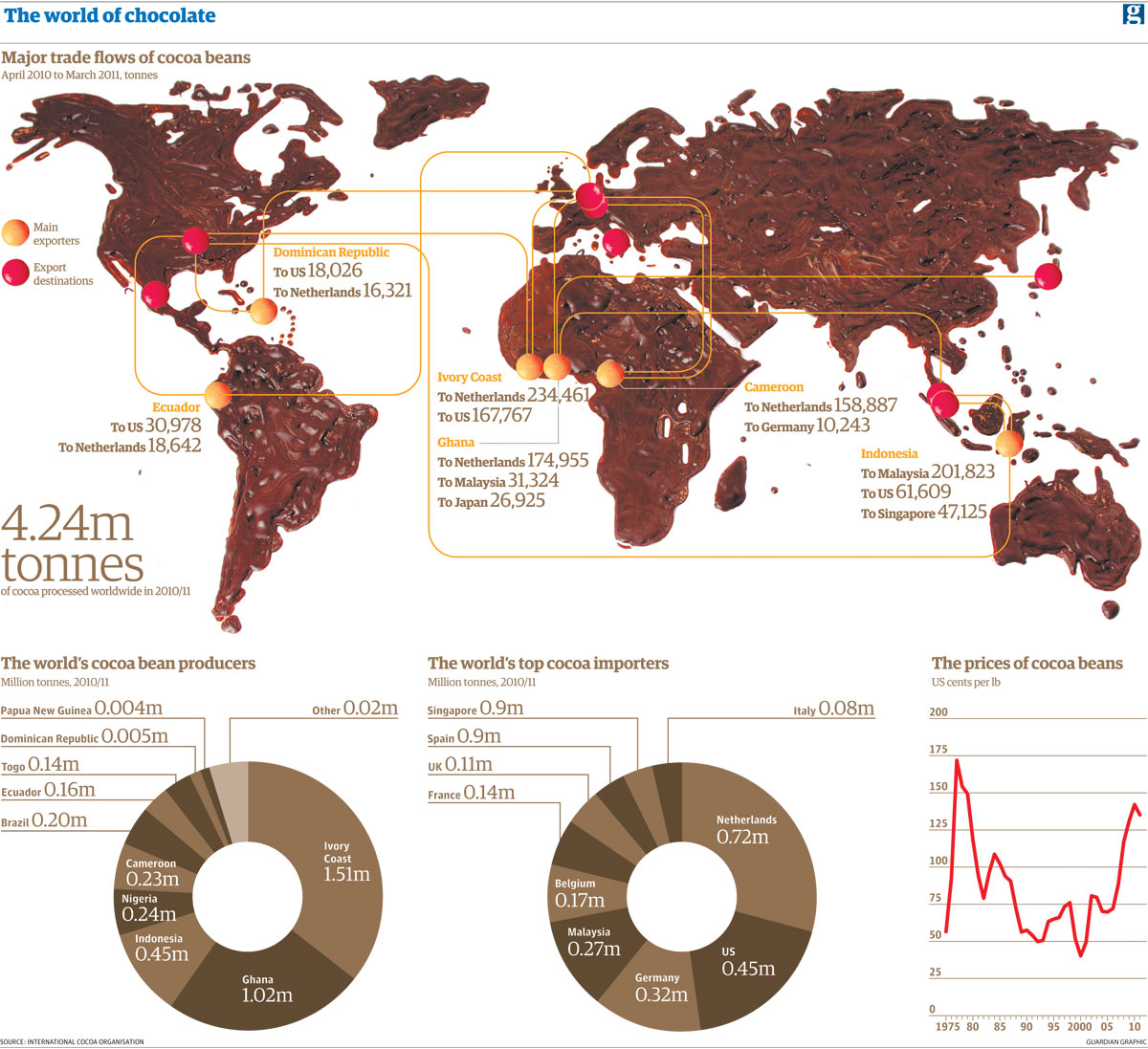
With chocolate consumption going global, one of the trends was for Europe to become the largest consumer of it. However, since European climates proved unsuitable for cocoa growing, this proved to be something of a quandary for sourcing cocoa. The Dutch colonized Indonesia and cocoa was grown there since its climate proved to be amenable. Other Europeans followed suit: Today's largest growers trace their cocoa production to colonial times: Cote d'Ivoire (France) and Ghana (Great Britain). See the Guardian's infographic on where chocolate is produced and consumed today:

It is against this background of lost choco-hegemony to West Africa that Central and Southern American regions are attempting a comeback. First, connoisseurs of the finest European chocolates know that the best cocoa beans are grown in the place they were first "discovered." To be honest, cocoa quality is not as important for American consumers who prefer chocolates full of sugar and milk (milk chocolate) unlike European consumers who focus on the taste and texture of largely unadulterated cocoa (dark chocolate):
The cocoa beans from Central and South America are known as being of high quality — fulfilling a certain niche, especially among consumers in Europe...

But Latin America can make a dent if demand for high-quality cocoa rises. Cocoa production “could change depending on how the market evolves,” said Moises Gomez of the ICCO [International Cocoa Organization; it should be ICO then]. “Most of world demand is for normal cocoa and it comes mainly from West Africa. Fine cocoa, which accounts for five percent of demand, comes from Latin America,” Gomez said. “Europe is the biggest buyer of top-grade cocoa,” he said.


“Americans are used to chocolate with a high milk and sugar content, and for that, you do not need high-quality cocoa [read: Hersheys]. But when you want a dark cocoa with good taste, you look for cocoa from Latin America or Madagascar,” he added...


Weather conditions and soil are the things that contribute most to the taste of the various grades of cocoa, said Gomez. He said while several high grades of cocoa were planted in Africa, they were not of the same quality as those in Latin America. All the different strains, from garden variety to hybrids, grow well in Latin America. And this happens in much of the region.


Second, even the likes of the Ivory Coast and Ghana may not be able to produce enough cocoa to meet global demand as China and India become populous consumers of chocolate:
Thomas Pugh, a commodities specialist with the British investment consultancy Capital Economics, predicts a fairly strong increase in Latin American supply in the coming years. “The biggest producers will continue to be in West Africa, but the forecasts for Latin America are good,” he told AFP.

Demand for cocoa from emerging countries is booming, especially in China, said Florence Pradier, the secretary general of Paris-based chocolate association Alliance 7. That, paired with a strong resurgence in demand from traditional chocolate consumers in Europe and North America, is good news for producers. According to a recent report by the French commodity research group Cyclope, demand in Asia is also being driven by India, with the strongest growth in the world at 20-25 percent a year.

So many years after the barbarity of Hernan Cortes that's been immortalized in song, it appears the Americas are on the cusp of  cocoa comeback after being marginalized for so long. What's interesting is how Europeans prefer (Central and South) American chocolates to the sorts produced in their former West African colonies if given a choice, while average North American consumers couldn't care less about cocoa quality. As long as the stuff is milky and sweet, the Yanks will eat it. I guess geography was not arranged to suit tastes. 

Anyway, cue up the Neil Young. Cortez, what a killer:

He came dancing across the water
With his galleons and guns
Looking for the new world
In that palace in the sun.


On the shore lay Montezuma
With his coca leaves and pearls
In his halls he often wondered
With the secrets of the worlds.

Pssst...Anyone Notice Done Japan-Australia FTA?

♠ Posted by Emmanuel in ,, at 4/07/2014 04:48:00 PM
 While the Trans-Pacific Partnership is on hold partly due to Japanese intransigence--more on this later--two TPP negotiators have nevertheless concluded a bilateral deal. The Japanese get improved market access for manufactured goods to Australia including those old standbys consumer electronics and automobiles. In exchange, the Australians will gain improved (selective) agricultural market access. Yes, rice is off the table--this is Japan after all--as are certain varieties of beef sacred to Japanese farmers. However, less sensitive agricultural product categories in Japan have been opened to Australian exports. The headlines make it sound like a (sorry) cars-for-cows deal:
Japanese media reported Australia would drop its five percent duty on small and mid-sized Japanese cars, while Tokyo had agreed to cut its steep tariff of 38.5 percent on Australian beef by up to half for some varieties.
For some reason, most news coverage is emanating from Australia and very little from Japan. Still, sentiment in Oz is fairly positive towards the FTA:
News Corp Australia revealed this morning that the price of an average imported Japanese car in Australia will drop by up to $1500 with the existing five per cent tariffs on imported cars axed. A similar FTA recently secured with Korea was estimated to be worth savings of $700 a year for the average Australian family....

Australian agriculture will also be allowed unprecedented access to Japanese markets with tariffs eliminated on the majority of horticultural products. Cheese and wine makers and sea food producers will also be given greater access to sell products into Japan with tariffs cut on some while others will benefit from a lifting in quotas. As expected, rice was excluded from the deal.
From my point of view, it's simply the Japanese strategically making agricultural concessions to keep up with the Koreans who inked a soon-to-be-implemented deal with Australia and feared being left at a competitive disadvantage down under. It's largely to maintain competitive parity since the tariff reductions will largely duplicate those given to the Koreans:
Australia will abolish a five-percent import tariff on most South Korea-made cars while a five percent tariff on other South Korean exports such as TVs, refrigerators and machinery would also be eliminated immediately. Tariffs will also go on resources, energy and manufactured goods, while the deal will open the door to new market opportunities for Australian services in education and telecommunications.

Buying Thai Rice: PRC Now Cares About Corruption?

♠ Posted by Emmanuel in , at 2/04/2014 11:22:00 AM
Yinglucks legacy is a colossal waste of food and money
China is famous for espousing a policy of non-interference in the internal affairs of other countries. This, of course, is in contrast to Western powers who usually demand "good governance" for aid or investment in terms of lessening corruption, promoting democracy and so on. Critics say that in doing so China undermines others' efforts to instill better governance. On the other hand, China says it does not meddle with others' business--especially other developing countries that have grown tired of Western paternalism.

It is thus interesting how China seems to be bowing to pressures regarding the purportedly corrupt practices of the Thai leadership. In previous posts, I have detailed the extravagant waste of money [1, 2] that is the rice-pledging scheme which subsidizes rice producers to the tune of 40-50% over market value. To reduce mountains of rice purchased at above-market rates which now go unused, the current leadership hit on the brilliant idea of selling part of its stockpile to China.

But surprise, surprise--even the Chinese are not honoring previous commitments due to the current investigations into corruption allegations stemming from the so-called rice-pledging scheme:
China has canceled a deal to buy 1.2 million tonnes of Thai rice after Thailand's anti-corruption agency launched investigations into a state rice-buying scheme, the Thai commerce minister said on Tuesday. The cancellation will add to the pressure on Thailand's government, which is struggling to secure funds for the rice scheme at a time when farmers who have not been paid are protesting in the provinces.
"China lacks confidence to do business with us after the National Anti-Corruption Commission started investigations into the transparency of rice deals between Thailand and China," Niwatthamrong Bunsongphaisan told reporters.
The deal between Thailand and Chinese state enterprise Beidahuang was signed on November 20, for delivery starting in December. The shipment was delayed, however, after Prime Minister Yingluck Shinawatra dissolved parliament in December.
If anything else, the Chinese snub is going to put further financial pressure on this money-losing vote-buying scheme to win the support of rural populations in the North who've voted for the Shinawatras:
The government is desperate to get funds for the scheme because some farmers who have sold grain to the state have been waiting for months for their money. The World Bank has estimated annual losses of 200 billion baht ($6 billion) since it was introduced in 2011. The government has struggled to sell the rice because of its high price at a time when global demand is thin. 

Opponents of the government are angry that taxpayers are footing the bill for a program they call tantamount to vote-buying.
The endgame for Yingluck Shinawatra is drawing even closer, with troubles being added by a most unexpected source--China of all parties suddenly becoming concerned with corruption. Weird. Meaningless elections aside, what will likely happen is court persecution of Yingluck Shinawatra over the rice-pledging scheme (tacitly supported by the military and royalty) leading to her ouster. Farmers complaining about not being paid will only undermine her support further, making her easy prey for her opponents. 

All the same, Thaksinite politics are hardly finished--especially if his sister is ousted through extra-electoral means. The real question is why big brother Thaksin did not dissuade her from embarking on this ruinous rice subsidizing path given his vastly broader political experience. In the ultimate hardball of Thai politics, amateurs like little sister Yingluck get smashed fairly quickly.

Business as Usual: Thailand Back in Crisis Mode

♠ Posted by Emmanuel in , at 11/27/2013 11:50:00 AM
There is an anarchic quality to Thai politics that has to be seen to be believed. At regular intervals, mass protests, military coups and other forms of upheaval toss out leaders whether they are democratically elected or otherwise. Since the turn of the century, media mogul Thaksin Shinawatra--sort of an Asian Silvio Berlusconi--has dominated the political scene, being PM from 2001 to 2006, when he was ousted in a military coup. Since 2006, he has lived largely outside the country to avoid criminal prosecution. However, his allies have held office most of the time, including his sister Yingluck Shinawatra who was elected in 2011:
Although Thaksin or his allies have won every election in the past decade, the judiciary often undercuts him, illustrating how the billionaire former telecommunications tycoon and populist hero remains one of the most polarising figures in modern Thai history.

Since the 2006 coup, court rulings have removed two prime ministers, disbanded four parties, jailed three election commissioners and banned 220 politicians. The military will be watched closely. A major force in politics since Thailand became a democracy in 1932, the military has staged 18 coups - some successful, some not - and made several discreet interventions in forming coalition governments, almost all with the tacit backing of the royalist establishment that now reviles Thaksin.
Now Yingluck Shinawatra finds herself in trouble. She recently tried to ramrod legislation that would grant Thaksin amnesty, but to no avail. Instead of bringing big brother home, she has raised the ire of the middle class Bangkok-based opposition. I've already called her Badluck Shinawatra for her terribly expensive and quite frankly unaffordable populist policies of supporting rice farmers in Thailand's north and northeast. Aside from trying to bring home their bete noire Thaksin home scot-free, Thailand's deteriorating economic situation is driving much unrest as ten of thousands have, well, Occupied Thailand's Government Offices:
Thousands of anti-government demonstrators kept up pressure on the Thai government Wednesday by surrounding more official buildings amid the highest tensions the country has seen since deadly unrest three years ago. The protesters in Bangkok continued to occupy the finance ministry building, which they stormed Monday and turned into their secondary command center.

They plan to send groups to a range of other ministries and government offices around the capital Wednesday, said Akanat Promphan, a spokesman for the protesters. Their objectives include the public health, labor, industry, social development and science ministries, as well as a government complex that houses multiple agencies, notably the Department of Special Investigation. The number of demonstrators, led by the opposition Democrat Party, has declined from the huge gathering of roughly 100,000 people that assembled in Bangkok on Sunday.
So those are the politics; now for the economy part. The Thai baht and the stock market are both plunging. Part of the pressure comes from Yingluck trying to auction bonds to pay the rice subsidies she vows will remain in place. Since October (harvest season), the government has failed to pay the farmers. These auctions have not succeeded either in selling the entire amount on offer, raising fears among Yingluck's allies. After all, if the farmers desert her due to non-payment of subsidies, the Thaksinite political base will be angry:
At least four sales of three-year debt in Thailand have failed to raise the targeted amounts in July and August. The notes yesterday were sold at a yield of 3.53 percent, 39 basis points higher than similar-maturity sovereign bonds, Chularat Suteethorn, head of the Public Debt Management Office, said. The securities were issued on behalf of Bank for Agriculture & Agricultural Cooperatives, which is helping to support farmers by purchasing rice at above-market prices. 
There is another large auction scheduled for Friday, November 29. If that too fails (and it looks like it will), you can bet more economic turmoil will hit Thailand and add fuel to the protester's ire at the government. Call this another example in how democracy does not always work. Sure these Southeast Asian equivalents of (Venezuelan) Chavistas are very good at winning elections, but their policies are largely unsustainable redistributive initiatives.

In the end, you got the government you deserve if you vote for this kind of nonsense.