Showing posts with label APEC. Show all posts

Geo/Econ Challenged: UK in CPTPP?

♠ Posted by Emmanuel in ,, at 3/31/2023 01:27:00 PM
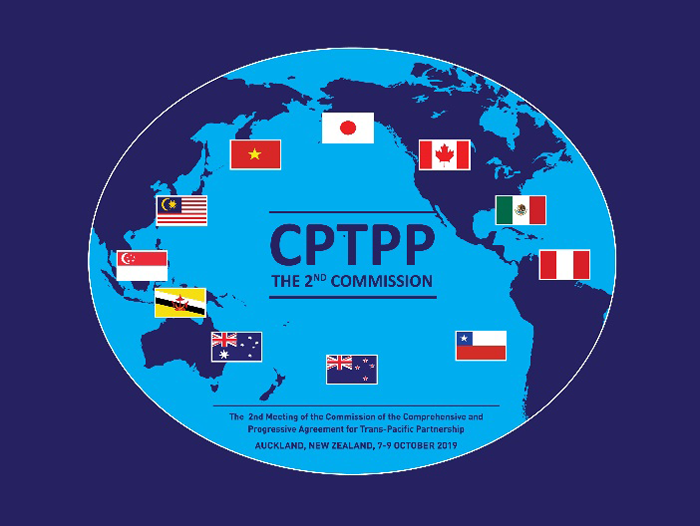
Second CPTPP Commission Meeting Logo
The UK will soon join this group, but does it really matter?

It has somehow come to pass that the UK has now joined an Asia-Pacific trade agreement. OK, so the free trade agreement in question is not the US-led Trans Pacific Partnership, but rather the US-absent Comprehensive and Progressive Agreement for Trans-Pacific Partnership (CPTPP). Moreover, the Pacific is vast: the world's largest ocean is said to contain over half the world's waters. Still, an undeniable fact is that the UK is not in the Pacific. (The last time I checked, it also belonged to this group called the "North Atlantic Treaty Organization".)

Chalk this oddity up to the Brexiteer pledge that leaving the European Union would somehow leave it better off by signing up to FTAs worldwide, and not just with the UK's neighbors. There are a few things to unpack before getting to the significance of this announcement, so here's a quick recap:

  • The trade-averse US government has continued post-Trump, meaning the US seems to have no intention of (re-)joining CPTPP. 
  • Lacking a firmly "Western" prestige partner, the remaining CPTPP countries likely decided to allow negotiations to proceed with the UK anyway.

Now, to the crux of the matter: are there significant economic benefits to be reaped by the UK from this agreement? The UK government estimates that their economy will gain 0.08% as a result over 10 years. 0.08%. To me that seems to be a rounding error instead of a significant gain. Put it down to the UK already having existing FTAs with most CPTPP members and trading far less with these Asia-Pacific nations than with its European neighbors:

The Comprehensive and Progressive Agreement for Trans-Pacific Partnership - or CPTPP - was established in 2018, and includes Australia, Brunei, Canada, Chile, Japan, Malaysia, Mexico, New Zealand, Peru, Singapore and Vietnam. Membership of the CPTPP loosens restrictions on trade between members and reduce tariffs - a form of border tax - on goods.

However, the gains for the UK from joining are expected to be modest. The UK already has free trade deals with all of the members except Brunei and Malaysia, some of which were rolled over from its previous membership of the EU. And even with some gains in trading the government only estimates it will add 0.08% to the size of the economy in 10 years. The Office for Budget Responsibility (OBR), which provides forecasts for the government, has previously said Brexit would reduce the UK's potential economic growth by about 4% in the long term.

Simply put, joining CPTPP would only claw back, oh, 2% of the economic output lost from leaving the EU. It's as close to non-news as you can get in the economic realm.

Biden's 'FTA-Less' IPEF Asia-Pacific Deal

♠ Posted by Emmanuel in , at 5/28/2022 12:31:00 PM

Japan usually goes along with US economic plans... but how about other Asian countries? 
 

Before Trump, the Republican Party represented the pro-trade American political party--especially in contrast to the trade union-dependent Democratic Party. Although Democratic presidents like Clinton and Obama promoted free trade agreements, they relied on Republican support to push FTAs through. After Trump, 'free trade' has become a dirty term in American politics regardless of party. So how is President Biden to shore up America's presence in the Asia-Pacific after his predecessor Barack Obama proposed the Trans-Pacific Partnership subsequently abandoned by Donald Trump? The answer is... do away with 'free trade' altogether.

I am not sure what appeal Biden's Indo-Pacific Economic Framework for Prosperity [IPEF] offers to Asian countries absent the usual tariff reductions. The details of IPEF are still very much to be determined based on consultations with the proposed participants. At best, it could represent useful technical assistance to others about making their economies more connected, resilient, clean, and fair. At worst, it could actually worsen trade access--especially to the vast American market--by imposing developed country environmental and labor standards on developing countries.  

At this stage, all we have to go on are the following bullet points:

  • Connected Economy: On trade, we will engage comprehensively with our partners on a wide range of issues. We will pursue high-standard rules of the road in the digital economy, including standards on cross-border data flows and data localization. We will work with our partners to seize opportunities and address concerns in the digital economy, in order to ensure small and medium sized enterprises can benefit from the region’s rapidly growing e-commerce sector, while addressing issues is such as online privacy and discriminatory and unethical use of Artificial Intelligence. We will also seek strong labor and environment standards and corporate accountability provisions that promote a race to the top for workers through trade [my emphasis].
  • Resilient Economy: We will seek first-of-their-kind supply chain commitments that better anticipate and prevent disruptions in supply chains to create a more resilient economy and guard against price spikes that increase costs for American families. We intend to do this by establishing an early warning system, mapping critical mineral supply chains, improving traceability in key sectors, and coordinating on diversification efforts.
  • Clean Economy: We will seek first-of-their-kind commitments on clean energy, decarbonization, and infrastructure that promote good-paying jobs. We will pursue concrete, high-ambition targets that will accelerate efforts to tackle the climate crisis, including in the areas of renewable energy, carbon removal, energy efficiency standards, and new measures to combat methane emissions. 
  • Fair Economy: We will seek commitments to enact and enforce effective tax, anti-money laundering, and anti-bribery regimes that are in line with our existing multilateral obligations to promote a fair economy. These will include provisions on the exchange of tax information, criminalization of bribery in accordance with UN standards, and effective implementation of beneficial ownership recommendations to strengthen our efforts to crack down on corruption.

Right now, IPEF is still nebulous enough to be vaporware. For others, there is a possibility that IPEF is largely downside (a grab bag of broadly protectionist US priorities) without upside (enhanced market access especially through lower tariffs).

APEC Vaporware: Free Trade Area of the Asia-Pacific

♠ Posted by Emmanuel in ,, at 11/11/2014 02:57:00 PM
Put 'er there, pal, put 'er there (which is precisely nowhere).
This is a quick interjection since I've already made a lengthier post on the unlikely resurrection of an APEC-based Free Trade Area of the Asia-Pacific (FTAAP) proposal originally dreamed up by the Americans that got nowhere...only to be revived by the Chinese to counter another American-led FTA initiative in APEC, the Trans-Pacific Partnership (TPP). To be sure, Beijing has scored some cheap PR points that the media has mistakenly picked up by flogging FTAAP anew: "APEC Leaders Endorse China-Led Free Trade Zone" says the Voice of America. "APEC Summit: Chinese Trade Pact Plan Backed by Leaders," the British Broadcasting Corporation chimes in.

If you actually read the text of the leaders' declarations, however, the FTAAP reality is much more modest. What APEC leaders have actually said is that they will commission a study that will be done by 2016 on the prospects for an FTAAP:
Launch a collective strategic study on issues related to the realization of the FTAAP by building on and updating existing studies and past work, providing an analysis of potential economic and social benefits and costs, performing a stocktake of RTAs/FTAs in force in the region, analyzing the various pathways towards the FTAAP, assessing impacts of the “spaghetti bowl” phenomenon on economies, identifying trade and investment barriers, identifying challenges economies may face in realizing the FTAAP, and considering any recommendations based on the study’s findings. The CTI Friends of the Chair Group on Strengthening REI and Advancing FTAAP, led by member economies, will organize and lead a task force to undertake the study and will seek contributions from interested APEC economies, the APEC Policy Support Unit, ABAC [APEC Business Advisory Council], PECC [Pacific Economic Cooperation Council] and APEC Study Centers. The linkage with the second term review of Bogor Goals will be strengthened while carrying out this study. The CTI and SOM will review progress annually, finalize the report, along with any recommendations, arrived at by consensus, and submit them to Ministers and Leaders by the end of 2016.
All the APEC honchos agreed to, then, is to ask a bunch of folks in an alphabet soup of APEC-related bodies to write some report due at the end of 2016. Big deal. There is no guarantee that they will act on the completed report, let alone begin negotiations for an FTAAP. To consider this statement on the FTAAP as a "victory" for China is stretching matters very far indeed.

Actually, the FTAAP proposal is not only rather ineffectual but does not necessarily favor either the US or China's visions for a pan-regional FTA. Instead, the text does the diplomatic thing in stating that either the US-led Trans-Pacific Partnership or the China-led Regional Comprehensive Economic Partnership (RCEP) may be building blocks to including all member economies in an FTAAP:
The FTAAP should aim to minimize any negative effects resulting from the proliferation of regional and bilateral RTAs/FTAs, and will be pursued by building on current and developing regional architectures. Greater efforts should be made to concluding the possible pathways to the FTAAP, including the TPP and RCEP.
It beats me how they'll avoid trade diversion by doing nothing to discourage the proliferation of pan-regional FTAs, but for FTAAP itself, it's much ado about nothing. It's APEC pencil-pushing--vaporware--at its finest.

Austerity Victim: APEC Leaders' Fancy Dress Party

♠ Posted by Emmanuel in at 11/15/2011 09:08:00 AM
Once upon a time there was a tavern
Where we used to raise a glass or two
Remember how we laughed away the hours
And dreamed of all the great things we would do...

Those were the days, indeed, as Mary Hopkin once sang. Remember in bygone years when Asia-Pacific Economic Cooperation (APEC) leaders would show unity by wearing national costumes that made Western heads of state in particular look ridiculous? I am afraid that we may have moved on from that tradition when the world was younger and somewhat more innocent. In a twisted form of hegemony, it appears that our American friends started and have now done away this tradition--at least for now. According to the UK Independent, Clinton started this gimmick in 1993 after giving each APEC leader a bomber jacket to be photographed in what has become known as the "APEC leaders' family photo."

I hope that you immediately noticed what was very conspicuously missing in the group photo above at the completion of the APEC leaders' meeting in Honolulu this year. Instead of your traditional jaunty outfits alike in the photo below taken from the 2006 gathering in Vietnam, they have apparently reverted to bog-standard business formal attire. Talk about a disappointment! Admittedly, though, Obama has never looked out of place the way Bush used to while wearing traditional garb.

So, why did Obama allegedly ditch the fancy dress when the hosting city was Honolulu--certainly a rich source of sartorial possibilities? For what it's worth...
Obama seemed content to play the stuffed shirt. Never mind that he is a native of the islands and having the Pacific Rim leaders show off the shirts might have provided a nice boost to tourism. A braver host might have offered the leaders other fashion options: grass skirts perhaps, or surfer-dude attire. Even the famously dour Richard Nixon once sported an Aloha shirt when campaigning for the White House on the archipelago. (His was of lurid hibiscus design...)

[Obama said:] "I got rid of the Hawaiian shirts because I looked at pictures of some of the previous Apec meetings and some of the garb that appeared previously and I thought this might be a tradition that we might want to break," Mr Obama told reporters. "I didn't hear a lot of complaints about breaking precedent."
Well the region is all the poorer for it, I say. The explanation going around for this decision was that, during these difficult times, leaders are wary of looking frivolous. While the White House did commission special outfits beforehand, there was some kind of consensus around not wearing them this time:
Honolulu clothing company Tori Richard, Ltd., designed both the APEC shirts worn by organizers and volunteers and a special APEC-themed shirt for the 21 world leaders, said Josh Feldman, company president and chief executive officer. Feldman said Tori Richard was contacted directly by the White House earlier this year and commissioned to design the shirt.

"We produced 21 shirts in the design that at the White House's request, we not show to the public until the leaders were given the shirt as a gift," Feldman said in an email. "While we are disappointed a decision was made not to wear them for the iconic photo, we were still honored to be selected."
Once again demonstrating how Bill Clinton understands politics more than Barack Obama, here's the former's take on the tradition he helped establish:
In her autobiography, Cherie Blair, wife of former British Prime Minister Tony Blair, revealed some of the political calculations that could lie behind even the simple act of donning a fancy outfit overseas. She said that her husband was given a lesson in international politics at a summit in Japan where she said Clinton chose the most hideous shirt offered to world leaders.

“Why on earth did you do that?” Tony Blair asked Clinton, according to the book written by the wife of the British leader then. “Take it from an old-timer,” Clinton told the British prime minister before explaining to the latter that his less offensive shirt was a naive political choice.

“Now you, Tony, wearing that particular shirt, people at home might conceivably think that you chose to wear it,” Clinton was quoted as saying. “Me, wearing this shirt, everybody at home is going to think, Boy is that Clinton diplomatic, being so nice to those foreigners. There’s no way he would have chosen to wear that. What a good man he is.”
IMHO, Obama lost a chance to "humanize" himself and his peers at a time when political elites are increasingly becoming seen as a homogeneous suit-wearing class. Not a very good show--take it from the big dog Clinton himself.

Those were the days, oh yes those were the days.