Showing posts with label Mining. Show all posts

Did Obama Kill Coal Industry...or Did (post)Modern Times?

♠ Posted by Emmanuel in , at 8/10/2015 01:30:00 AM
There has been a series of informative articles and op-eds in Bloomberg discussing the plight of the American coal industry [RIP...sort of...read on]. Big Coal is fighting wars on two fronts. The first, obviously, is the environmental one: burning coal generates more carbon dioxide than most other energy sources for the equivalent amount of energy. Speaking of which, natural gas is rapidly supplanting coal as an energy source that's not only cleaner but also cheaper. So, the initial article concerns how coal firms have stopped paying dividends to stockholders, which makes perfect sense in that you need to have earnings in order to pay out dividends. Needless to say, coal firms aren't making that much nowadays.
When Peabody Energy Corp. announced it was suspending quarterly payments to shareholders to save cash, it marked the end of an era for traditional U.S. coal miners. Coal, for decades viewed as a stable investment, is now fighting for its life. Earlier this year, Arch Coal Inc. halted its dividend and has been warned by the New York Stock Exchange it could be delisted if shares stay below $1. Walter Energy Inc., which also suspended its payout, and Alpha Natural Resources Inc. have been dropped by the exchange. Walter filed for bankruptcy earlier this month.

Tuesday’s announcement from Peabody, the largest U.S. coal producer, came minutes after Consol Energy Inc., a company increasingly focused on producing natural gas, cut its dividend to 1 cent from 6.25 cents.
So America's largest coal firm has stopped paying dividends like everyone else. Another controversy concerns Obama's "Clean Power Plan" meant to rein in carbon emissions specifically. This law would supposedly put lots of coal miners out of business. In fact, the second-largest US coal firm declared bankruptcy right before Obama made his speech:
As the White House puts its cards on the table, the second-largest U.S. coal producer is folding its current hand and reshuffling. Alpha Natural Resources declared bankruptcy this morning to get out from under $3.3 billion in debt accumulated over the past several years. The specific timing of its filing—hours before the EPA publishes its rules—may be coincidental. That it has happened at all is not.

Several factors converged to bring about coal's collapse, of which Obama is only the easiest for coal industry leaders to blame. There's the U.S. natural gas boom, which gave power producers a cheaper, less-polluting alternative. Coal companies took on debt around 2011, when Chinese demand pushed prices up globally, according to Bloomberg. That binge has wound down since then, taking coal prices with it, and coal companies like Alpha Natural Resources are left holding the bill.
Michael Bloomberg being a green activist, it is no surprise that he says it's not Obama's fault that coal is going the way of the dodo Stateside. Rather, then market is responsible for this turn of events:
Critics of the Environmental Protection Agency’s new Clean Power Plan are describing it in apocalyptic terms. But much of what they believe about the plan -- that it will destroy the coal industry, kill jobs and raise costs for consumers -- is wrong. And it’s important to understand why.

The overblown political rhetoric about the plan tends to obscure the market reality that the coal industry has been in steady decline for a decade, partly as a result of the natural gas boom, but mostly because consumers are demanding cleaner air and action on climate change. Communities across the U.S. have led the way in persuading utilities to close dirty old coal plants and transition to cleaner forms of energy. The Sierra Club’s grass-roots Beyond Coal campaign (which Bloomberg Philanthropies funds) has helped close or phase out more than 200 coal plants over the past five years.

The primary reason for the public revolt against coal is simple: It causes death, disease and debilitating respiratory problems. A decade ago, coal pollution was killing 13,000 people a year. Today, the number is down to 7,500, which means that more than 5,000 Americans are living longer, healthier lives each year thanks to cleaner power. 
From an environmental standpoint it would be easy to follow what Bloomberg says, but then again, he's a Noo Yawker not attuned to the sensitivities in the coal belt states. My first reaction when reading these stories was "huh, they still have coal companies in America?" Nevertheless, it is entirely possible for an upcoming battle royale to emerge pitting the administration against the coal miners and their allies. In mid-Eighties Britain, it was an epoch-making fight. I don't foresee that same amount of divisiveness repeating itself in the US, but I think that fancy boys like Bloomberg will be surprised at how much opposition a "sunset" industry and its allies will be able to put up.

Diversifying Zambia's Copper-Based Economy

♠ Posted by Emmanuel in , at 7/18/2014 09:42:00 AM
Welcome to Zambia's Copperbelt.
Commodity-based economies are often Johnny-One-Note economies: their fortunes rise and fall based on those of a single commodity (or at best, a handful of them). In Africa, Zambia has had boom and bust cycles based on copper. During the Cold War, its preeminence was such that it once ranked as the world's third-largest producer after the US and the USSR during the late 60s. As copper prices have waxed and waned, Zambia's economic well-being has largely followed a similar path.

So many decades later on, Zambia is emblematic of the challenges these commodity-based economies face of moving towards more diversified sources of economic output: 
The country’s economic development over the past decade has not attracted as much attention as some other African states, such as the oil economies of Angola, Nigeria and Equatorial Guinea, yet Zambia’s success has been almost as dependent on the export of a single commodity – in this case, copper. The government has pledged to reduce its dependence on copper exports, but there is no doubt that Zambia has benefited from its mineral wealth. China’s economic explosion and the long boom in the global telecoms industry has pushed up demand for Zambian copper, so the country now exports more and generates increased income per tonne of production. Annual copper production increased from 257,000 tonnes in 2000 to more than 900,000 tonnes last year, with the government setting a target of 1.5 million tonnes for 2015.
To be sure, there have been some moves towards diversification:
Some progress was made on rebalancing the economy last year. The strongest performing sectors during the year were transport, storage and communications, with a 27.1 per cent rise in GDP; construction (24 per cent); community, social and personal services (17.4 per cent); financial institutions and insurance (13.7 per cent); manufacturing (8.2 per cent); and mining (five per cent). In common with the rest of the continent, most people are employed in agriculture and it is here that stronger growth had most effect on living standards.
However, the noteworthy thing about African nations' efforts to diversify is that, well, there is not much diversity to them in emphasizing infrastructure:
Following a continent-wide trend, the government is banking on infrastructural improvements to help drive private sector development. The country’s road network is being upgraded, in urban and rural areas, to enable farmers to transport their crops to market – even during the rainy season. A total of 8,000 km of road is to be surfaced and sealed by 2017, taking the total to 16,000 km. Much of the work is being carried out by Chinese companies and funded by Beijing or Lusaka itself. The country’s first Eurobond issue in 2012 was 15 times oversubscribed and raised $750 million, but yields on the bond have increased as government spending has risen and another issue may be required later this year. In addition, Lusaka has taken out a wide range of loans with various Chinese state-owned organisations, probably on attractive terms, but whose details have not been published. 
I am of two minds on infrastructure as a development tool. On one hand, it may simply expedite the extractive (copper) trade by making it easier to get ores out of the country. OTOH, other industries should also benefit, but the details of what industries benefit and how infrastructure is geared to meet their needs in scant As any number of other countries also demonstrate, diversification is difficult.

Rating Countries by Mining Policy Attractiveness

♠ Posted by Emmanuel in at 6/23/2014 02:00:00 AM
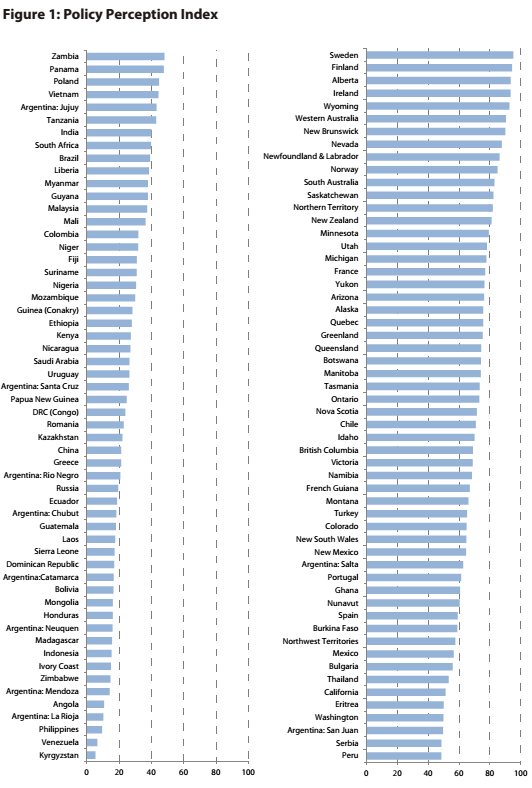
To no one's surprise, investors say Sweden has the best mining policies.
More so than the amount of extractable resources or the economic conditions in a particular country, I'd argue that the political climate is more important in determining its attractiveness to investors. Even in this day and age, mining remains a key industry, especially since many high-tech goods rely on certain minerals. Nor have we moved into a post-hydrocarbon age for powering the world economy. Canada's Fraser Institute produces an annual survey that ranks countries on these criteria, and the latest one shows definite trends. In general, developing countries with their poorer governance lag behind developed ones. Indeed, those concentrated at the bottom and the top are instructive. In general, poor performers have some shared characteristics:
  1. The leaders are leftist nutters who may expropriate you at any time;
  2. Mining regulations are unclear regarding what areas can be mined, what areas are protected and what the government's share of the revenues are;
  3. Other rules regarding the environment and foreign direct investment are similarly unclear.
In other words, highly uncertain political environments tend to rate lower regarding policy perceptions. Here is a brief description from the Fraser Institute:
Policy Perception Index: A “report card” to governments on the attractiveness of their mining policies. While geologic and economic considerations are important factors in mineral exploration, a region’s policy climate is also an important investment consideration. The Policy Perception Index (PPI), referred to in previous surveys as the Policy Potential Index, is a composite index, measuring the overall policy attractiveness of the 112 jurisdictions in the survey. The index is composed of survey responses to policy factors that affect investment decisions. Policy factors examined include uncertainty concerning the administration of current regulations, environmental regulations, regulatory duplication, the legal system and taxation regime, uncertainty concerning protected areas and disputed land claims, infrastructure, socioeconomic and community development conditions, trade barriers, political stability, labour regulations, quality of the geological database, security, and labor and skills availability. The PPI is normalized to a maximum score of 100.
And here is the entire policy perceptions ranking. As usual, it is galling that countries that could benefit the most from stable and predictable mining policies are those which do worst:

Is 'Responsible Mining' an Oxymoron?

♠ Posted by Emmanuel in , at 5/26/2014 02:00:00 AM
Like other extractive industries, mining elicits much hand-wringing among leftists about labor exploitation, environmental degradation, and the decimation of indigenous cultures in mining communities. As a more practical sort, I appreciate how mining makes modern life possible, from the computers leftists design their accusatory banners with to the cell phones they use to organize the overthrow of bourgeois capitalist scum with. In urbanized societies, there is a squeamishness about where our food comes from (slaughtering animals) and where the raw materials that make modern life possible come from (mining) since we are removed from these activities. Animals bleed and die. Mounds of earth are dug up and disposed to gather tiny nuggets of copper and gold. Deal with it for it's always been that way as we fill the earth and subdue it. I certainly do not doubt there are flagrant violations of acceptable mining practices here and there, but I am not convinced that there is a real alternative to mining at the present despite all its problems. While bleeding hearts leftists always target big, evil MNCs, it also bears remembering that small-scale wildcat miners tend often get a free pass despite having similarly questionable practices since they are "indigenous."

Just recently, I was sent a notice by Elsevier about a new journal of their focusing just on mining-related issues, The Extractive Industries and Society. Reading the first few articles, there is a definite leftist slant to the submissions. Still, Robin Broad offers a fairly interesting take on the whole idea of "responsible mining." Is it a contradiction in terms, or is it something we can actually achieve? She offers a number of different conceptions of the notion before offering her own:
  1. The neoliberal definition - To most corporate mining executives and, alas, also to many government officials, mining is responsible if it focuses on maximizing economic growth which, in turn, maximizes economic profits. The idea is that this formula will work to make everyone better off and in the most efficient way. This, of course, is what neoclassical economic theory tells us. In terms of social benefits, this is deemed ‘‘responsible’’ because the economic benefits will – again, in theory – multiply and trickle down to the poor. In terms of environmental impact, the ‘‘environmental Kuznets curve’’ purportedly proves that, at least in theory, as a country grows in economic terms, certain environmental pollutants decrease.
  2. The corporate social responsibility definition - A second use of the term ‘‘responsible mining’’ is a slight variation to the neoliberal definition, with the mining firm stating a clear commitment to that other buzzword: ‘‘corporate social responsibility.’’ Typically, this does not involve changing the production process itself. Rather, the corporation commits to using some of its profits to do something ‘‘good.’’ So, for instance, in the Philippines, the Canadian/Australian mining company OceanaGold has committed to ‘‘responsible mining,’’ a pledge which translates into planting trees at nearby sites, contributing to medical missions, and supporting community programmes in education and other areas.
  3. The structuralist definition - A third definition of ‘‘responsible mining’’ focuses on ‘‘responsibility’’ from the perspective of who receives the economic and financial benefits of mining. Just as the first definition builds on mainstream economic theory, this third is modern-day structuralism a` la Raul Prebisch (Prebisch, 1950). Structuralists focus on how to generate maximum economic benefits for the South (be it a specific country or the South in aggregate terms) rather than the North. This ‘‘paradigm’’ of responsible mining focuses on increasing the taxes that corporations pay to the Southern government (or doing away with tax holidays). 
  4. The fourth The final definition of ‘‘responsible mining’’ is what, in my view, it should really mean: a more comprehensive notion of economically, environmentally and socially responsible mining. Socially, as I have witnessed in the Philippines, Guatemala, and El Salvador, the presence of mining corporations invariably brings conflict and death to previously peaceful municipalities d consent’’ of local communities, especially before any corporate ‘‘contributions’’ are made to local officials or communities. Environmentally, responsibility involves careful assessment – based on full information and by a knowledgeable and objective party other than the mining corporation – of all possible environmental impacts of the mining. This includes an assessment of the impact of all chemicals proposed to be used in the mining process (typically cyanide used to separate gold from the rock), the toxins released by the mining (for example, arsenic is often released in El Salvador and elsewhere) as well as overall ‘‘acid-rock drainage’’, and the broader environmental impacts and risks. 
It's all quite interesting from the perspective of language games, but I am as always more concerned with action than rhetoric. Then again, you might take a constructivist stance is stating that rhetoric surrounding "responsible mining" actually shapes mining practices.

Gold, Copper and Neocolonialism in Peru

♠ Posted by Emmanuel in , at 8/10/2012 09:57:00 AM
As in any number of other countries, mining remains a most controversial industry in Latin America. If you want an industry which has every possible controversy going with it--pollution issues, labour issues, domestic revenue issues and foreign exploitation issues among others--look no further. It is not encouraging that the issues remain the same after all these years: Being unable to create local mining concerns of requisite sophistication, it remains the case that foreign mining concerns still possess the much-needed expertise to bring extractive industries' output to the world market.

This situation is playing out in Peru as we speak. Listening to the industry's critics and following recent events, it's as if the conquistadors and their rapacious habits never left the Cajamarca region:
North of this sprawling capital city [of Lima] and high in the Andes Mountains lies Cajamarca, a region well-known in Peru for two main reasons: the conquest of the Inca Empire by Spain’s Francisco Pizarro and the area’s extraordinary wealth of natural resources. Here, Colorado-based Newmont Mining Corp. has been operating Latin America’s largest gold mine, Yanacocha, since 1993.

The mine is nearing the end of its life and Newmont wants to develop the nearby $4.8 billion Minas Conga copper and gold project, which will be the biggest foreign investment in Peru’s history. But the project has run into intense local opposition and five people were killed during recent protests, causing the government to impose a state of emergency.

Opponents, led by Cajamarca’s president, contend that the project will harm scarce water resources in the area. Their position has clashed with that of Peruvian President Ollanta Humala, who officially announced his support for Minas Conga in late June. This conflict has become a high-stakes test of how Peru treats foreign investment. The country has more than $50 billion in mining investments in the pipeline and taxes from mining are a key source of government revenue.
The odd thing as followers of Latin American politics are concerned will point out is that Humala originally styled himself as a leftist in the Hugo Chavez mould. Yet, upon ascending to the presidency, he has been quite the opposite in liberalizing opportunities for foreign investment. Is he the Peruvian Fernando Henrique Cardoso? His opponents wish otherwise and desire a Hugo-alike according to some--especially in light of the coloured history of foreign miners operating in the region:
[Miguel] Santillana, an analyst at the Peru Institute who has also worked as a consultant for foreign mining companies said there was bad blood from the beginning between the local community and the Yanacocha mine operators, as people in Cajamarca tend to associate mining with abuse of resources. The current conflict over Minas Conga has much more to do with politics than environmental concerns and it’s an effort to redefine the country’s economic model, according to Santillana, who believes that political leaders in Cajamarca want to weaken Humala and redirect Peru toward left-wing policies like those pursued by Ecuador, Venezuela and Bolivia.

In late June, Newmont said in a statement that before it begins the construction of Minas Conga mining facilities, it will build water reservoirs that will benefit the local community. But this commitment failed to appease the project’s opponents and the conflict has escalated.
More recently, outright hostility has broken out as the regional president has told the foreign miners to pack up and leave--clearly in contrast to the desires of the central government:
The president of the Peruvian region of Cajamarca, Gregorio Santos, said there is no use continuing talks with two Roman Catholic priests trying to reach a peaceful solution to the dispute over the Minas Conga copper and gold project[...]between those who oppose the Minas Conga project and the company, which has been supported by the government of President Ollanta Humala.

"The facilitators have already completed their tasks," Mr. Santos said. "The facilitators aren't going to make any decisions. The executive branch already knows the position of the people of Cajamarca." Mr. Santos has been one of the main leaders of the opposition and the protests against the mining project in the northern region of Cajamarca. 
Call it a rebellion over mining, but for now, the state of emergency declared by the central government in this region continues.

Today's Resource Curse on Aussie Surfboard Mfg

♠ Posted by Emmanuel in ,, at 1/05/2012 04:36:00 AM
Little surfer, little one, make my heart come all undone...with your"Made in China" surfboard?

Is there nothing sacred about beach culture that the Chinese won't infiltrate with their relentless manufacturing machine? First you had them testing the Brazilian bikini industry. Now you have them putting Australia's equally famed surfboard makers to the test with inexpensive boards.

It may be odd that the Bloomberg article I excerpt here was the main story on the site front page, but closer inspection reveals that it's quite a straightforward application of resource curse theory: Enduringly strong global and in particular Chinese demand for Aussie minerals and deposits has appreciated the Australian dollar (AUD) massively, promoting both a decline in domestic manufacturing and an influx of foreign goods (that are often substitutes as the article notes). Given how seriously Australians take their surfing, emotions are running high as PRC-made wares come ashore in larger quantities:
On Australia’s Gold Coast, a 22-mile- long (35-kilometer) stretch of beaches named Surfers Paradise and Rainbow Bay, Neil Rech opened a surf shop in December and unwittingly disturbed the peace. His store, Sedition Surfboards [an apt name IMHO], sells Chinese imports for A$250 ($259), one-third the cost of some Australian-made boards that competitors are offering. Rival retailers averse to discounts and upset about local job losses questioned his patriotism, and even threatened violence, he said.

“It’s quite heavy,” Rech, 34, said of the backlash. After teaching for two years in China before opening a store in Coolangatta, Queensland, “I realized how cheap you can actually get these boards so I thought it’d be a great opportunity to bring them here and sell them to the public cheaper.”
And then we have a backgrounder on the economics of it all that are definitely unfavourable to the domestic industry:
Inexpensive imports from Asia, coupled with a 54 percent jump in the local dollar since October 2008, are delivering a double dose of pain to one of Australia’s most iconic industries. The struggles at surfboard makers are playing out at manufacturers across a country where China’s demand for iron ore and fuel has spurred a mining boom while leaving non-resource businesses behind.

Manufacturers are on the wrong side of a divide in Australia’s economy, which has avoided a recession since 1991 and boasts an unemployment rate of 5.3 percent, about half the level in Europe. While the number of mining jobs (AULQMINN) soared 21 percent to 242,400 in the fourth quarter from a year earlier, manufacturing employment slumped 4.4 percent to 953,500 and retail positions sank 2.2 percent to 1.21 million.
Chalk another one up for China. Now, if they only had a Beach Boys-like ensemble singing in Mandarin it would be a total appropriation of beach culture. Heaven knows, they've already got the beachwear arena, er, covered.

Clare Short, New Mining Transparency (EITI) Chair

♠ Posted by Emmanuel in , at 10/18/2011 02:32:00 PM
Here's a worthwhile initiative I may not have mentioned yet that should nevertheless gain more attention for the work it does. I suppose that it's only fitting that an initiative that was launched by Tony Blair (in 2002) should now be chaired by none other than his bete noire Clare Short. If you remember, Clare Short was the international development secretary (head of DfID) from when New Labour took the reins of power in 1997 to May 2003 when she resigned this post to indicate her disgust over UK participation in the Iraq invasion. Those were some days; dare I say when Brits still used to dream about the future.

In the meantime, let it not be said that the Extractive Industries Transparency Initiative (EITI) has been less than active. Devised to help follow the money in mineral-rich countries--it is hoped that doing so will help reduce chances for corruption and channel revenues to more productive purposes. That is, to reduce the resource curse so common to countries blessed with abundant resources.

Something promising is that mining firms are actually calling for EITI to monitor activities in countries where they have mining operations--a phenomenon similar to that in any number of other industries such as tea production (the Ethical Tea Partnership). Here is a snippet from a recent interview of Clare Short:

In your own work with international development issues, you have occasionally been a severe critic of extractive industries in developing countries. Can you now say that there are positive signs of a genuine will among oil and mining companies to change their behaviour and to be more open in their dealings – especially when working amid the weaker regulatory environments of developing countries?

There are many places where resource extraction has not delivered adequate benefits to local people. It remains true that resource-rich countries on average have more poverty than comparable non-resource rich countries.

A growing number of companies have woken up to the reality that in order to succeed in the long term, transparency is the way to go. They have learned the hard way about the risk involved in operating in countries where there is little trust and also the risk of corrupt practices which breach their domestic law. To mitigate these risks, and because they know that it is the right thing to do, companies are now working with governments and civil society in organisations such as EITI. In several countries, it is the extractive companies that are calling upon the national governments to act more transparently, and to implement the EITI standard.

I’m encouraged by the number of companies that are supporting EITI. I hope that this is a reflection of a desire to be part of the solution. But there are still many companies that do not really favour transparency and are only willing to permit very limited reporting, and maybe see the EITI as a fig leaf rather than a route to full transparency. Of course, governments can require fuller reporting, and some are doing so.

It's me here again. Also note that while EITI may not receive much press notice in North America, it is being widely implemented, with 35 countries signing up to it and a dozen having already being declared EITI-compliant...

Would you expect EITI compliance to become a global standard any time soon?

With 35 countries implementing the EITI [standard] and more joining, EITI is making good progress towards becoming a global standard. It is critical that countries don’t just stop at compliance: they can use the EITI platform to debate wider issues affecting their country. That might be bidding, contracting, operating, allocating or spending. It might be that the reports can go deeper to list payment-by-payment, or physical volumes or sales. It might be that the principles can be applied to other sectors – for example, forestry, fisheries or agriculture. We are seeing innovations in countries that really want to use the EITI as a route to better management of the whole of their extractive sector, thus improving the benefits of the sector to the citizens of their countries. To me, that is even more important than being a global standard.
-------------------------------

One hopes this tough, principled Brummie politician is just what the EITI needs to move its programmes forward.

PRC Rare Earth Metal Hoarding: Fake Trade Issue?

♠ Posted by Emmanuel in ,,,,, at 7/06/2011 12:03:00 AM
Given several new developments, today's a mighty fine time to update our coverage [1, 2] of worldwide rare earth metal availability provided its importance to modern industrial production. Beginning a year and a half ago, the US, EU and Mexico filed related WTO cases [DS 394, 395 and 398 respectively] challenging the PRC's use of quotas, export duties and licence requirements to limit exports of rare earth metals required in many high-technology products. With 95-97% of these metals emanating from the PRC at the present time, it is not a trivial problem for various manufacturing concerns abroad that rely on their supply. Although the PRC has claimed that environmental protection and conservation were the grounds for limiting exports, such claims have been undermined by largely unfettered access by local firms to these rare earth metals. The NY Times cheat sheet above graphically illustrates China's dominant position in sourcing these valuable materials.

To make a long story short, China has just been found in violation of trade rules via a ruling from the WTO's dispute settlement mechanism. Bloomberg offers a summary. The naturally pleased US Trade Representative claims victory while offering this version of what has just transpired:
U.S. Trade Representative Ron Kirk announced today that a World Trade Organization (WTO) dispute settlement panel has agreed with the United States, finding that export restraints imposed by China on several important industrial raw materials are inconsistent with China’s WTO obligations. China’s actions were not justified as conservation measures, environmental protection measures, or short supply measures. The raw materials at issue include various forms of bauxite, coke, fluorspar, magnesium, manganese, silicon carbide, silicon metal, yellow phosphorus, and zinc, and are used in a multitude of downstream applications in the steel, aluminum and chemicals industries...

The export restraints challenged in this dispute include export quotas and export duties, as well as related minimum export price, export licensing, and export quota administration requirements. These types of export restraints can skew the playing field against the United States and other countries in the production and export of numerous processed steel, aluminum and chemical products and a wide range of further processed products. The export restraints can artificially increase world prices for these raw material inputs while artificially lowering prices for Chinese producers. This enables China’s domestic downstream producers to produce lower-priced products from the raw materials and thereby creates significant advantages for China’s producers when competing against U.S. and other producers both in China’s market and other countries’ markets. The export restraints can also create substantial pressure on foreign downstream producers to move their operations and, as a result, their technologies to China.
The USTR's claims on "market distortion" grounds are straightforward: the Chinese are responsible for rare earth metal shortages worldwide that disadvantage foreign firms by limiting their availability while raising their prices. However, local producers do not face similar limitations. What's more, perhaps consistent with China's wish to be on the technological leading edge via knowledge transfer, such limitations encourage foreign manufacturers to bypass such restrictions by locating in the Middle Kingdom.

But is that all there is to this story? While the US, EU and Mexico chose the route of litigation to free up more supplies from China, Japan appears to have found a (potentially) superior solution: get these materials from non-PRC sources. And so we have another tale hot off the presses touting Japan's newfound sources that both cut out China and make these metals appear less rare than at first glance. Instead of being in Inner Mongolia, these finds are under the sea:
Vast deposits of rare earth minerals, crucial in making high-tech electronics products, have been found on the floor of the Pacific Ocean and can be readily extracted, Japanese scientists said on Monday. "The deposits have a heavy concentration of rare earths. Just one square kilometer (0.4 square mile) of deposits will be able to provide one-fifth of the current global annual consumption," said Yasuhiro Kato, an associate professor of earth science at the University of Tokyo.

The discovery was made by a team led by Kato and including researchers from the Japan Agency for Marine-Earth Science and Technology. They found the minerals in sea mud extracted from depths of 3,500 to 6,000 meters (11,500-20,000 ft) below the ocean surface at 78 locations. One-third of the sites yielded rich contents of rare earths and the metal yttrium, Kato said in a telephone interview.

The deposits are in international waters in an area stretching east and west of Hawaii, as well as east of Tahiti in French Polynesia, he said. [Kato] estimated rare earths contained in the deposits amounted to 80 to 100 billion tonnes, compared to global reserves currently confirmed by the U.S. Geological Survey of just 110 million tonnes that have been found mainly in China, Russia and other former Soviet countries, and the United States.
We then return to the geopolitics of it all:
A chronic shortage of rare earths, vital for making a range of high-technology electronics, magnets and batteries, has encouraged mining projects for them in recent years. China, which accounts for 97 percent of global rare earth supplies, has been tightening trade in the strategic metals, sparking an explosion in prices. Japan, which accounts for a third of global demand, has been stung badly, and has been looking to diversify its supply sources, particularly of heavy rare earths such as dysprosium used in magnets.

Kato said the sea mud was especially rich in heavier rare earths such as gadolinium, lutetium, terbium and dysprosium. "These are used to manufacture flat-screen TVs, LED (light-emitting diode) valves, and hybrid cars," he said.
As you would expect, there are qualifiers. First, Japan is not free and clear to mine them unlike if they were in its exclusive economic zone, i.e. its territorial waters. If it wishes to abide by international law which I presume it does, then it will have to consult with UNCLOS authorities--and likely with other countries which have manufacturing interests such as the litigants mentioned above. The Economist offers this take on potential complications:
Seafloor mining beyond countries’ territorial waters is regulated by the International Seabed Authority, set up under the United Nations Convention on the Law of the Sea. So far it has issued only eight licences, all for exploration, not production, all for nodules, not massive-sulphide deposits, and all to governmental or quasi-governmental agencies (of China, France, Germany, India, Japan, Russia, South Korea and an east European consortium). No wonder. Commercial miners want both a clear title to their holding and exclusive rights to exploit it. They also have to answer to shareholders.
Second, there are likely more technical obstacles to deep sea mining and, third, its environmental sustainability than the Japanese let on. From Nature News:
Current on-land mines, and sites picked out for future mines, have rare-earth concentrations of about 3–10%, he points out [whereas those found by the Japan researchers are in the 0.1-0.2% range]. The much lower concentrations at the Chinese clay mine mentioned by Kato and his colleagues are only economically viable because the material is much easier to access than it would be in hard rock. That's not true for mud located below 4 or 5 kilometres of water, which would require expensive ship time and equipment to pull up. "There are better options," he says.

Craig Smith, an oceanographer at the University of Hawaii at Manoa, notes that companies are exploring the idea of mining manganese nodules from the sea floor to exploit their commercially-valuable contents, including copper and nickel as well as rare earths. Commercial mining of nodules is "probably a decade away", says Smith. Ocean mud could prove another possible source of the increasingly valuable elements.

Smith and others have raised concerns about the environmental consequences of deep-sea mining, particularly around hydrothermal vents, which host unique worms, clams and other life. Kato points out that gathering the metals from mud won't involve disturbing the vents; he found the highest concentrations of rare-earth elements thousands of kilometres away from vents. Closer than that, the rare earths were diluted by other deposits. But Smith notes that sea-floor life away from vents could also be fragile. Ecosystems on the cold ocean floor regenerate very slowly, he says, so any damage done by mining could take decades or centuries to heal.
Qualifiers and all, it's a potentially significant discovery. Whether Japan itself stands to benefit from this find is a matter of interpretation concerning the law of the sea and the state of deep sea mining technology. (If you're further interested, io9 has a map depicting where these deposits lie as per the Nature Geoscience article.)

Returning to the main story, China also has the opportunity to appeal the WTO ruling, though I firmly believe that the PRC's claims are covers for protectionism plain and simple. Perhaps other countries ramping up the capacity to mine rare earth metals on land will be more viable than either the route of litigation or deep sea mining. That said, China being alone in continuing large-scale mining of such resources remains a testament to its foresight and long-term planning. In a way, it's being punished for being resourceful, dubious PRC claims at the WTO notwithstanding.

The Pinko Path: On Peru Joining Latin Left's Ranks

♠ Posted by Emmanuel in ,,, at 6/08/2011 12:04:00 AM
It's somewhat odd that the whitebread commentariat hasn't made more of this event, especially since it's happening in their own backyard. While dependencia theory of Latin American countries becoming pliant and fertile grounds for Western exploitation may have gone out of fashion in academic circles, the same does not necessarily hold with Latin American leadership struggles. In the run-up to the seventies when dependencia theory was in full bloom, you had the likes of Jacobo Arbenz in Guatemala and Salvador Allende in Chile whose political fates were--how do I put this--eased along by American intervention. Curiously enough, when leftist ideologies were supposed to have gone out of style, we have seen in the past few years the emergence of several new figures on the Latin left. The questions remain the same as ever: should we promote local industry or welcome foreign extractive concerns? Is there a way to reconcile both objectives to promote development? The faces may change but the essential issues remain the same.

Sure, the brothers Castro had their share of (short-lived) ideological peers over the intervening years. However, it is only in more recent decades that we have witnessed the rise of Hugo Chavez in Venezuela, Evo Morales in Bolivia, Daniel Ortega in Nicaragua, and Rafael Correa in Ecuador. (Prior to Fernando Henrique Cardoso becoming president of Brazil, he was one of the foremost dependencia authors, but turned out to be rather neoliberal upon assuming office.) And so it is that in this alleged twilight time for the Latin left that we have another potentially joining its ranks with the recent election victory of Ollanta Humala in Peru, stock-in-trade socialist firebrand rhetoric in hand.

Without a doubt, certain parts of the Andean business community are running scared as markets have reacted quite negatively:
Shock waves from leftist Ollanta Humala's victory in Peru's Sunday presidential election rattled stock markets and corporate suites around Latin America, as investors girded for the possibility of sweeping changes in one of the region's star economies. Peruvian stocks fell a record 12.5% on fears over increased government intervention in the economy after Mr. Humala's defeat of conservative Keiko Fujimori on Sunday [daughter of controversial former President Alberto Fujimori]. Nervousness also roiled shares of companies throughout the region with Peruvian investments, such as Grupo Mexico, a huge copper producer, and LAN Airlines, a Chilean based regional air carrier...

One of Mr. Humala's economic advisers, Kurt Burneo, tried to reassure markets that Mr. Humala wouldn't spoil an economic formula that has produced 12 consecutive years of growth. "I totally reject that a fiscal binge could happen," Mr. Burneo told Peruvian radio. He said Mr. Humala would be committed to maintaining growth and investment in order to fund his plans for greater social spending. "One point of growth of output generates an increase of 1.2% in tax revenue, thus it's key to continue growing, " Mr. Burneo said.

Mr. Burneo, a former vice minister of the economy in the centrist government of former President Alejandro Toledo who is well-liked by investors, underlines the questions surrounding Mr. Humala's government. Mr. Burneo joined Mr. Humala's campaign in the runoff race after Mr. Toledo was eliminated in the first round of voting, and it is unclear whether he represents Mr. Humala's current philosophy.

Analysts say there is often dissonance between the more moderate advisers who joined Mr. Humala after the first round and the more left-leaning ones who began with him. In a television interview Sunday, Felix Jimenez, a left-leaning economist who is part of the original Humala team, was still defending the interventionist 197-page governing proposal by Mr. Humala that spooked investors during the first voting round. That plan was replaced with a more mainstream five-page plan in the runoff.
So many years after, it's back to debating dependencia:
The Peru election is reviving an ideological debate that had seemed to be settled in Latin America between the largely market-oriented economies of Peru, Brazil, Chile and Uruguay ,and the more populist ones of Venezuela, Ecuador, Nicaragua and Bolivia. The latter seemed on the decline in recent years, beset by faltering economies and growing domestic political headaches, while the former grew more strongly and consistently. In 2005 to 2010, per capita gross income in Peru rose 82%, to about $5,200. Peru has roughly halved the poverty rate to just above 30% over the past decade.

But Mr. Humala's win is prompting some soul searching about the flaws in Peru's economic model, governing institutions and political elite. Analysts said Mr. Humala capitalized on the persistence of rural poverty, the broad distrust Peruvians feel towards traditional politicians and institutions and divisions within the centrist political establishment that kept it from settling on a single candidate to oppose Mr. Humala, who lost a prior presidential bid.
It was, to be sure, something of a surprise to Peruvian elites and observers of the country's political scene:
"For some observers, the idea of an Humala victory in 2011 was inconceivable," said Maxwell Cameron, a political scientist at University of British Columbia. "If he lost in 2006, surely he would win even fewer votes in 2011 after another five years of growth. However, he added, "It was precisely this overconfidence that led the center-right to fail to unify behind a single candidate with broad appeal." Moreover, "After five years of growth, prosperity remained unequally distributed and heavily concentrated in the coast and major cities..."

A paper written a few years ago by Julio Carrion, a political scientist at the University of Delaware, sums up the paradox in Peru between high growth and widespread public dissatisfaction. The title: "It isn't the Economy, Stupid. Economic Growth Does Not Reduce Political Discontent in Peru."

Poverty and inequality were accountable for part of the problem, he wrote, but not all of it. Another issue, he wrote, is Peruvians lack of faith in government and public officials. In a survey last year by Latinobarometro of Chile, Peruvians ranked the lowest of 19 nations in the region in their confidence, in Congress, political parties, and the courts. About one-fifth of the members of Peru's Congress have been caught up in scandals, by the count of a local newspaper...

Mr. Humala, a former military officer, cast himself as the anti-politician. He emerged in the public eye in 2000 when he led 60 troops in an uprising against Alberto Fujimori in an isolated mining town. The act was largely symbolic, but it catapulted Mr. Humala into prominence. Moving forward, [political consultant Hugo] Santa Maria told a conference call of investors that economic growth for the second half of 2011 could decline to 4% to 4.5% from around 7% due to investors' caution over Mr. Humala. "A slowing down of private investment...will slow down the economy," he said.
So, a previous Latin American high-flyer is in danger of stalling. Mining giants operating in the country are already thinking twice, for instance. Will Humala be a Lula de Silva (a former activist turned pro-investment figurehead; they apparently have lots of them in Brazil) or a Hugo Chavez (an erstwhile mentor of his)? It was not so long ago that Lula was regarded with healthy suspicion, yet he turned out to be quite progressive in trying to reconcile social activism with welcoming enterprise. Commentators suggest Humala has learned from his 2006 run when his Chavistic stylings scared off many voters, and that he now intends to be more Lula-like. (The stock market rebounded Tuesday.) His appointments for central bank governor and finance minister represent early opportunities to assuage fears.

Yet, it again begs the question about the foundational stability of rapid but unequal growth in LDCs. So many times you see trickle-down failing to do its thing despite reasonably healthy growth rates. It's certainly something for libertarians and their ilk to ponder.

But with all that comes a blessing of sorts: a side benefit of the Cold War ending is that Washington no longer sees the need to pull the strings in its backyard in fear of Soviets gaining a foothold in Latin America. Despite the appearance of various regimes casting a baleful eye towards Washington--we want to be self-sufficient, go away American imperialists, etc--the old will to meddle in this part of the world is not what it once was.

UPDATE: Markets are being further assuaged by credit rating agencies stating no downgrade is imminent, but geez, isn't it too soon to comment after such recent elections?

PRC v. Oz: China Detains Rio Tinto Mining Execs

♠ Posted by Emmanuel in ,, at 7/10/2009 11:05:00 AM
Think of Australia and China as star-crossed lovers. The former needs to find developing market customers as demand for its commodity exports fall in the developing world. Meanwhile, the latter needs coal, steel, and other minerals to power its mighty manufacturing-for-export machine. As in many things IPE, frictions arise. Australians are wary of those dratted foreigners acquiring controlling stakes in major Aussie mining concerns. For instance, see China's efforts to head off a proposed Rio Tinto-BHP Billiton deal that would have combined Australia's largest mining concerns in fear of the resulting combination exercising undue monopoly power. (See the table to the left taken from the Wall Street Journal on the China-Rio Tinto soap opera.)

Now we have word from the WSJ that China is taking a more aggressive stance towards Australian miners by detaining Rio Tinto executives over alleged security intrusions. Being no slouch in being accused of industrial espionage itself, this is pretty rich for the Chinese authorities. Moreover, I doubt whether the Chinese have any trade secrets that would hold interest for the likes of Rio Tinto. At any rate, this episode marks a low point in PRC-Australia relations. If you will recall, Oz PM Kevin Rudd is a fluent Mandarin speaker, and this was supposed to portend better relations:
China said a detained Australian mining executive and three colleagues "stole Chinese state secrets for a foreign country," escalating Beijing's business dispute with a major supplier and straining the economic relationship between two nations that depend on each other for growth.

The actions of the four Shanghai-based employees of mining giant Rio Tinto PLC "hurt China's economic interests and economic security," said foreign ministry spokesman Qin Gang, breaking Beijing's official silence on their detention since Sunday. Mr. Qin didn't say what secrets are alleged to have been stolen. The allegations relate to the employees' actions in relation to negotiations between Rio Tinto and Chinese steelmakers on the price of iron ore, according to reports in the Chinese press that an official at the State Security Bureau in Shanghai said were accurate.

On Friday, Australian Foreign Minister Stephen Smith noted that official Chinese comments posted Thursday stated Mr. Hu stole state secrets by illegal means, including bribery of Chinese steel company officials. Rio Tinto declined to comment on the situation.

China's state-secrets law has a broad reach that could cover the commercial information of state firms. Australian Prime Minister Kevin Rudd said Friday that his government will take whatever action is appropriate in the case and "proceed carefully."

Three of the detained employees are Chinese citizens; the fourth, Stern Hu, general manager in China of Rio Tinto's iron-ore division, is Australian. Australia's foreign ministry said consular officials will be able to visit Mr. Hu on Friday, and that China has given assurances that he is being treated well.

The detentions stunned the Australian mining industry and sparked a fierce reaction from opposition politicians. In Australia, anti-China sentiment has been simmering as some worry about a surge in Chinese firms buying into Australian resource companies. Last month, Rio Tinto walked away from a $19.5 billion deal to expand an alliance with Aluminum Corp. of China in favor of a tie-up with fellow Anglo-Australian miner BHP Billiton Ltd.

China, scouring the world to secure energy and materials to feed its fast-growing economy, has spent the past several years trying to improve relations with resource-rich nations in Africa and Latin America. It has offered aid and investment to developing countries and a sympathetic ear to governments not well received in the West. But China's business dealings haven't always been welcome in other countries, and the Communist Party has often failed to sway foreign public opinion...

The interests of China and Australia are interlocked, with Australia's iron-ore miners and China's steel industry depending heavily on each other. Australia is the world's biggest exporter of iron ore, expected to account for 40% of global seaborne iron ore produced in 2009, while China is by far the biggest importer, set to account for 62% of imports of seaborne ore this year, according to Goldman Sachs JBWere. China was Australia's second-largest trading partner last year, narrowly outstripped by Japan. China has built up the world's largest steel industry to supply its demand for the metal as it expands its cities and adds roads, bridges and other infrastructure.

Scholars say economic interdependence will likely push the two governments to find a solution. "Even if the charges are found to be unfounded, it won't make a really serious dent in the nature of the relationship which at this stage is economic and strategic," said Michael McKinley, an expert in global politics at Australian National University...

Mr. Rudd's government has been wrestling with how best to handle a surge of investment by Chinese state enterprises in the mining sector. This year, more than $6 billion of such investments have been announced, more than double all of last year. The detentions could complicate the situation for Chinese firms going to Australia's Foreign Investment Review Board, analysts say...

Mr. Rudd Friday played down any threats to relations between Australia and China. "I am confident we can get through this," he told 3AW radio. "This is a relationship which is very broad, but we take the interests of any single Australian national very seriously." He said he isn't ruling out intervening on the matter but described the process as a "complex, consular" case that requires a step-by-step approach.

The strains with a key trading partner aren't unprecedented in Australia. In the 1970s, Japanese companies were investing in Australian resources for the same reasons China is now. At the time, Japan's involvement raised the ire of some Australians -- but has since been broadly recognized as providing much-needed funds for development. "The current situation is largely the same," said Hou Minyue of the Australian Studies Center at East China Normal University. "There is a process the two countries need to go through to understand each other."
The Japanese also aroused the ire of many while cottoning up to Oz in previous times to garner a steady supply of raw materials. What will be interesting to watch is how Canberra treats Chinese firms trying to gain clearance for investment in Aussie miners after this episode. As always, stay tuned for further developments.

UPDATE: In its latest salvo, Oz officials warn that foreign investment may be discouraged by China's actions.

Rio Tinto and China: A Love-Hate Relationship

♠ Posted by Emmanuel in ,, at 5/16/2008 12:21:00 AM
In addition to Chinalco's stake in Rio Tinto, the relationship between the Australian mining giant and China's steelmakers is definitely a many-sided one that mirrors Australia's mixed relationship with China. While Australia's current bout of prosperity owes a lot to China's emergence in the world economy, Oz is wary of becoming too dependent on the PRC for its fortunes. Indeed, Australia may not take too kindly to large-scale purchases of its firms by the Chinese like other developed countries fear. Let us start with the sunnier of two articles on this relationship. First, Rio Tinto is seeing Chinese investment as a potential source of funding in its Simandou project in Guinea. Although the African mine is much closer to Europe, Chinese demand may become the deciding factor in the future for this project which is partially funded by the IFC. From the Financial Times:

Rio Tinto is seeking partnerships with Chinese steel and construction companies to help develop a $6bn (£3.08bn) West African iron ore mine, in what would be the mining group’s largest deal with China, its biggest customer. Sam Walsh, head of Rio’s iron ore division, said in an interview with the Financial Times that the Simandou project in Guinea could eventually supply steelmakers in Europe and Asia with up to 170m tonnes of iron ore a year. The first phase of the mine’s development targets 70m tonnes a year by 2018.

“Europe is the natural market (for the Simandou ore), but there’s a lot of interest from Asia. One option would be to bring a Chinese partner into the project. Our preference would be to have a steel company that is allied to a construction company,” said Mr Walsh. The Chinese steelmaker would agree to buy a portion of Simandou’s output on a long-term “off-take” contract while a Chinese construction group would be valuable in making sure the mine is built on schedule and on budget, at a time of rising costs.

Rio Tinto is the world’s second largest producer of iron ore after Vale of Brazil, and plans to expand its output significantly in the next decade to take advantage of strong Chinese demand. The bulk of its production comes from its huge mines in Western Australia’s iron-rich Pilbara region, but Rio is also looking for new sources of iron ore worldwide. The Simandou deposit was large and high-grade, said Mr Walsh, and Guinea had the potential to be “the third largest precinct for iron ore in the world” after Brazil and Australia. “The Simandou ore body is stunning.” But Simandou lies 750km from the sea and the lack of infrastructure in the area will be a challenge. Rio will have to build a railway from scratch to transport the ore to the coast for export.

Mr Walsh said Rio had spent $300m on Simandou so far, out of a projected total cost of $6bn, and would make a final decision on whether to go ahead with the mine in 2009. He added that he hoped to make progress in finding Chinese partners for the project “this year”, so they could be involved in the design of the mine and the infrastructure.

China is Rio’s biggest customer and this year Chinalco, the Chinese metals group, shocked the market by buying a 9 per cent stake in Rio. Since then Rio has been increasingly talking about how it could co-operate with Chinese companies on new mining projects.

Rio has been emphasising the strength of its growth prospects – such as Simandou and the Oyu Tolgoi copper project in Mongolia – as part of its defence against a hostile takeover bid from rival BHP Billiton. It argues that BHP’s offer of 3.4 BHP shares for each Rio share does not reflect the strength of its project pipeline. But BHP recently hit out at this.

As for the hate side of the relationship, there remains no conclusive deal for Australian miners to provide Chinese steel producers with iron ore after the last one expired earlier in the year. China had hoped that it could negotiate a deal similar to the one it concluded with the world's largest iron ore concern, Brazil's Vale. (If you are familiar with the term "pattern bargaining" in union negotiation jargon, what Chinese steelmakers seek would be similar.) However, Australian firms have been holding out for higher prices for a number of reasons identified below. In the meantime, the rhetoric emanating from both Australian firms and the Chinese steelmaker's association is becoming increasingly combative. From the FT once more:

Rio Tinto on Thursday night slammed Chinese steelmakers over increasingly aggressive negotiating tactics, after the China Iron & Steel Association called for its members to boycott the Anglo-Australian mining group’s spot sales of iron ore.

The steelmakers have failed to agree a 2008-2009 annual contract price with Rio and BHP Billiton despite months of talks. Earlier this year, the Chinese authorities delayed issuing permits needed to import some shipments of Australian iron ore, a move that was also considered a negotiating ploy.

Rio has demanded a price for the annual contracts in excess of the 65-71 per cent rise agreed between Vale, the Brazilian miner, and Chinese steelmakers. The Chinese pay less to ship Rio’s ore from Australia. Rio, which is fighting a hostile takeover bid from BHP worth at least $160bn, has also provoked the Chinese by threatening to move away from traditional long-term contracts by selling more ore into the spot market, where prices are higher.

In a statement published on its website on Thursday, CISA said: “We appeal to domestic mills and traders not to support or take part in Rio Tinto’s spot iron ore sales activities in China.” Rio said it was entitled to sell into the spot market. “For CISA to suggest joint action by the Chinese steel industry to prevent this is a very concerning development.”

Spot iron ore prices of $180-$190 a tonne are markedly higher than the $108 a tonne agreed by Vale and its Chinese customers.

CISA, whose members are China’s large steel mills, accused Rio Tinto of acting in bad faith, telling customers it lacked supply to completely fulfil long-term contracts while at the same time offering iron ore on the spot market to capture higher prices.

CISA said Rio had only supplied 86 per cent of iron ore specified under contracts in 2007 with Chinese clients while in 2006 it only supplied 88 per cent of the agreed amount. Around 20 Chinese steelmakers have long-term supply contracts with Rio Tinto.

Rio said the comments should be considered in the “context of our ongoing price negotiations”. It rejected the CISA’s claims and added it had “rights under a number of contracts that include options to reduce volumes. Rio will continue to negotiate in good faith for a pricing outcome that reflects the continuing strong market fundamentals.”

Sam Walsh, chief executive of Rio’s iron ore division, said that when the iron ore market was tight, it was understandable that mills wanted to maximise their iron ore volumes. “However, Rio Tinto remains determined to achieve a fair pricing outcome for its shareholders,” Mr Walsh said.

Rio also pointed out that the Baltic Index for freight rates from Brazil to China is at a record differential compared to freight rates from Australian ports. Iron ore exported from Western Australia’s Pilbara region is nearly three times closer to China than ore shipped from Brazil. Rio and BHP want to share the Chinese steelmakers’ savings from cheaper freight costs.