Vile Capitalists Invade Cuba...With Microfinance

♠ Posted by Emmanuel in , at 10/12/2010 12:01:00 AM
[NOTE: Inspired by the story in question, what follows is my finest World Socialist Website impression at the moment. See what you make of it.] Friends, comrades, lend me your ears. The imperialists are once more attempting to take over the island of Cuba with their financial chicanery. Their latest attempt involves subjugating our free peoples via the evil machinations of "microfinance." Sure, they like to portray it as some sort of grassroots movement by the proletariat, but no, it's a full-blown assault planned and orchestrated by the global rentier class. Having sucked the life out of the rest of the developing world and even turned inward to destroy some of its workings in the imperialist's metropoles, its sights are now set on Cuba. The spinners of capitalist propaganda at Reuters have the details. It's as if the conquistadors never left...
Some European countries are quietly working to bring hard-currency loans to Cuban farmers, an idea the communist-led government has traditionally resisted but now looks ready to accept to help its economic reforms. A small flow of Spanish money for credits in Cuba is set to start up in 2011 and there are hopes it can grow as Cuba modernizes its state-dominated socialist economy.

The first loans will be financed by Spain's Agency for International Development Cooperation, which next year will donate 490,000 euros ($680,000) for agriculture, a priority for the cash-strapped Caribbean state dependent on food imports. "We are trying to help create a financial instrument currently nonexistent in Cuba to provide the agriculture sector with credit in hard currency," said Juan Diego Ruiz, local coordinator of the Spanish government aid agency.

Cuban officials have for long been wary of "microcredits" -- first developed in the 1980s to provide financial services to the poor in Bangladesh -- because they worry the small loans to groups of individuals could undermine the country's socialist principles, especially if coming from abroad.

But Western diplomats say Cuba's government now appears ready to give such financing a try, even though it does not want to talk openly about "microcredits". Hard currency loans would allow groups of Cuban farmers, who lease land from the state, to buy the imported supplies, ranging from irrigation systems to seeds, they badly need to increase production, Ruiz said.

Cuban President Raul Castro has made a series of reforms aimed at boosting agricultural output and he unveiled plans last month to lay off 500,000 state workers in the next six months. The government says many of those being laid off will be allowed to enter the private sector in the boldest reform since Castro succeeded his older brother Fidel Castro in 2008.

Those changes have made Cuba more appealing for European policymakers and Ruiz said the hard currency small loans "could eventually become an instrument linked to the ongoing process of economic adjustments." Spain has offered 4 million euros ($5.5 million) to finance potential future loans for microcredit in Cuba under very favorable terms that take into account the island's current acute liquidity shortage.

The 27-nation European Union also has been discussing providing up to 2 million euros ($2.8 million) for credit. "The European Commission is willing to accompany or facilitate the process of economic reforms at the request of the Cuban government," said the EU representative in Cuba, Javier Nino-Perez...

Western diplomats say Cuba's resistance to microcredits in the past seems to have eased following sharp economic shocks in recent years. The island was battered by three hurricanes in 2008, which did an estimated $10 billion in damage and dragged down the already struggling economy. The global financial crisis that followed delivered another blow.

Traditionally, the government blames the long U.S. trade embargo against Cuba for most of its financial woes. When last month's ground-breaking labor reforms were announced, state media said the central bank was studying the idea of offering credits to small private enterprise, but specifics were not spelled out.

Because of the political sensitivities, diplomats said the loans will not go directly from foreign providers to individuals. Instead, the initial Spanish funds will be channeled through the state-owned Bank of Credit and Commerce to groups of farmers leasing land from the state.

But Cuba would have to allow microcredit recipients to open bank accounts in hard currency. Cuba does not belong to multilateral financial institutions such as the International Monetary Fund or World Bank, so its success in microfinancing will depend on credits from friendly nations.

"The main challenge is scale. Microfinances only work when there is sufficient scale to have an impact, and in order to reach that, external financing is critical," said Sergio Navajas, an expert with the Inter-American Development Bank in Washington. Experts say Cuba appears headed down a path taken by its communist ally Vietnam, which has developed a market socialism often seen as a model for Raul Castro's current reforms. Microfinances played a key role in the Vietnamese economic transformation. "At first, Vietnamese authorities were also cautious," a Western diplomat in Cuba said.
My goodness...doi moi for the hoi polloi! First came DVD players. Then came cell phones. Pretty soon the remaining sanctity of Cuban labour will be further encroached by these lecherous usurers. They've softened us up real good with various crises endemic to capitalism. With our resistance crumbling, they now want to turn us into "market socialists"--code words for imperial corporate takeover. If Comrade Fidel were in good health, he'd have none of these bourgeois affectations. But alas, the revolution limps along meekly.

Visualizing the World's Shifting Economic Centre

♠ Posted by Emmanuel in at 10/11/2010 12:07:00 AM
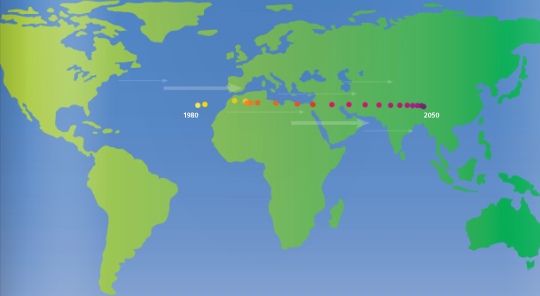
From the latest issue of the LSE Research newsletter--which I will talk about more soon--comes interesting research in economic geography care of Danny Quah, head of our nation- and perhaps even world-leading Economics department and a fellow here at LSE IDEAS like a certain blogger you may know about ;-) Click for a larger image:

Danny Quah writes: This map depicts the dynamics of the global economy's centre of gravity, the average location of economic activity across geographies of the Earth. My calculations take into account all the GDP produced on this planet. I found in my research that in 1980 the global economy's dentre of gravity was in the mid-Atlantic. By 2008, as a result of the continuing rise of China and the rest of East Asia, the economic centre of gravity (ECG) had drifted to a location east of Helsinki [Finland] and Bucharest [Romania]. Extrapolating growth data in almost 700 locations across Earth, I have projected that by 2050 the world's ECG will have shifted east 9,300 hundred kilometres from its 1980 location--landing, appropriately enough, at a point between India and China.

Race to Head 'Asian Monetary Fund' Heats Up

♠ Posted by Emmanuel in , at 10/11/2010 12:01:00 AM
A few months back, I discussed developments surrounding the creation of an ASEAN+3 Macroeconomic Research Office (AMRO) in Singapore. That post contains the back story behind the ill-fated Japanese proposal to create an Asian Monetary Fund in 1997 during the Asian financial crisis. At the behest of the haughty Americans who were wary of losing regional influence if a regional emergency lender emerged, unsubtle pressure forced the Japanese to back down. However, plans to create a regional lender have never entirely disappeared. First the Chiang Mai Initiative (CMI) was launched, a system of bilateral swaps among the ASEAN+3 (ASEAN's ten member states plus China, Japan, and South Korea). Later on, it became the Chiang Mai Initiative Multilateralization (CMIM) that is a $120 billion common pool of funds as opposed to a series of swaps.

Still, one of the odd preconditions for CMI (and CMIM after it) was that countries in this scheme could only get more money out than what they put in by first gaining an IMF seal of approval--probably a standby agreement. This situation was strange since regional emergency lending arrangements were originally meant to bypass the IMF and instead rely on good-neighbourliness in East Asia. In other words, it was again meant to placate certain Western powers. Hence, the establishment of an ASEAN+3 Macroeconomic and Research Office is important insofar as one of its envisioned roles is giving the "go" signal for disbursing emergency funds. That is, ASEAN+3 countries will no longer rely on the American-influenced IMF since AMRO in Singapore will decide on who gets what when and where.

The Thais are, for good reason, recognized as providers of diplomats in Southeast Asia. Supachai Panitchpakdi was formerly the director-general of the World Trade Organization and now heads the UN Conference for Trade and Development. Meanwhile, Surin Pitsuwan is the ASEAN secretary-general. As it now transpires, the deputy governor of the Bank of Thailand (their central bank), Bandid Nijathaworn, has quit his post in hopes of becoming AMRO's first head. After all, who wouldn't want to head our region's barely disguised 'Asian Monetary Fund' offshoot?
Bandid Nijathaworn has announced his resignation as the Bank of Thailand's deputy governor for monetary stability, effective at the end of November. Arkabusk Krairiksh, assistant governor for the management assistance group, said the central bank's board of directors approved Mr Bandid's resignation yesterday.

Mr Bandid said stepping down would allow him to be an independent applicant for the director of the Asean+3 Macroeconomic and Research Office (Amro), the regional office of the US$120 billion (3.7 trillion baht) Chiang Mai Initiative Multilateralisation Agreement. His departure was based on goodwill and he categorically denied his decision stemmed from internal conflicts or the fact he was not selected as governor of the BoT.

The Amro office was born out of the Asean+3 Finance Ministers and Central Bank Governors' meeting in December 2009. "Amro is an important organisation in the region. My application stands a good chance of forging cooperation between the BoT and the office," he told the Bangkok Post. "I decided to resign because I would like to pursue a new and challenging opportunity to play a key role in Amro as an independent candidate."
With such slow movement in including third world voices in IMF governance despite even Dominique Strauss-Kahn's agitation, it's certainly understandable as to why ASEAN+3 is keen on, yes, having a bank of our own. I can only assume that Bandid will be the first of many to try and become the 'AMF' chief.

US Elections: Win Votes With China Scare Stories

♠ Posted by Emmanuel in , at 10/10/2010 04:29:00 PM
Or so they think. In the video game Fallout 3 I wrote about during Christmastime when I have time and hardware to actually play video games, there is a scenario of "Chinese Invasion" in which the Red Army takes over a seemingly idyllic suburban American town. It's all quite tongue-in-cheek since, unlike the Guantanamo Ghraibers, the Chinese do not have a history of colonial expansion. Fast-forwarding these prosaically whitebread fears to today, I just wanted to point your attention to the latest fad in American politics with midterm elections coming up; perhaps an inevitable one of painting electoral opponents as being too cosy with the reds. It's so very McCarthyite, dahling, except the commies in question are Chinese not Russian and are more state capitalist than command economy:
With many Americans seized by anxiety about the country’s economic decline, candidates from both political parties have suddenly found a new villain to run against: China. From the marquee battle between Senator Barbara Boxer and Carly Fiorina in California to the House contests in rural New York, Democrats and Republicans are blaming one another for allowing the export of jobs to its economic rival. In the past week or so, at least 29 candidates have unveiled advertisements suggesting that their opponents have been too sympathetic to China and, as a result, Americans have suffered. The ads are striking not only in their volume but also in their pointed language.

The ads are striking not only in their volume but also in their pointed language. One ad for an Ohio congressman, Zack Space, accuses his Republican opponent, Bob Gibbs, of supporting free-trade policies that sent Ohioans’ jobs to China. As a giant dragon appears on the screen, the narrator sarcastically thanks the Republican: “As they say in China, xie xie Mr. Gibbs!”

In an ad featuring Chinese music and a photo of Chairman Mao, Spike Maynard, a Republican challenger in West Virginia, charges that Representative Nick Rahall supported a bill creating wind-turbine jobs in China. And on Wednesday, Senator Harry Reid, the majority leader, began showing an ad that wove pictures of Chinese factory workers with criticism that Republican Sharron Angle was “a foreign worker’s best friend” for supporting corporate tax breaks that led to outsourcing to China and India.

The barrage of ads, expected to total in the tens of millions of dollars, is occurring as politicians are struggling to address voters’ most pressing and stubborn concern: the lack of jobs. “China is a really easy scapegoat,” said Erika Franklin Fowler, a political science professor at Wesleyan University who is director of the Wesleyan Media Project, which tracks political advertising.

Polls show that not only are Americans increasingly worried that the United States will have a lesser role in the years ahead; they are more and more convinced that China will dominate. In a Pew poll conducted in April, 41 percent of Americans said China was the world’s leading economic power, slightly more than those who named the United States.
The story linked to above has more fun factoids alike the 19 Democrat and 10 Republican candidates airing anti-China ads. At least more Yanks know their inevitable place in the global pecking order given current dynamics of a country headed for ruin at warp speed. It's so typical of your modern-day American: make excuses instead of doing something constructive. Meanwhile, you'd better get down on your knees and see if there are reds under the bed. With Christmas approaching, I can't wait to play Fallout 3 again. Unlike many, I try to separate fact from fiction.

US 'Blame the Victim' Tactics on Currency @ IMF

♠ Posted by Emmanuel in , at 10/10/2010 02:43:00 PM
So the much ballyhooed gathering on international finance ministers at the IMF came and went with nary a sign that major changes are in store. On Friday, US Treasury Secretary Tim Geithner came out swinging against those nefarious external surplus-running countries with a penchant for currency intervention:
The United States believes that global rebalancing is not progressing as well as needed to avoid threats to the global economic recovery. Our initial achievements are at risk of being undermined by the limited extent of progress toward more domestic demand-led growth in countries running external surpluses and by the extent of foreign exchange intervention as countries with undervalued currencies lean against appreciation. These are the critical challenges of this period, and we must work collectively and through our multilateral forums, such as these meetings, to address them cohesively.
Meanwhile, things were getting quite testy outside the meeting proper. While Geithner and IMF Managing Director Dominique Strauss-Kahn envisioned putting enhanced surveillance mechanisms in place to monitor the activities of major economies with major CA imbalances, there wasn't much said about implementation. After all, what leverage would an erstwhile lender like the IMF have over non-borrowers? It remains a moot point if this question isn't answered.

Also, as per the title of this post, developing countries were aggrieved by the political economy of labelling what activities constitute "intervention." For obvious reasons, the US is keen on excluding extraordinarily loose fiscal and monetary policies as evidence of such when its effects are arguably wider-ranging and longer-lasting. International currency war, anyone? On to the sniping:
Outside the formal meeting, the skirmishes over currencies continued. Tim Geithner, US treasury secretary, stepped up his call for the IMF to sharpen its focus on global imbalances. Governments intervening to hold down their currencies had accumulated large foreign exchange reserves which were threatening to destabilise the world economy, he said.

“The IMF must strengthen its surveillance of exchange-rate policies and reserve accumulation practices,” he told the IMF’s ministerial steering committee. “[E]xcess reserve accumulation on a global scale is leading to serious distortions in the international monetary and financial system, and is inhibiting the international adjustment process.”

Dominique Strauss-Kahn, IMF managing director, is proposing a new surveillance mechanism whereby the fund would conduct special analyses of its large member countries, including China, the US and the eurozone, and assess how the policies of each affected the others.

In the weeks before the meetings, several emerging market countries including Brazil, India and Thailand have complained about the effect of rapid capital inflows distorting their economies by pushing up interest rates. But policymakers from China and other emerging markets said that these destabilising flows were a result of ultra-low policy in the US and other advanced economies, which was driving money into emerging economies in search of higher yields.

Zhou Xiaochuan, China’s central bank governor, told the IMF meeting that the focus on currencies was one-sided. “The continuation of extremely low interest rates and unconventional monetary policies by major reserve currency issuers have created stark challenges for emerging market countries in the conduct of monetary policy,” he said. “The Fund’s current surveillance framework, which focuses on exchange rate policies, effectively leaves developed countries outside the Fund’s oversight.”
Which brings me to the last point here regarding LDC participation at IFIs. Despite earlier suggestions that developed countries--especially overrepresented European ones--would be willing to shift the allocation of voice and votes at the emergency lender to emerging economies, it remains a work in progress. DSK says so himself:
[T]he international community failed to make progress on reforms to the Fund to give emerging economies a greater say over the global economic governance...Dominique Strauss Kahn, IMF managing director, acknowledged that the communiqué issued by the Fund’s governing body was short on substance. “The language is ineffective,” he said, adding “policy has to be adapted”.

Regarding reform of the Fund to increase the voting power of emerging nations at the expense of mostly European countries, which are over-represented, he said there had been movement towards agreement. “I’d say agreement will be found in the coming weeks,” he said, but admitted some large hurdles still needed to be crossed on the increase in voting share of emerging economies’ representation on the IMF board and the selection of future managing directors.

“There is only one obstacle, which is the agreement of the members,” said a frustrated Mr Strauss Kahn who had hoped to wrap up the reform package at the weekend.
And here is the part of the communique that the IMF managing director found overwhelming concerning "quota and governance reforms":
We reemphasize that quota and governance reforms are critical to institutional legitimacy and effectiveness. The Fund is and should remain a quota-based institution. We urge members who have not consented to the 2008 quota and voice reform to do so promptly. We have made progress toward finding common ground on the core reform areas, and we are working actively to resolve outstanding issues. These issues relate to the size of the quota increase and the quota shift, in line with our October 2009 Istanbul communiqué; enhanced voice and representation of emerging markets and developing countries at the IMF’s Executive Board; modalities for protecting the voting share of the poorest members; enhanced ministerial engagement and strategic oversight; and an open, transparent, and merit-based process for selecting the heads of the IMF and other IFIs. We call for progress in Board and management accountability, Board effectiveness, and staff diversity. Given the urgency of these issues, we call on the Managing Director to report to the IMFC on progress on quota and governance reforms by the end of October.
The more things change, the more they stay the same, eh? Pardon me, for some reason, I'm feeling Canadian today. America does like to have its own cake and eat it too even if she is no longer in the same position to get its will done like before.

Premature? Japan's ¥ Intervention Called a "Dud"

♠ Posted by Emmanuel in , at 10/08/2010 02:57:00 PM
The Not-So-Amazing American Job-Killing Machine just keeps rolling along. And, apropos for those who believe that "state deficits don't matter," a major part in September's tally of 95,000 lost jobs was due to layoffs by states struggling to make ends meet with such contributions having added 76,000 to the unemployment rolls. Amazingly, I hear this sort of "state deficits don't matter" rhetoric from many Americans, reflecting their poor grasp of what's going on in their own backyard (for shame). With still-moribund state revenues, I expect this trend to not only continue but accelerate in the near future.

The obvious upshot of this mediocre news emanating Stateside--the latest in a very long line of them--is that further quantitative easing is expected from the Federal Reserve. So the euro is hovering near the $1.40 mark to the alarm of Eurogroup Chairman Jean-Claude Juncker who is trying to talk the currency down (the Eurogroup is composed on Eurozone finance ministers).

Meanwhile, the yen has hit another 15-year high in light of such news. Indeed, financial newswire RTT is already branding Japan's earlier currency intervention officially a "dud":
The dollar touched a new 15-year low against the yen and continued its dramatic decline against the euro on Wednesday, saddled by expectations that Friday's jobs report will push the Federal Reserve into another round of quantitative easing. A key prelude to the government's monthly jobs report showed the private sector unexpectedly shed jobs in September. Automatic Data Processing said private sector employment fell by 39,000 jobs in September following a revised increase of 10,000 jobs in August.

Despite this week's surprise rate cut to zero by the Bank of Japan, the dollar fell further against the yen to hit Y82.70 -- its lowest since 1995. September's intervention by Japanese officials into the currency markets failed to weaken the yen, which many still view as undervalued relative to the narrowed interest rate gap between Japan and other nations.

The dollar extended its 8-month low versus the euro, slipping to $1.3947. The dollar has collapsed since hitting a 4-year high near 1.1805 in June. A downgrade on Irish debt by Fitch ratings agency did nothing to prop up the dollar. The buck hit a new record low of CHF 0.9598 versus the Swiss franc. Positive Canadian economic data drove the dollar within a cent of parity versus the loonie to C$1.006.
The euro becoming impervious to its members' troubles, the Swiss franc making records on a regular basis, the Canadian unit approaching parity once more, and the yen hitting 15-year highs as an everyday matter. It certainly doesn't look very confidence-inspiring for dollar holders.

Still, I think it's premature to say that Japan's intervention was ineffective since the presumption is that the BoJ won't come in again to prop up the dollar if, say, the psychologically important ¥80 handle is threatened. While Japan and the US feature ZIRP in excelsis, years of deflation in the latter mean that it has a better case to have such low interest rates, for the yen's value in real terms is not nearly as bad as it looks in nominal terms.

In the meantime, the honest truth is that we are all interventionists now--and the Americans are the worst of the lot.

UK Migration Favours Footballers Over Scientists?

♠ Posted by Emmanuel in , at 10/08/2010 12:05:00 AM
Or so say prominent scientists here in the UK. Sometime ago, I mentioned how the UK's Conservative and Liberal Democrat coalition partners were bound to have noticeable differences over migration. The Tories claim that New Labour had lost control of migration from non-EU countries. (Facilitating labour mobility within the EU is a precondition for membership.) Thus, the Conservatives have implemented a temporary cap on migration from outside the EU while supposedly being in the process of determining how to better keep tabs on migration.

Interestingly, the scientific community here in the UK--obviously composed of a substantial share of immigrants--is wary that Britain's scientific advantage may be depleted if these proposed immigration limits are implemented. In a letter to the London Times, eight prominent academic scientists have complained about the government's migration policies. All are Nobel Prize winners; the two most recent being Russian emigrants Andre Geim and Konstantin Novoselov who have just won the 2010 Physics award.

They also cite the strange immigration immigration priorities of the government since there are apparently no restrictions placed on footballers plying their trade in the Premier League. As you would expect, scientists argue that they contribute more to society and economic growth than do footballers. Much as I enjoy following sport, I think I know where a state's priorities should lie:
The UK's cap on immigration threatens the country's future as a centre of scientific excellence, a group of Nobel prize-winning scientists has warned. In a letter to the Times, the eight UK academics said the visa curbs would deprive science and industry of talent. They said it was a "sad reflection" that scientists and engineers could not be afforded the same exception to the rules as Premier League footballers.

The Home Office said it had consulted widely on the immigration cap. It introduced a limit for work visas for non-EU citizens in June. A key part of the Conservative election manifesto, the temporary cap of 24,100 will be replaced by permanent measures from April 2011.

In their letter, the academics wrote: "The government has seen fit to introduce an exception to the rules for Premier League footballers...It is a sad reflection of our priorities as a nation if we cannot afford the same recognition for elite scientists and engineers." They added: "International collaborations underlie 40% of the UK's scientific output, but would become far more difficult if we were to constrict our borders.

"The UK produces nearly 10% of the world's scientific output with only 1% of its population; we punch above our weight because we can engage with excellence wherever it occurs...The UK must not isolate itself from the increasingly globalised world of research - British science depends on it." The CBI [Confederation of British Industry], the Royal Society and university vice-chancellors have already voiced concerns about the immigration cap.

Sir Harry Kroto, who won the Nobel Prize in Chemistry told BBC Radio 4's Today programme that one of his own researchers had been refused permission to study at Cambridge University under the rules and will now stay at a US university. "The UK loses out and in the future we can see the UK can only survive on its intellectual property, rather than as a country that provides things, with countries like India and China providing things more cheaply, so we need to look at that," he said.

"If one looks over the years, one quarter of the Nobel Prizes that came to the UK were won by immigrants from outside. It's probably very unwise to not look very carefully at the scientists, engineers and technologists who could come to this country and give this country the extra support it needs to compete in the future."
As mentioned earlier, the Liberal Democrats are not so keen on this gung-ho approach on immigration, though the Tories beg to differ:
Liberal Democrat Business Secretary Vince Cable has said the measure is doing "huge damage" to British firms. Downing Street said the limit would be implemented in a way that still allowed the brightest and best to come to Britain. Minister for Immigration Damian Green said Britain could benefit from migration but not uncontrolled migration.

"Britain remains open for business and we will continue to attract and retain the brightest and the best people who can make a real difference to our economic growth, but unlimited migration places unacceptable pressure on public services...We have consulted with business and other interested parties on how the limit should work and have also asked the Migration Advisory Committee to consult on what the actual limit should be. These consultations are now closed and we will announce the findings in due course."

Two of the scientists behind the letter are Russian migrants, Professor Andre Geim and Professor Konstantin Novoselov, of the University of Manchester, who won the Nobel prize for physics on Tuesday. They invented graphene, the world's thinnest material which is 200 times stronger than steel. The other signatories are Sir Paul Nurse, Sir Tim Hunt, Sir Martin Evans, Sir Harry Kroto, Sir John Walker and Sir John Sulston.
I say it's an own goal, period.

Americans are Full of %^&! on Exchange Rates

♠ Posted by Emmanuel in ,, at 10/07/2010 12:17:00 AM
Ooh, this makes me very, very mad. When it comes to the white man / forked tongue sweepstakes, America is well-nigh unbeatable. The United States has done nearly everything humanly possible to debauch its currency and expects others to gladly accept the consequences. Witness the following, and I will be very surprised if anyone faults these statements:
  1. The US government plays a large part in making the dollar unattractive by implementing near-zero interest rate policies, quantitative easing via clogging its central bank's balance sheet with toxic assets, running trillion dollar-plus deficits, and creating expectations that such practices will continue indefinitely and even expand given the remote prospects for sustained American recovery;
  2. Accordingly, the US couldn't care less about maintaining the value of the dollar, meaningless "strong dollar" statements here and there aside;
  3. Pleas to allow "market forces" to assert themselves are thus nothing more than an indirect way of saying "let the dollar go" as it would under normal circumstances.
Which brings me to US Treasury Secretary Geithner haranguing the so very many currency interventionists whose efforts pale in comparison with those of America. Alike before, the US is again keen on using international financial institutions to do its dirty work in chiding these "interventionists" prior to this weekend's World Bank / IMF meetings in DC:
Global institutions must persuade emerging nations such as China to let their currencies rise or risk a round of competitive depreciations that would endanger the world economy, U.S. Treasury Secretary Timothy Geithner said on Wednesday. Geithner, laying out the U.S. position ahead of this weekend's semi-annual meetings of the International Monetary Fund and World Bank, pressed the IMF to step up its efforts to make sure countries do not pursue beggar-thy-neighbor currency policies.

The United States has pressed for years for the IMF to toughen its surveillance of currency policies, including during the former George W. Bush administration when a senior U.S. Treasury official charged in 2006 the IMF was "asleep at the wheel" on its basic duty of preventing manipulation. "This is a problem because when large economies with undervalued exchange rates act to keep the currency from appreciating, that encourages other countries to do the same," Geithner said at the Brookings Institution, a Washington think tank.

He said the time was ripe to create a more-level currency playing field, given that rich nations were getting ready to cede some power to emerging economies at the IMF. "We think this is a moment where it's worthwhile making sure those reforms to governance ... are complemented by more effective ways for the IMF to play a greater role in helping change behavior on the exchange rate front," he said. "That's the basic deal on offer."

He told a questioner the Obama administration has ample backing for its efforts to get Beijing to move toward market-oriented exchange rates, which would make its exports more costly, but cautioned against expecting quick results. "China will be less likely to move to allow its currency to rise more rapidly if it is not confident other countries will move with it," Geithner said, in a clear reference to risks that others are becoming more willing to keep their currencies' value down as a policy to boost exports.

Geithner sounded a note of frustration that so many countries appeared willing to use currencies as a policy tool. "The main problem today is you have a set of emerging economies that both remain undervalued and are leaning heavily against appreciation," he said. "That's not a viable strategy for them, it's not a sustainable strategy for their trading partners, for the countries they compete with, and it's not good for the system as a whole."

Currencies have become a point of contention in recent weeks as the U.S. dollar, to which China links the yuan's value, has steadily fallen in anticipation of a further easing in U.S. monetary policy. This has sent investors into emerging markets in search of higher yields, driving those countries' currencies higher. Geithner said it will require coordinated action among trading partners to settle how to let markets determine currency values and warned the United States can't make the case alone.

"Don't look for a near-term quick fix on this," he said. "This is the central existential challenge of cooperation internationally and it will take a long period of time." Geithner refused to respond when asked directly whether some type of coordinated intervention was needed in currency markets, saying he would only answer the question if it was "useful" for him to do so.
In the same breath, though, Geithner hints at the source of many of these problems--American easy money policies:
He also said the United States is going to have to move cautiously in removing economic stimulus because growth is still relatively soft, signaling it will be reluctant to take major steps quickly to cut its debts or raise interest rates. "We believe the United States in particular needs to continue providing well-targeted support for the recovery in the near term even as we put in place plans to help ensure fiscal sustainability over the longer term," he said.

Geithner said that the problem of undervalued currencies was "inherently a multilateral problem" that would take a cooperative effort to solve in the form of an effective multilateral mechanism to push countries with big current account surpluses to abandon export-oriented policies. He suggested the IMF needed to be more forceful in surveillance of global currency practices and to push for "a cooperative rebalancing of policy" that would help sustain growth. "We'd like to see the IMF have more leverage, more capacity to make a difference in these things," Geithner said.
Here is what I have to say to Geithner: the rest of the world is simply responding to the underhanded tricks Americans implement on a regular basis. While others would have suffered this Yankee foolishness more gladly before, it's good to know that times have changed. At the end of the day, other countries are performing open market operations in reaction to the actions of certain others who have undertaken actions almost guaranteeing that the value of their currency is shot. Again, who's doing the most "intervening" here? While I do not wholeheartedly endorse such responses to American free money policies, I understand why others believe they are entitled to do so. In all honesty, I cannot blame them.

Additionally, it is improbable that developing countries would back mechanisms allowing US interests to be served at the IMF so blatantly. While any number of developing countries are probably not happy about the magnitude of Chinese currency intervention since they may perceive pressure to follow suit, they probably do understand that the same brush used to tar China when it attempts to massage exchange rates can also be used against them if they feel the need to do so. So no dice but more empty American double-talk on beefing up the IMF's surveillance functions.

We should take the lead of the students at Peking University who know how to make sense of these typical American shenanigans. Told that China's American holdings were safe, they simply laughed the jokester Geithner off the stage. Don't buy into this American buffoonery lest they make a joke out of you, too. You sir and your colleagues are the largest interventionists on this planet as the lengths you have gone to in driving down the value of your currency have no peer. To paraphrase a certain saying, no nation has ever helicopter-dropped its way to prosperity.

PM Cameron: There is Such a Thing as Big Society

♠ Posted by Emmanuel in at 10/07/2010 12:01:00 AM
The place of society in the wider public sphere is one of the key battlegrounds of political economy as The Commanding Heights usefully points out. Back in 1987, Margaret Thatcher crystallized the ethos of the age by stating "there is no such thing as society":
I think we have gone through a period when too many children and people have been given to understand "I have a problem, it is the Government's job to cope with it!" or "I have a problem, I will go and get a grant to cope with it!" "I am homeless, the Government must house me!" and so they are casting their problems on society and who is society? There is no such thing! There are individual men and women and there are families and no government can do anything except through people and people look to themselves first.
After thirteen years in the wilderness, the Conservatives have returned to government in tandem with some Liberal Democratic colleagues. While disowning some of the more right-leaning extremes of Thatcherite ideology, the idea that government needs to be rolled back has a new emphasis. The point of rolling back the frontiers of the state is not mainly because there are so many sponging on the state (see above), but because there are many in the private and third sectors who are more able to deliver social services. It's a neat cop-out on the states-markets debate.

Voila! The "Big Society" idea--long bandied about in Conservative manifestos--has now emerged on centre stage during the Tory conference in Birmingham. Before turning to that, a recent publication lays out its main idea--sharing and caring without massive government expenditures:
We want to give citizens, communities and local government the power and information they need to come together, solve the problems they face and build the Britain they want. We want society – the families, networks, neighbourhoods and communities that form the fabric of so much of our everyday lives – to be bigger and stronger than ever before. Only when people and communities are given more power and take more responsibility can we achieve fairness and opportunity for all.

Building this Big Society isn’t just the responsibility of just one or two departments. It is the responsibility of every department of Government, and the responsibility of every citizen too. Government on its own cannot fix every problem. We are all in this together. We need to draw on the skills and expertise of people across the country as we respond to the social, political and economic challenges Britain faces.
Hence Cameron's new tagline, "Your Country Needs You" which echoes WWII-era rhetoric. Mostly shorn of Hayekian elements, here are the key elements of his new speech on the "Big Society Spirit":
It's the spirit that I saw in a group of NHS maternity nurses in my own constituency, increasingly frustrated by the way they were managed and handled, who wanted to set up a co-op to use their own expertise, their ideas, their contacts to provide a better serice for the mums in their area.

It's the spirit you see just down the road from this conference in Balsall Heath, where local residents' were fed up with the pimps and the prostitutes and the gangs and the drug dealers. So they set up street patrols to clear them out of the area and turn what was a no-go zone into a desirable place to live

It's the spirit that just today, has seen some of our leading social organisations come together to set up a new Citizen's University, to help give people the skills they need to play a bigger part in our society. It's the spirit of activism, dynamism, people taking the initiative, working together to get things done.

It's the spirit that has inspired the conference this week as you've heard from teachers and counsellors with a passion for what you do. Seeing our activists building community centres down the road in Allan Rock or on the other side of the world in Rwanda, it's the social activism that spirit that drives our country today...

But what I'm talking about, the spirit that we need, is the big society spirit - and here's why I think its time has come. All over the world, governments are wrestling with the same challenges. Not just building prosperous, competitive economies, providing good public services, paying for pensions but creating strong societies, improving quality of life, ensuring everyone feels that they belong.

The countries that succeed will be those that find new ways of doing things, new ways of harnessing the common good, better alternatives to the old-fashioned state and we're on the right side of that argument.

Here at home, at this year's election, the result may not have been clear-cut when it came to the political parties. But it was clear cut enough when it came to political ideas. The old way of doing things: the high-spending, all-controlling, heavy-handed state, those ideas were defeated. Statism lost...society won [my emphasis].

That is what happened at the last election and that is the change I believe we can lead. From state power to people power. From unchecked individualism to national unity and purpose. From big government to the big society. The big society is not about creating cover for cuts. I was going on about it years before the cuts.

It's not about government abdicating its role, it is about government changing its role. It's about government helping to build a nation of doers and go-getters, where people step forward not sit back, where people come together to make life better...

We can build a country defined not by the selfishness of the Labour years but by the values of mutual responsibility that this party holds dear. A country defined not by what we consume but by what we contribute. A country, a society where we say: I am not alone. I will play my part. I will work with others to give Britain a brand new start.
To be honest, the United Kingdom is in pretty sorry shape. I will of course attribute this condition to following the US example rather slavishly in Anglo-Saxon mimesis. So fat, so inequitable, so full of debt and financial folly, so prone to waylaying you into ill-planned military misadventures. Among other things, the Birmingham conference featured a 2015 termination date for the UK's Afghanistan involvement. Hopefully, the "Big Society" idea if nothing else will mean the UK establishing a worthwhile identity for itself instead of copying such a sad, bad example. American whingeing sickens us all.

Washing Machine Changed World More Than Web

♠ Posted by Emmanuel in , at 10/06/2010 12:07:00 AM
Don't take my word for it; take Ha-Joon Chang's. Just a few posts back, I wrote about the absolute deluge of events here at the LSE on Tuesday, including the launch event of Chang's new book 23 Things They Don't Tell You About Capitalism that turns a lot of economic orthodoxy on its head. Despite my doubts about some of the things Ha-Joon Chang mentions--for instance, he believes that it is possible for governments to pick winners--he too believes the Internet isn't all it's cracked up to be. Now here's something Chang and I could probably agree about as various world governments envision building their policies around the Web. I also have to give kudos to Chang for coming up with quite a catchy title. Plus, the cover is interesting if I don't exactly see what it has to do with a wide-ranging critique of economic orthodoxy.

Whatever your view of Ha-Joon Chang, his new book is certainly worth a read if you get the chance from what I gathered at the lecture. Here is an excerpt of his interview with the Observer on the subject matter of which innovation matters more in the bigger scheme of things:
Is it really true that the washing machine has changed the world more than the internet?

When we assess the impact of technological changes, we tend to downplay things that happened a while ago. Of course, the internet is great – I can now google and find the exact location of this restaurant on the edge of Liverpool or whatever. But when you look at the impact of this on the economy, it's mainly in the area of leisure.

The internet may have significantly changed the working patterns of people like you and me, but we are in a tiny minority. For most people, its effect is more about keeping in touch with friends and looking up things here and there. Economists have found very little evidence that since the internet revolution productivity has grown.

And the washing machine was more transformative?

By liberating women from household work and helping to abolish professions such as domestic service, the washing machine and other household goods completely revolutionised the structure of society. As women have become active in the labour market they have acquired a different status at home – they can credibly threaten their partners that if they don't treat them well they will leave them and make an independent living. And this had huge economic consequences. Rather than spend their time washing clothes, women could go out and do more productive things. Basically, it has doubled the workforce.

The washing machine is just one element here. Other factors have contributed to the liberation of women – feminism, the pill and so on.

Yes, but feminism couldn't have been implemented unless there was this technological basis for a society where women went out and worked. Of course it's not just the washing machine, it's piped water, electricity, irons and so on.